An accepted ECR proves EPFO received your file. It does not prove the wages, UANs, or exit dates inside it are correct.
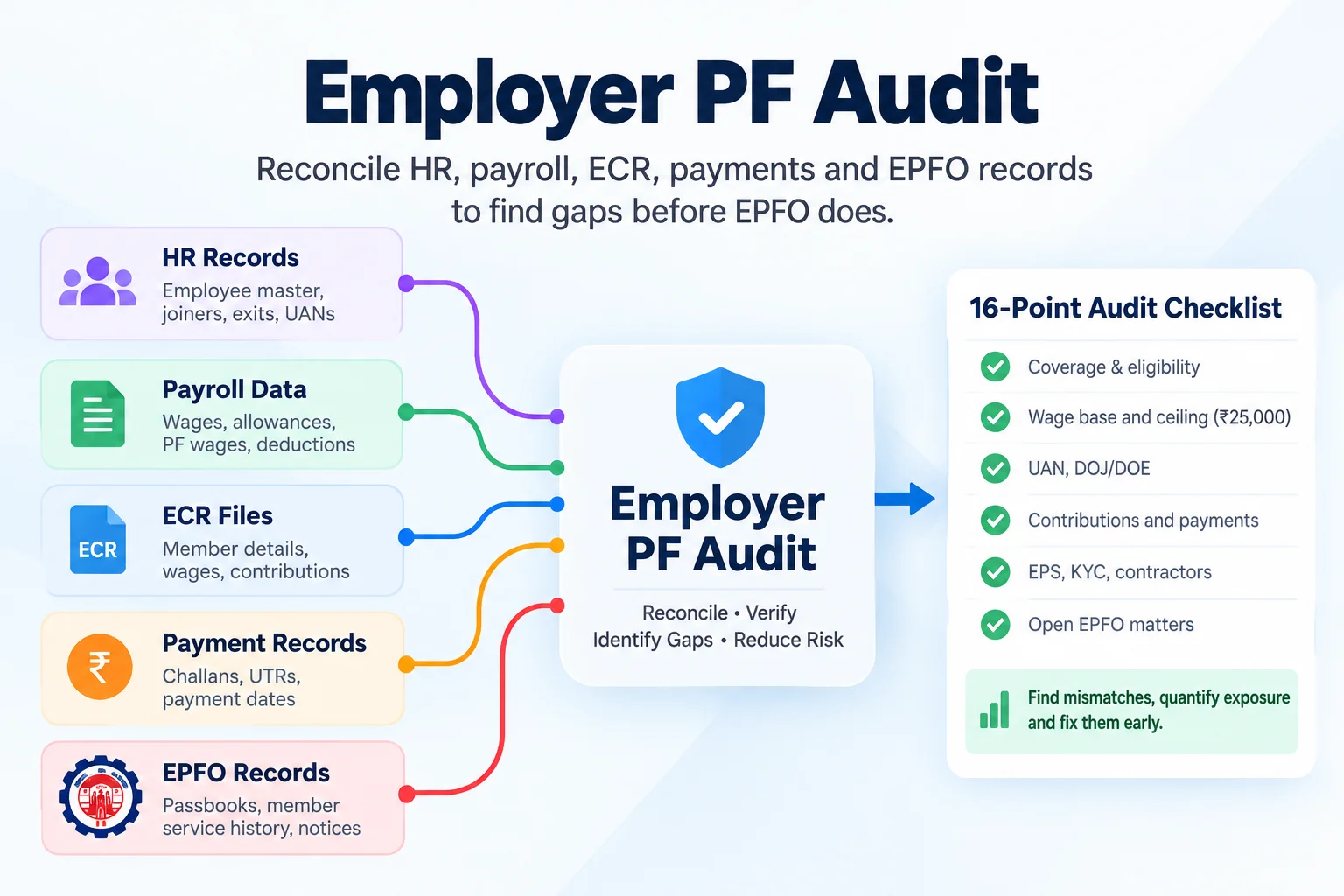
An employer PF compliance audit reconciles your HR, payroll, ECR, payment, and EPFO records to find those gaps before an employee complaint or a Section 125 inquiry does. In 2026, the stakes changed: the Code on Social Security, 2020 replaced the EPF Act, the wage ceiling rose to ₹25,000, and the VISHWAS and AMNESTY windows close on 28 December 2026.
| Question | Short answer |
|---|---|
| What is it? | A reconciliation of employee, payroll, ECR, payment, and EPFO records to find mismatches, gaps, and legal exposure. |
| Is it mandatory? | No law requires a private PF audit. EPFO can inspect your records and assess dues for up to five years back, so an internal audit is how you find gaps first. |
| What does it check? | Coverage, wage base, UAN, DOJ/DOE, contributions, payments, EPS, contractors, international workers, and open EPFO matters. |
| Why audit now? | VISHWAS and AMNESTY close on 28 December 2026. The Employees’ Enrolment Campaign closed on 31 October 2026, so unenrolled staff found now fall under the standard rules. |
| What is the core test? | Whether HR, payroll, ECR, payment, and EPFO records tell the same story for every employee. |
What is an employer PF compliance audit?
An employer PF compliance audit is a structured reconciliation of an organisation's provident fund records against its HR and payroll data. It identifies data mismatches, contribution errors, coverage gaps, historical backlogs, and unresolved EPFO matters.
Monthly compliance asks, "Did we file and pay?" An audit asks, "Are the records we filed correct, and can we prove it?"
This is different from Kustodian’s Free EPF Audit, which is for individual employees checking their own PF account.
The legal basis since 21 November 2025
The Code on Social Security, 2020 took effect on 21 November 2025 and repealed the EPF Act, 1952. The EPF Scheme, 2026 (G.S.R. 525(E), 29 June 2026) replaced the 1952 Scheme. Many teams still use the old section numbers, so both are shown below.
| What the audit tests | Code on Social Security, 2020 | Old EPF Act equivalent |
|---|---|---|
| Which pay counts as wages | s.2(88): excluded allowances above 50% of total pay are added back | s.2(b) |
| Records and wage slips you must keep | s.123 | Para 36, EPF Scheme 1952 |
| No cutting pay to offset higher PF cost | s.124 | s.12 |
| How EPFO assesses dues | s.125: no proceedings after 5 years from the due date | s.7A (no time limit) |
| Interest on late payment | s.127: 12% a year simple interest (S.O. 2698(E), 29 May 2026) | s.7Q |
| Damages for default | s.128: up to 100% of arrears, after a hearing | s.14B |
| Appeal against assessment | s.23(3): 25% pre-deposit, no waiver power | s.7-O: 75%, waivable |
| Prosecution | s.137: a written direction to comply comes first, unless the same violation repeats within 3 years | none |
Inquiries pending on 21 November 2025 must conclude by 20 November 2027. Defaults from before the Code are still assessed under the transition rules.
Why 2026 is the year to audit
Five changes in twelve months mean last year's clean audit no longer tells you where you stand. Two deadlines are still open.
| Change | Date | What it means for your audit | Deadline |
|---|---|---|---|
| Wage ceiling raised to ₹25,000 (S.O. 5109(E)) | 17 Sep 2026 | Employees on ₹15,001–₹25,000 now fall in mandatory coverage. September needed a split-month calculation. | Ongoing |
| Employees' Enrolment Campaign, 2026 | 29 Jun 2026 | Let employers enrol staff missed between 1 April 2009 and 31 March 2026 on relaxed terms. Gaps found now fall under the standard rules. | Closed 31 Oct 2026 |
| VISHWAS, 2026 | 29 Jun 2026 | Settle damages for defaults before 14 June 2024 at reduced rates. Interest must be paid first; fraud cases are excluded. | 28 Dec 2026 |
| AMNESTY, 2026 | 29 Jun 2026 | PF trusts running without a formal exemption can regularise. See PF Trust compliance. | 28 Dec 2026 (extendable by up to six months) |
| Labour Codes wage definition | 21 Nov 2025 | Allowances above 50% of pay count toward wages. Low-basic salary structures need re-testing. | Ongoing |
VISHWAS is the sharpest reason to act now. It settles damages for pre-June 2024 defaults at reduced rates, and EPFO has said it will not be extended past 28 December. The Enrolment Campaign closed on 31 October: employees found unenrolled today have to be brought in under the standard rules, which means arrears, 12% interest and possible damages.
Do you need an employer PF audit?
You need one if any line below is true. Headcount alone does not decide it: a 200-person firm with five years of unreconciled exits carries more risk than a 5,000-person firm with clean controls.
| Trigger | Why it matters |
|---|---|
| Employees keep raising PF complaints | Repeated tickets usually point to one broken process |
| Payroll and ECR totals differ in any month | The gap is either underpayment or wrong data |
| Payroll vendor, HRMS, or PF consultant changed | Handover is where exits, UANs and corrections get lost |
| Merger, acquisition, or new establishment code | Two record sets now have to agree |
| An EPFO notice, inquiry or s.137 direction is open | Assessment can reach back five years |
| Salary structure has a low basic and high allowances | The 50% wage rule may already have raised your liability |
| You have staff on ₹15,001–₹25,000, contractors or international workers | All three are common coverage gaps in 2026 |
The 16-point employer PF audit checklist
Each check compares two records that should agree. A mismatch is a finding; the evidence column is what proves the record either way.
| # | Check | Compare | Red flag | Evidence | How often |
|---|---|---|---|---|---|
| 1 | Coverage | HR master ↔ ECR population | Eligible employee missing from ECR | HR master, ECR | Monthly |
| 2 | Excluded employees | Exclusion list ↔ wage at joining | Exclusion with no wage proof, or wage now under ₹25,000 | Offer letter, payroll | Quarterly |
| 3 | Wage base | Pay components ↔ s.2(88) | Allowances above 50% of pay left out of PF wages | Salary structure, payroll register | Annually + on restructure |
| 4 | Wage ceiling | Contribution base ↔ ₹25,000 ceiling | Capped employees still capped at ₹15,000 after 17 Sep 2026 | Payroll config, Sep 2026 ECR | Once now, then quarterly |
| 5 | UAN / Member ID | HR ↔ EPFO | Duplicate UAN or wrong mapping | Form 11, UAN report | Monthly for joiners |
| 6 | Date of joining | HRMS ↔ EPFO | DOJ differs | Appointment letter, first payslip | Monthly for joiners |
| 7 | Date of exit | Exit records ↔ EPFO | DOE missing or wrong | Exit record, final settlement | Monthly for leavers |
| 8 | PF wages | Payroll register ↔ ECR | Wage differs for the same employee-month | Payroll register, ECR file | Monthly |
| 9 | Payment | ECR ↔ TRRN ↔ bank debit | Amount or TRRN does not match the bank | Challan, TRRN, bank statement | Monthly |
| 10 | Timeliness | Payment date ↔ 15th of next month | Late months (interest at 12% a year runs) | Bank statement | Monthly |
| 11 | EPS | Age, wage band ↔ EPS share | EPS paid past 58, or missing for newly covered staff | Payroll, ECR | Quarterly |
| 12 | Service history | EPFO passbook ↔ employment record | Missing months or transfer gaps | Passbook, transfer records | Annually |
| 13 | KYC | Employee data ↔ EPFO | Aadhaar, name or DOB mismatch blocking claims | KYC status report | Quarterly |
| 14 | Contractors | Contractor ECRs ↔ your gate/attendance data | Contract staff with no PF proof | Contractor ECR + challan copies | Monthly |
| 15 | International workers | IW list ↔ ECR | IW contributing on capped wage with no SSA certificate | Passport, CoC/SSA certificate | On joining |
| 16 | Open matters | Notices ↔ responses | Unanswered notice, inquiry, damages order or s.137 direction | Notice file, replies | Monthly |
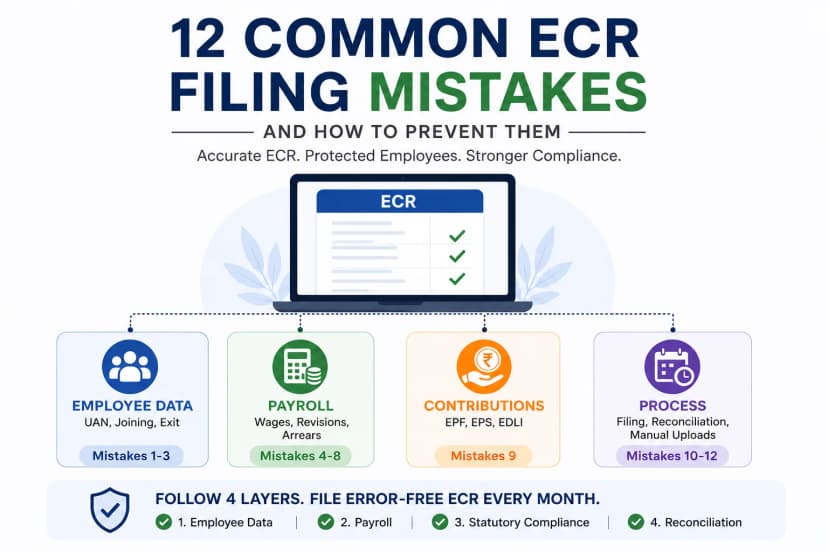
For EPS-specific failures, see the Employer EPS Errors guide. For ECR-level mistakes, see 12 ECR Filing Mistakes.
Start with population, not records
Before fixing any individual record, check that the right people are in PF at all. This is the cheapest check and the one most teams skip.
| Record (illustrative) | Headcount | Gap |
|---|---|---|
| HR employee master | 1,842 | — |
| Payroll | 1,817 | 25 not paid |
| ECR | 1,764 | 53 paid but not in PF |
Sort every name in both gaps into one of four buckets before correcting anything:
- Correctly excluded: wage above the ceiling at joining, not a previous member, with proof on file.
- Timing: joined or left mid-month; should clear next cycle.
- Enrolment gap: should be in PF and is not. Enrol them now; the Enrolment Campaign’s relaxed terms ended on 31 October 2026.
- Data error: in PF under a wrong or duplicate UAN, so they look missing.
Only buckets 3 and 4 need correction. Mixing them up is how teams file corrections for people who were never wrong.
Where the records break
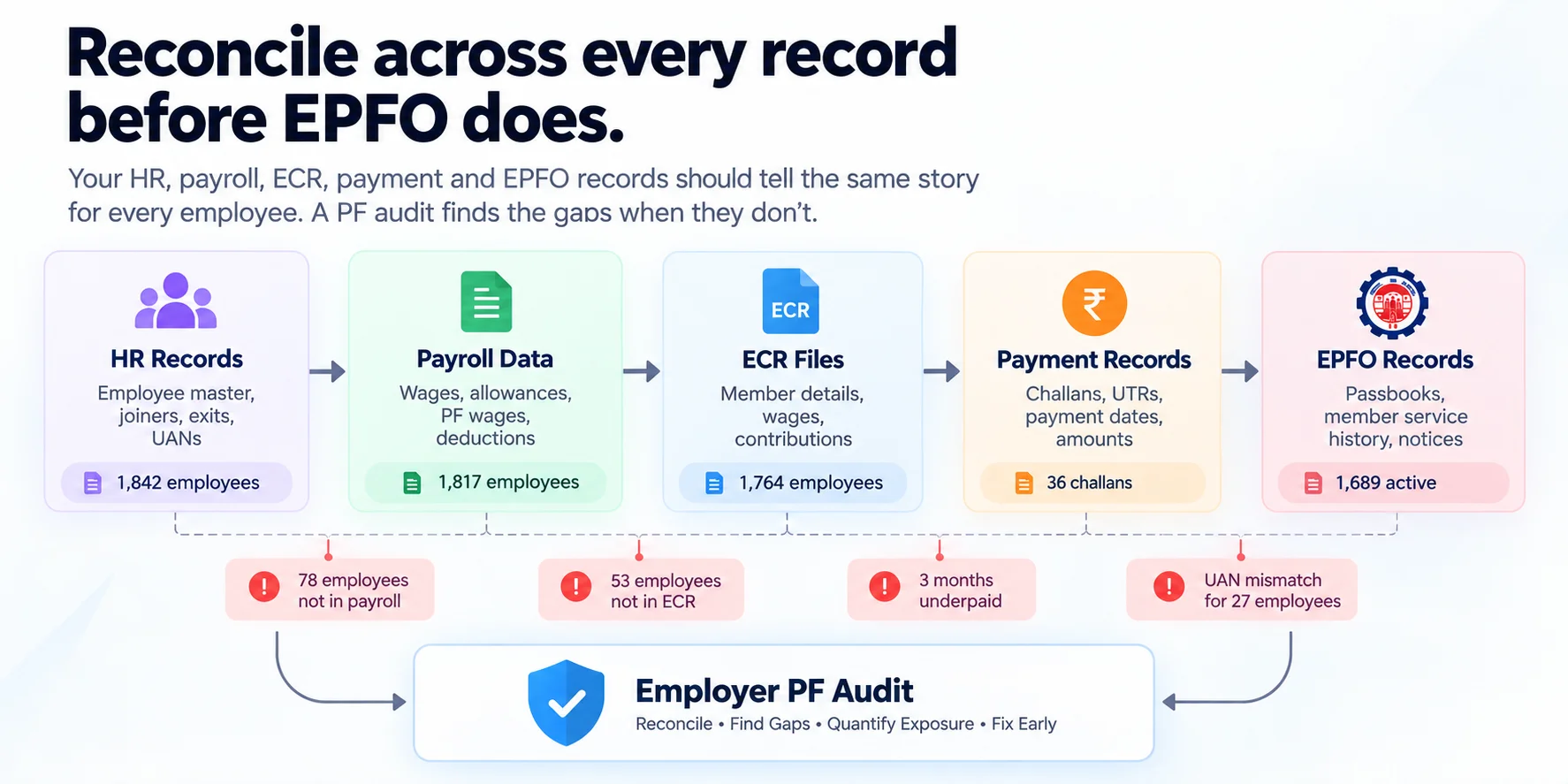
When two adjacent boxes disagree, the error started at or before the earlier one. A wage mismatch between payroll and ECR is a payroll or ECR-preparation problem, not an EPFO one.
One error, or a broken process? The PF Pattern Test
Kustodian's PF Pattern Test: if a finding recurs (frequency), affects a cohort (spread) and returns after correction (persistence), fix the process before fixing the records.
| Test | Question | Example (illustrative) |
|---|---|---|
| Frequency | Does the same error type keep appearing? | Wrong DOEs in 9 of the last 12 months |
| Spread | Does it hit a cohort, site, or period? | All 37 wrong DOEs are leavers from the 2 months after a payroll vendor switch |
| Persistence | Does it come back after you fix it? | New joiners still get fresh UANs despite earlier merges |
One wrong DOE is a correction. Thirty-seven wrong DOEs from one migration is a question about the exit workflow, and filing 37 corrections without fixing it guarantees a 38th. Once a pattern is scoped, the historical PF errors guide covers how to work the backlog, and PF correction dependencies covers the order corrections must follow.
How to prioritise findings
Rank findings by what they cost if left alone, not by how many there are. Money exposure is set by the Code; employee impact is set by whether the error blocks a claim.
| Finding | Employee impact | Legal and financial exposure | Priority |
|---|---|---|---|
| Open notice, s.125 inquiry or s.137 direction | Medium | Dues assessed on your records alone if you don't respond (s.125(5)); 25% pre-deposit to appeal | Immediate |
| Unpaid or short contributions | High | 12% a year interest from the due date (s.127) + damages up to 100% of arrears (s.128) | Immediate |
| Pre-June 2024 damages dispute | None | Reduced settlement under VISHWAS only until 28 Dec 2026 | Immediate |
| Eligible employees never enrolled | High | Back contributions, 12% interest and possible damages; the Enrolment Campaign closed on 31 Oct 2026 | Immediate |
| Wage base fails the 50% rule | Medium | Arrears on every affected employee-month since 21 Nov 2025, plus interest | High |
| Wrong DOE, duplicate UAN, missing service | High: blocks withdrawals, transfers, pension | Employee grievances; correction backlog grows monthly | High |
| Contractor staff without PF proof | High | The principal employer answers for the gap | High |
| Missing documents or SOPs | Low | Weakens every defence, because inquiries decide on the records you produce | Planned |
What this looks like in practice
An employer came to Kustodian after an EPFO notice showed a ₹2 lakh PF liability reappearing in its financials. The audit reconciled wages against ECRs and traced the payments to where they had actually been routed, then re-submitted the filings. The outcome was zero penalty, with the liability re-allocated to the correct records.
The lesson generalises: a liability that keeps coming back is usually a records problem, and an inquiry decides on records.
How Kustodian runs an employer PF audit
Kustodian has handled 100+ employer engagements and ₹203 Cr+ in claims. Every audit follows the same sequence:
- Collect HR, payroll, ECR, payment and EPFO records for the review period.
- Reconcile population first, then each check in the 16-point list.
- Scope each finding with the Pattern Test: one employee, a cohort, a site or several.
- Prioritise by the exposure table above.
- Resolve through the right path: correction, joint declaration, settlement window or notice response.
- Govern: fix the process that produced the pattern, and set the reconciliation cadence.
What you receive: a reconciliation report across all five record sets, a findings register scoped by employee and cohort, a priority list ranked by exposure, and the correction path for each finding.
What you send: employee master, 12 to 24 months of payroll and ECRs, payment records, and any EPFO correspondence.
Employer PF audit FAQs
Is a PF audit mandatory for employers?
No law requires a private PF audit. But the Code requires you to keep wage and contribution records (s.123), lets EPFO assess dues up to five years back (s.125), and lets an inquiry decide on your records alone if you don't respond. An internal audit is how you find gaps before EPFO does.
How often should employers audit PF?
Reconcile payments and joiners/leavers monthly, population quarterly, and run a full audit once a year. Also audit after any payroll migration, consultant change, merger, or a pay restructure.
How far back can EPFO assess PF dues?
Under s.125 of the Code, no assessment can start more than five years after the amount fell due. The old s.7A had no limit. Inquiries pending on 21 November 2025 must finish by 20 November 2027.
What if the audit finds employees who were never enrolled?
Enrol them now. The Employees’ Enrolment Campaign, 2026 let employers declare staff missed between 1 April 2009 and 31 March 2026 on relaxed terms, but it closed on 31 October 2026. Under the standard rules you owe arrears for the period they should have been covered, with 12% interest (s.127) and possible damages (s.128).
Can the audit help with old PF damages?
Yes, if the default is from before 14 June 2024. VISHWAS, 2026 settles damages at reduced rates until 28 December 2026. You must clear the interest first and undertake not to appeal further; pending appeals then abate.
Does the ₹25,000 wage ceiling affect existing employees?
Yes. Employees on ₹15,001–₹25,000 fall into mandatory coverage from 17 September 2026, and some will be newly eligible for EPS. See the wage ceiling guide for the payroll maths.
Know where your PF records stand before EPFO asks
VISHWAS and AMNESTY close on 28 December 2026, and EPFO has said VISHWAS will not be extended. After that, the same findings cost more.
For HR, payroll, finance and compliance teams.Sources
- Code on Social Security, 2020, India Code (ss. 2(88), 23, 122–128, 137)
- Employees' Provident Funds Scheme, 2026, G.S.R. 525(E), 29 June 2026, Gazette of India
- Interest notification S.O. 2698(E), 29 May 2026; wage ceiling notification S.O. 5109(E), 17 September 2026, Gazette of India
- Compliance Handbook for Employers under the Four Labour Codes, Ministry of Labour and Employment
- EPFO Employer Portal
- Assessment, recovery and compliance under the Code on Social Security, Taxmann, law as on 7 September 2026
PF Interest Loss Calculator
See how much interest you lose every month your claim sits unresolved.