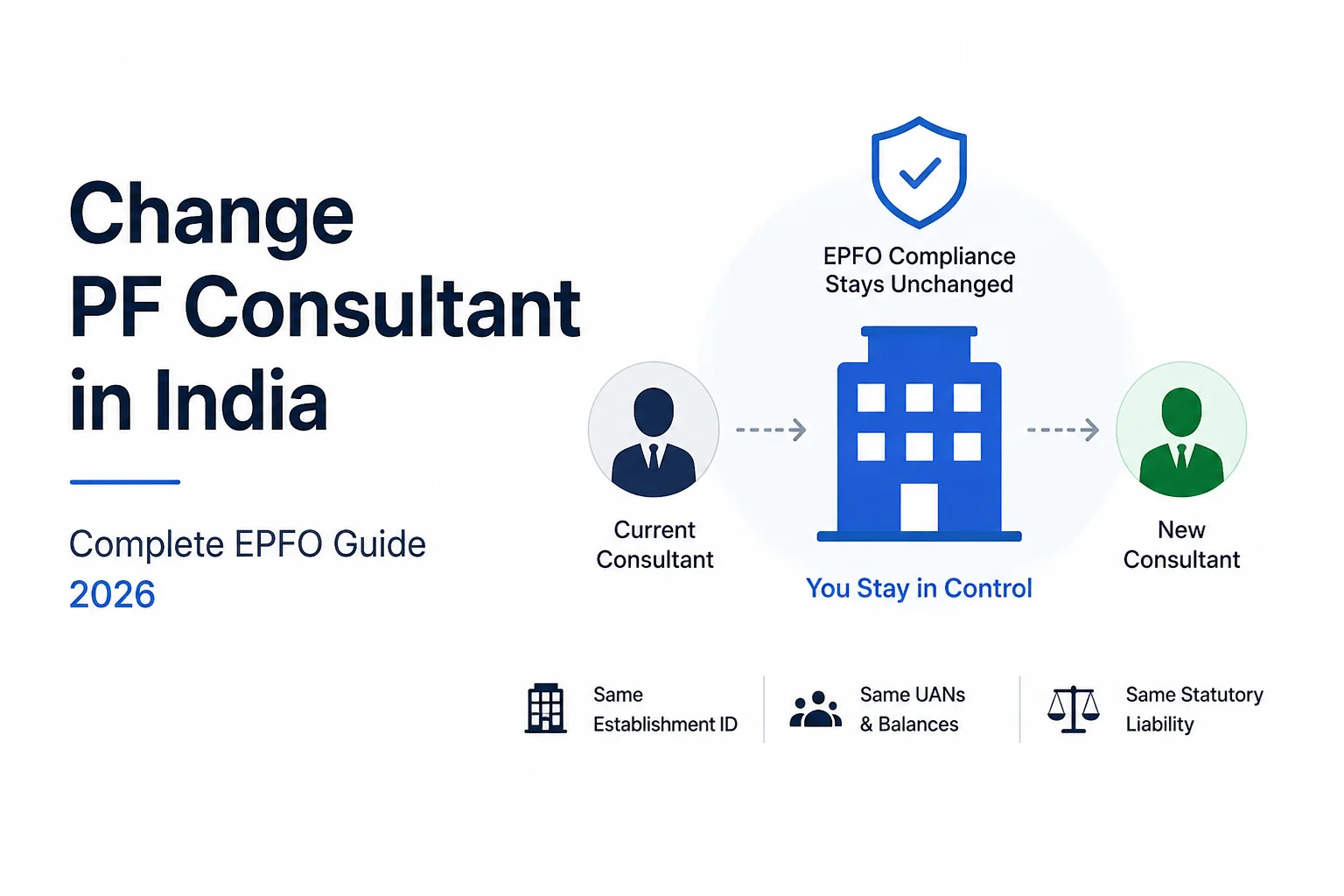
You can change your PF consultant at any time. EPFO does not approve, register, or need to be notified of who your consultant is — your consultant is a service provider, not a party to your EPFO registration. What EPFO does need is a signed revocation letter for the outgoing signatory and a fresh registration for the new one, submitted to your Regional PF Commissioner's office.
That distinction is the whole guide. Employers rarely lose compliance during a consultant switch because the switch itself is risky — they lose it because nobody owned the handover of credentials, open cases, and institutional knowledge that lived with the outgoing consultant.
This guide gives you the exact workflow, the one checklist that matters, and the mistakes that turn a routine vendor change into a six-week scramble.
Need a second opinion first?
Kustodian is a PAN india EPF compliance firm that manages consultant transitions, historical PF record corrections, and EPFO notice responses for employers directly.
What Actually Changes — and What Doesn't
| Item | Changes? | Detail |
|---|---|---|
| PF consultant | Yes | New provider takes over day-to-day filing and support |
| DSC / authorized signatory | Yes | Old signatory revoked, new one registered with EPFO |
| EPFO Establishment ID | No | Stays with the employer permanently |
| Employee UANs and balances | No | Unaffected by who files on your behalf |
| Employer's statutory liability | No | You remain legally responsible regardless of consultant |
| Historical records and open cases | No | Carried forward — not reset or cleared by the switch |
The one sentence to remember: a consultant transition is an operational handover, not a re-registration with EPFO.
Should You Actually Change Consultants?
Not every frustration is a consultant problem. Use this to find the real owner before you act.
| Symptom | Usual owner | Switch consultant? |
|---|---|---|
| Missed filings, unreturned calls, no escalation path | Consultant | Yes |
| ECR errors traced to wrong employee data from HR | Employer | No — fix internally first |
| Payroll-to-ECR mismatches from a system issue | Payroll vendor | Not necessarily |
| DOJ/DOE/UAN corrections pending 6+ months with no plan | Consultant | Yes, after an audit |
| Notices unanswered or answered late | Consultant | Yes |
| One person holds all the knowledge, no SOPs exist | Consultant (or your own governance) | Yes — but fix the dependency either way |
If the pattern looks like unresolved historical records rather than ongoing service failure, run a PF Record Audit before switching — a new consultant inherits your old data either way, so it's worth knowing what's actually in it.
Before You Switch: The One Checklist That Matters
Most failed transitions trace back to one root cause: the employer didn't control its own operational assets and found out too late. Everything you need to recover lives in one table — reference it, don't rebuild it.
| Asset | Why it matters | Owner going forward |
|---|---|---|
| EPFO Employer Portal login + recovery email/mobile | Without this, you can't even start the DSC revocation process | Employer |
| Digital Signature Certificate + authorized signatory details | Required to file; must be revoked from the outgoing signatory and re-registered for the new one | Employer |
| Last 6–12 months of ECR filings and challans | Baseline for reconciliation and audit defense | Employer |
| Employee PF master data | Validates every future filing | Employer |
| Payroll-to-ECR reconciliation files | Prevents the new consultant from inheriting silent mismatches | Employer |
| Open EPFO notices and correspondence | Missed deadlines here carry penalty exposure under Section 7A | Employer |
| Pending correction tracker (DOJ, DOE, UAN, EPS, contribution) | These don't resolve themselves when the consultant leaves | Employer |
| Compliance calendar and internal SOPs | Removes single-person dependency | Employer |
Run this checklist before you tell your current consultant you're leaving — not after. Access recovered under an active engagement is a request; access recovered after termination is a negotiation.
The Transition Workflow: 7 Steps
Step 1 — Assess before you announce anything. Pull your filing history, open notices, and correction backlog. This is your baseline, and it protects you from inheriting blame for issues that predate the new consultant.
Step 2 — Overlap consultants; don't leave a gap. Appoint the incoming consultant while the outgoing one still has system access. A one- to two-week overlap is enough to transfer context without a compliance gap.
Step 3 — Recover every asset in the checklist above. Do this while the outgoing consultant is still responsive. If any credential can't be verified, resolve it now — not at the next filing deadline.
Step 4 — Submit the DSC revocation letter to EPFO. The outgoing authorized signatory's digital signature must be formally revoked with your Regional PF Commissioner's office, and the incoming signatory registered in its place. This is the one EPFO-facing paperwork step in the entire transition — everything else is internal handover.
Step 5 — Hand over every open item with a name and a date attached. Every pending DOJ/DOE/UAN/EPS correction, every unresolved employee grievance, every open notice needs an owner and an expected close date in a shared tracker. "The old consultant was handling it" is not a handover.
Step 6 — Validate the first filing cycle independently. Don't assume the new consultant's first ECR is correct. Cross-check wage data, employee count, and challan amounts yourself before treating the cycle as closed.
Step 7 — Review after one full cycle. Confirm filings landed on time, grievances moved, and you — not the consultant — hold the credentials. This is when the transition is actually done.
| hase | Typical duration |
|---|---|
| Assessment + consultant overlap | 3–7 working days |
| Asset recovery + DSC revocation/re-registration | 2–5 working days |
| Knowledge transfer | 3–10 working days |
| First payroll cycle validation | 1 full cycle |
| Full stabilization | 30–60 days |
Standalone fact: for a single-establishment employer with no major historical backlog, a PF consultant transition typically completes in 2–4 weeks. Multiple establishment codes or an open correction backlog extend this.
Common Mistakes — and What They Cost
| Mistake | What it costs you | Fix |
|---|---|---|
| Ending the engagement before recovering credentials | Locked out of your own portal at the next filing deadline | Recover everything in the checklist first — see above |
| Assuming the consultant's records are the system of record | No audit trail once they're gone | Keep your own repository, updated monthly, not just at transition |
| Not naming an owner for each open correction case | Cases quietly die and resurface at audit or claim time | One tracker, one owner, one date per case |
| Skipping independent validation of the first ECR cycle | Contribution errors compound before anyone notices | Cross-check the first cycle yourself, every time |
| Letting one person hold all the operational knowledge | Business continuity risk beyond just this transition | Document SOPs regardless of whether you're switching |
| Choosing the new consultant on price alone | Reactive support exactly when you need proactive support | Evaluate against the checklist below, not the quote |
Choosing the Next Consultant: What to Actually Ask
Before signing, ask these seven questions. A consultant with real governance answers them without hesitation:
- Who owns the EPFO portal credentials and DSC — us or you?
- What's your documented process for historical correction cases (DOJ/DOE/UAN/EPS)?
- Can you name your process for handling a Section 7A notice, specifically?
- What happens to our account continuity if our relationship manager leaves your firm?
- What governance report do we get monthly, and what's in it?
- Have you run a consultant handover for an employer our size before?
- How do you reconcile payroll-to-ECR mismatches when they show up?
A vague answer to any of these is the same signal that likely got you here.
FAQ
Can I change my PF consultant mid-financial-year? Yes. There's no requirement to wait for year-end. Time it around your filing calendar, not the fiscal year.
Does EPFO need to approve the change? No. EPFO doesn't register or approve consultants. It only needs the DSC revocation and re-registration paperwork for the authorized signatory change.
Will employee UANs or PF balances be affected? No. UANs, balances, and service history are tied to the employee and the employer's EPFO establishment — never to the consultant.
What happens to pending correction cases when we switch? They carry forward. Nothing is auto-resolved or auto-cancelled by a consultant change — document them and hand them over explicitly, or they stall.
What if the outgoing consultant holds the DSC? Recover it before the engagement ends. If they're unresponsive, you can still initiate revocation directly with your Regional PF Commissioner's office using a signed request letter — you don't need the outgoing consultant's cooperation to revoke their signatory access.
How long does a transition realistically take? 2–4 weeks for a single establishment with no major backlog. Add time for multiple establishment codes or unresolved historical corrections.
Can we switch payroll vendor and PF consultant at the same time? You can, but it doubles the validation burden. Stagger them if you can, or run extra scrutiny on the first combined filing cycle.
Will employees notice? They shouldn't. A properly sequenced handover doesn't touch contribution processing or claim support from the employee's side.
Where This Fits
Once your new consultant is in place, the real work is usually what got deferred under the old one: historical PF record corrections, pending EPFO notices, or EPS discrepancies that a switch alone won't fix.
Book a Free Employer PF Consultation — we, at Kustodian, review your DSC/portal ownership, correction backlog, notice exposure, and transition readiness, and hand you a prioritized action plan before you make the switch.
Sources: EPFO Guidelines for Processing of Digital Signature Certificate (DSC) & e-Sign Requests Submitted by an Employer in EPF; EPFO Specimen Signature Card and Revocation of Specimen Signatures (Annexures A & B, Registration of DSC for PF process circular).
PF Interest Loss Calculator
See how much interest you lose every month your claim sits unresolved.