Primary intent: What is a PF Trust? · Also covers: Employer PF Trust, Exempted PF Trust, PF Trust vs EPFO, PF Trust transfer, Annexure K, PF Trust passbook, PF Trust pension.
1. What Is a PF Trust?
If your employer operates a PF Trust — also called an Exempted Provident Fund Trust — your Provident Fund works differently from a regular EPFO account. This matters most before you change jobs, transfer your PF, withdraw money, or check your pension.
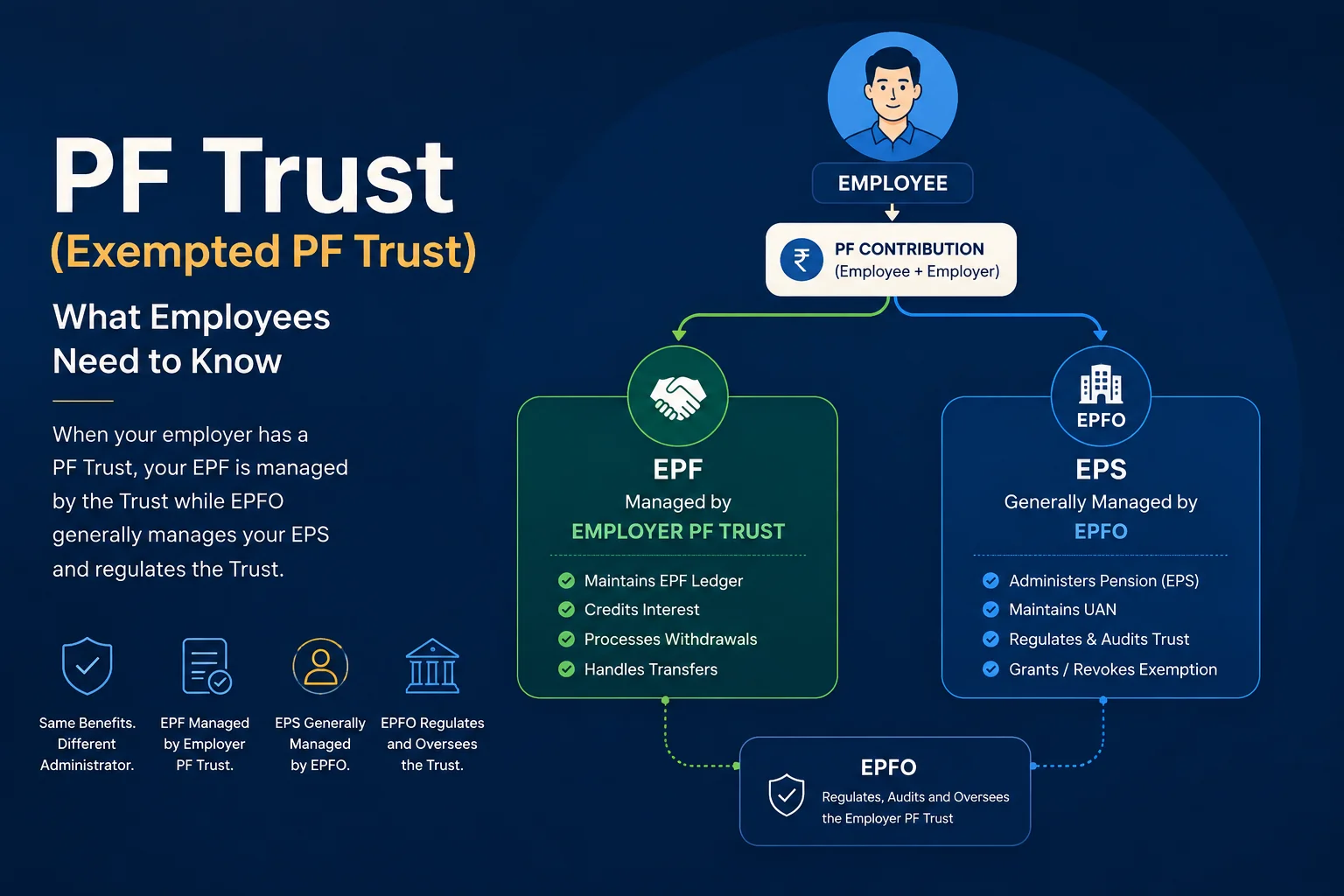
Quick answer: A PF Trust is an employer-managed provident fund, approved by EPFO under Section 17 of the Employees' Provident Funds and Miscellaneous Provisions Act, 1952. Instead of EPFO maintaining your EPF account, your employer's own Trust manages contributions, investments, interest, and withdrawals — while EPFO continues to regulate the Trust and, in most cases, still administers your Employees' Pension Scheme (EPS).1
In one line: a PF Trust changes who manages your EPF. It doesn't change what you're entitled to.
Five things to know before anything else
- Your EPF may be managed by your employer, not EPFO.
- Your EPS pension is still almost always with EPFO.
- Interest cannot legally be lower than the EPFO-declared rate.
- Moving between a Trust and EPFO often needs extra paperwork — specifically Annexure K.
- Most Trust-related problems surface only during a job change, transfer, or withdrawal — not during routine monthly contributions.
This guide applies to you if:
Your employer says it's an Exempted Establishment · your salary slip names a Trust instead of EPFO · your EPFO passbook doesn't show your latest balance · you're changing jobs · you're waiting on Annexure K · your transfer or withdrawal is stuck · your EPS service history looks incomplete.
Why the exemption exists
EPFO can only grant Section 17 exemption if the employer's own PF rules are "not less favourable to the employees" than standard EPFO benefits — it's a conditional approval, not a way to reduce what you receive. To keep it, the employer must maintain minimum scale and corpus thresholds and answer to an EPFO-accountable Board of Trustees.
Who does what — the one table you need
| Responsibility | Employer PF Trust | EPFO |
|---|---|---|
| Maintain EPF ledger & balance | ✓ | — |
| Credit EPF interest (floor = EPFO rate)1 | ✓ | — |
| Process withdrawals | ✓ (Trust process) | — |
| Maintain UAN | — | ✓ |
| Administer EPS (pension) | — (usually) | ✓ |
| Regulate & audit the Trust | — | ✓ |
| Grant / revoke exemption | — | ✓ |
Everything below this page builds on this one table — refer back here rather than re-deriving it.
Common myths
| Myth | Reality |
|---|---|
| A PF Trust is a private fund, outside the law. | It's a statutory fund, governed by the same EPF Act. |
| Trust employees aren't covered by EPFO. | EPFO still regulates the Trust and generally runs EPS. |
| The employer can set any interest rate. | It cannot legally go below the EPFO-declared rate. |
| A Trust can ignore EPFO rules. | Non-compliance can get the exemption revoked. |
Need help managing an exempted PF Trust?
Kustodian helps employers navigate EPF compliance, PF Trust governance, and complex EPF/EPS issues. Book a free consultation with our experts today.
2. How a PF Trust Actually Works
Employee earns salary
        │
        ▼
Employee + Employer contribute
        │
        ▼
Employer deposits contributions
        │
        ├──► EPF → Employer's PF Trust
        └──► EPS → EPFO (usually)
        │
        ▼
Trust maintains ledger, credits interest annually
        │
        ▼
Transfer / Withdrawal / Settlement
Your monthly deduction looks identical either way — the difference starts after the deposit. For an exempted establishment, the Trust takes over your EPF ledger, credits your annual interest, and processes your withdrawals and transfer paperwork. Because EPFO isn't the one holding that ledger, your latest balance may not show up in the EPFO passbook — that's expected, not a sign anything's wrong.
Example: Rahul joins a company with a PF Trust. His EPF sits with the Trust; his EPS stays with EPFO. Three years later he moves to an EPFO-covered employer. The transfer now needs both sides reconciled — his Trust records have to match up with EPFO's, and depending on the case, he'll need Annexure K: EPFO's own record of his accumulated balance, interest, and service history, used specifically for transfers between exempted and unexempted establishments.3 This reconciliation step is why Trust-to-EPFO transfers typically take longer than EPFO-to-EPFO ones.
3. PF Trust vs EPFO: Does It Change Your Benefits?
For almost everyone: no. What changes is administration, not entitlement.
| Question | Answer |
|---|---|
| Will I receive less PF? | No. |
| Can the Trust pay lower interest? | No — floor is the EPFO rate.1 |
| Is my pension affected? | No — EPS generally stays with EPFO. |
| Can I still transfer my PF? | Yes. |
| Can I still withdraw? | Yes, under the same eligibility rules. |
You'll only notice a practical difference when you're changing jobs, transferring PF, withdrawing, checking your latest balance, or reconciling pension records. Day-to-day, a Trust employee's experience is close to identical to a regular EPFO member's.
Neither system is "better" in the abstract — it depends what you need:
| If you want... | Often easier with... |
|---|---|
| Dedicated employer support | PF Trust |
| A standardised national process | EPFO |
| Simpler EPFO-to-EPFO transfers | EPFO |
| Centralised online records | EPFO |
The only question that actually matters: "Which process applies to my employer?" That's what determines where you check records and how transfers or withdrawals get handled — not which system is theoretically superior.
4. How to Tell If Your Employer Has a PF Trust
Ranked by reliability:
- Ask HR directly — "Does the company operate an Exempted PF Trust?" Fastest, most reliable answer.
- Check your salary slip — look for "Provident Fund Trust," "Exempted PF Trust," or a Trust name separate from EPFO.
- Check onboarding documents — your offer letter or handbook may state it outright.
- Check your PF records — balance missing from the EPFO passbook, separate annual statements from your employer, or an internal withdrawal process are all signals.
- Watch for it during a transfer — if a new employer's HR asks for Annexure K, your previous employer was almost certainly exempted.
| Signal | Reliability |
|---|---|
| HR confirms directly | Certain |
| Transfer paperwork mentions Annexure K | High |
| Employer issues its own annual PF statement | High |
| Balance visible on the EPFO passbook | High signal you're not in a Trust |
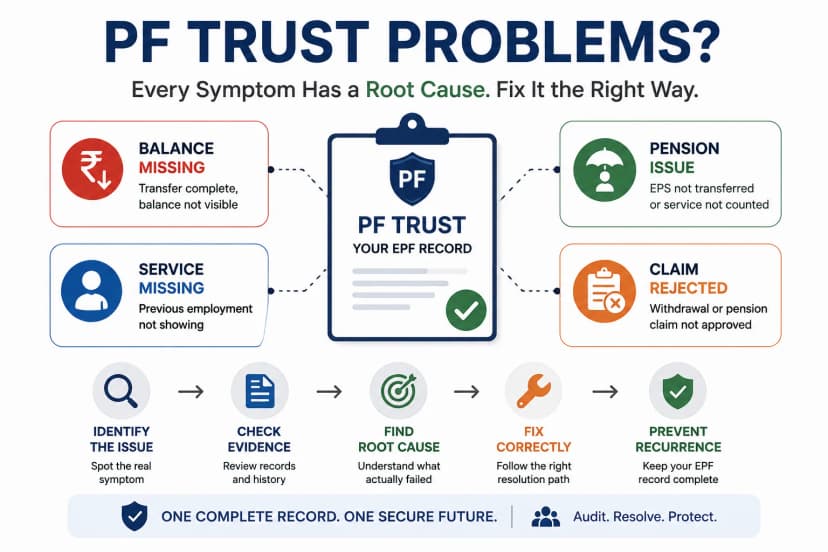
5. Common PF Trust Problems
| Problem | Symptom | Likely cause | Where to go |
|---|---|---|---|
| Transfer pending | No movement after a job change | Annexure K or reconciliation pending | PF Transfer Guide |
| Annexure K missing | New employer wants extra documents | Trust-to-Trust/EPFO handoff incomplete | Annexure K Guide |
| Service history missing | Past tenure not reflected | Incomplete reconciliation | Service History Guide |
| EPS not transferred | Pension service gap | EPF moved, EPS didn't follow | EPS Transfer Guide |
| Balance not visible | Missing on EPFO passbook | Trust holds the ledger, not EPFO | Missing Balance Guide |
| Employer not approving | Transfer/withdrawal stuck | Action pending employer-side | Employer Delay Guide |
| Previous employer closed | Can't reach the Trust | Employer no longer operating | Closed Employer Guide |
| Withdrawal rejected | Claim returned or delayed | Incomplete records or eligibility gap | Claim Rejection Guide |
The 3-Failure-Mode Framework
Across the PF Trust cases we've reviewed, breakdowns fall into one of three patterns:
- Records never moved — the transfer was never initiated on either side.
- Records moved incompletely — EPF transferred, but EPS or service history didn't come with it.
- Records moved but weren't reconciled — Member IDs, exit dates, or balances stay inconsistent even after the transfer "completes."
Almost every one of these stays invisible until a transfer, withdrawal, or pension claim forces the issue — often years after the actual job change. That's exactly why checking early costs so much less than fixing it retroactively.
Stuck with a PF Trust transfer or missing EPF records?
Kustodian helps resolve Annexure K issues, service history gaps, EPS transfer problems, and other complex PF Trust cases. Book a free EPF consultation with our experts today.
6. Before You Leave a Trust-Managed Employer
Verify before your final settlement:
- Exit date updated correctly
- UAN linked to the correct Member ID
- Latest contributions credited
- Transfer request initiated, if applicable
- Annexure K generated, where required
- EPS service history complete
- Employer contact retained for future verification
- Annual Trust statement downloaded
- Personal details (name, DOB, Aadhaar, PAN) consistent across records
Keep these three documents regardless of anything else: your final salary slip, relieving letter, and PF statement. Between them, they resolve most future disputes faster than anything EPFO or the Trust can look up after the fact.
Cross-reference: missing Annexure K or incomplete service history is Failure Mode 2 above; unreconciled Member IDs or exit dates are Failure Mode 3.
7. Frequently Asked Questions
Basics
- What is a PF Trust? An EPFO-approved, employer-administered EPF arrangement that must match or exceed standard EPFO benefits.
- What is an Exempted Establishment? An employer granted Section 17 exemption to run its own PF Trust instead of using EPFO directly.
- Does every employer have one? No — only employers meeting EPFO's scale and corpus thresholds qualify.
- Is a PF Trust safe? Yes — it stays regulated by EPFO, and non-compliance can get the exemption revoked.
Balance & Passbook
- Why can't I see my balance on the EPFO passbook? Your Trust holds the ledger directly; EPFO doesn't mirror it live.
- Does the Trust issue a passbook? Most give an annual or on-request statement instead of a live portal.
Transfers
- Is Annexure K mandatory? Only when the transfer involves an exempted establishment on either side.
- Why is my transfer pending? Usually one of the three failure modes above — most often incomplete record transfer, not outright loss.
- How long should a Trust transfer take? Longer than an EPFO-to-EPFO transfer, because records need reconciling between two separate administrators.
Withdrawals
- Who approves my withdrawal? The Trust, if your employer is exempted; otherwise EPFO directly.
- Can the Trust reject my claim? Yes — on the same eligibility grounds EPFO applies, not a separate standard.
Pension (EPS)
- Does the Trust manage EPS? No — EPS stays with EPFO even when your EPF is Trust-managed.
- Why is my pension service missing? Typically Failure Mode 2 — EPF transferred without EPS following it.
Employer status
- Can a Trust lose its exemption? Yes — EPFO can revoke it for non-compliance with SOP conditions, after which administration reverts to EPFO.2
8. Free PF Trust Health Check
Most PF Trust problems stay invisible until you need the money — a job change, a transfer, a withdrawal, or a pension claim. By then, fixing a missing Annexure K, a broken service-history link, or a Member ID mismatch can take weeks.
What the audit checks: UAN–Member ID mapping · service history completeness · Trust transfer status · Annexure K requirements · EPS continuity · exit dates · duplicate or missing Member IDs · balance consistency across Trust and EPFO.
Unlike a generic PF checker, this looks at how your EPF, Trust records, and EPS actually fit together — built to surface the exact failure modes above before they block a transfer or claim.
Footnotes
- EPF & MP Act, 1952, Section 17(1)(a) — exemption is conditional on the employer's benefits being not less favourable than standard EPFO benefits, including the interest floor.
- EPFO Standard Operating Procedure for Management/Regulation of Exempted Establishments (Nov 2023) — scale, corpus, and Board of Trustees accountability conditions.
- Per EPFO's Annexure-K documentation: a record of member details, PF accumulations with interest, service history, and dates of joining/exit, required by the receiving Field Office or Trust to complete a transfer
PF Interest Loss Calculator
See how much interest you lose every month your claim sits unresolved.