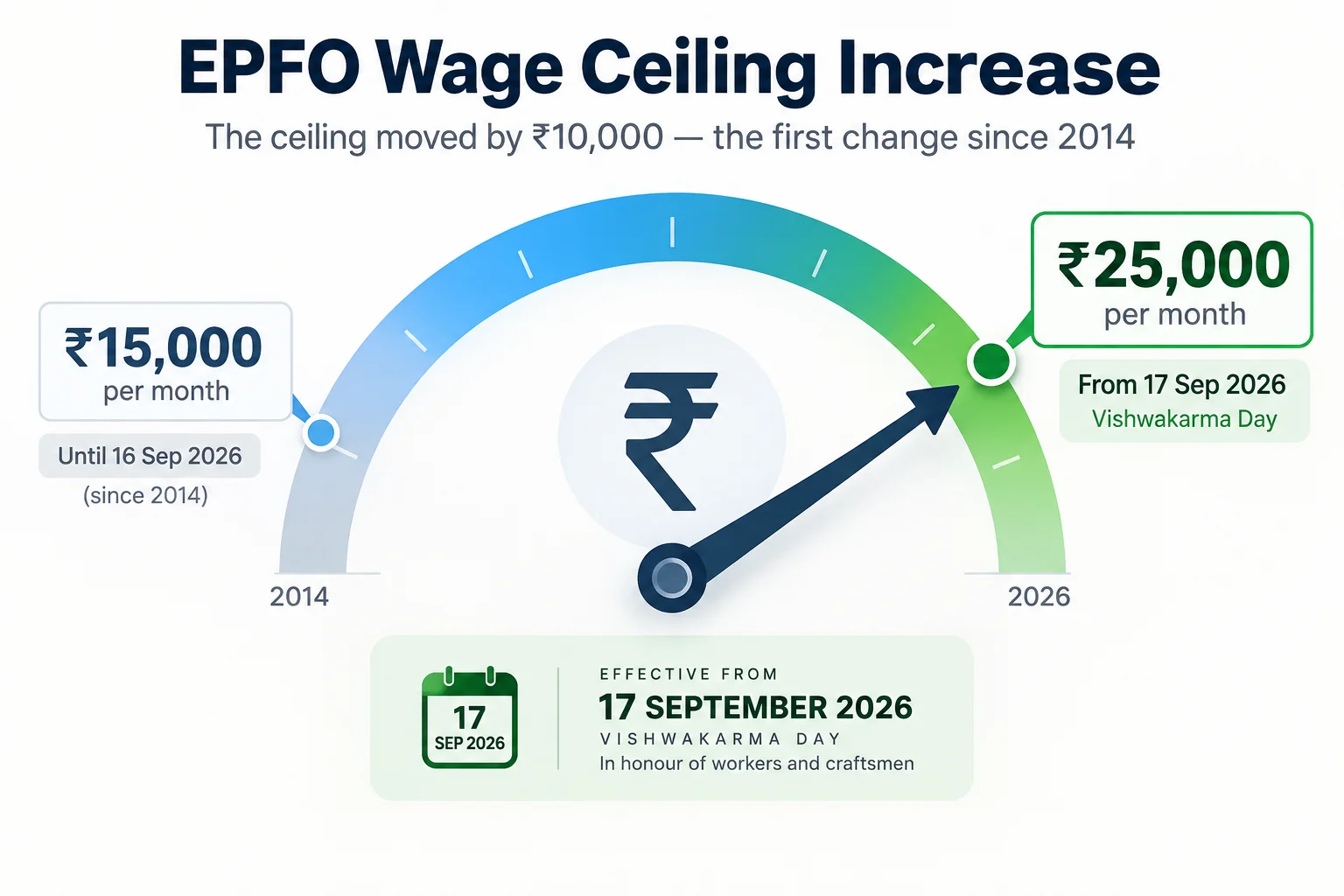
The Union Cabinet raised the mandatory EPFO wage ceiling from ₹15,000 to ₹25,000/month on 16 September 2026 — the first revision in 12 years. New employees joining at ₹15,001–₹25,000/month now qualify for mandatory EPF, EPS and EDLI coverage from 17 September, Vishwakarma Day — a date Labour Minister Mansukh Mandaviya tied deliberately to the festival honouring workers and craftsmen. Confirmed: the Cabinet decision, the figure, and the effective date, corroborated by PTI, ANI and two Union ministers on record. Not yet public: the Gazette notification and EPFO's implementation circular — which is what determines edge cases like employees already in this wage band before the change.
Prepared by: Kustodian — we've helped 9,000+ Indian families recover unclaimed EPF, pension, and insurance assets.
At a Glance
| Question | Answer |
|---|---|
| New ceiling | ₹25,000/month (up from ₹15,000) |
| Cabinet approval | 16 September 2026 |
| Effective date | 17 September 2026 — Vishwakarma Day, per Labour Minister Mandaviya |
| Who's covered | New joiners at wages ₹15,001–₹25,000/month |
| Additional workers (govt estimate) | 51 lakh+ |
| Contribution rate | Unchanged — 12% employee, 12% employer |
| Legal status | Cabinet-approved and ministerially confirmed; Gazette notification not yet public |
Timeline
| Date | Event |
|---|---|
| 2004–2014 | Ceiling frozen at ₹6,500 |
| Sep 2014 | Raised to ₹15,000 — last revision until now |
| 2016–2022 | Multiple proposals floated (₹21,000; later ₹30,000) — none cleared Cabinet |
| Jan 2026 | Supreme Court directs Centre/EPFO to decide within 4 months, hearing a PIL that called the frozen ceiling arbitrary |
| 16 Jun 2026 | Expenditure Finance Committee clears a ₹25,000 proposal — a deliberate middle ground between the two earlier floated figures |
| 16 Sep 2026 | Union Cabinet approves the hike; Ashwini Vaishnaw announces it at the post-Cabinet briefing |
| 17 Sep 2026 | Effective date — Vishwakarma Day, confirmed separately by Mandaviya |
| Pending | Gazette notification + EPFO implementation circular |
Before vs. After
| Up to 16 Sep 2026 (₹15,000 ceiling) | From 17 Sep 2026 (₹25,000 ceiling) | |
|---|---|---|
| Mandatory coverage band | Wages up to ₹15,000 at joining | Wages up to ₹25,000 at joining |
| New joiner at ₹20,000/month | Excluded employee — no mandatory EPF/EPS/EDLI | Mandatorily covered |
| Annual govt budgetary support | ~₹10,250 crore | ~₹11,339 crore (est.) |
| 5-year cost to government | — | ~₹56,696 crore (est.) |
| EPFO's current base | 7.98 crore contributing members, 7.68 lakh establishments | +51 lakh members (govt estimate) |
What "Wages" Means Here
The ceiling applies to basic wages + dearness allowance, as defined under the EPF Act — not gross salary, and not CTC. This definition itself doesn't change with the new ceiling; only the threshold does. If your employer's payroll splits basic pay from allowances, it's the basic+DA figure that decides whether you fall inside the ₹25,000 band, not your total salary slip.
What This Actually Costs — A Worked Example
Take a new employee joining on or after 17 September 2026 at a basic wage of ₹20,000/month. Before this change, they'd have been an excluded employee — outside mandatory coverage entirely, since ₹20,000 exceeded the old ₹15,000 ceiling. Now they're mandatorily enrolled:
| Component | Monthly amount |
|---|---|
| Employee's EPF contribution (12%) | ₹2,400 |
| Employer's EPF contribution (3.67%) | ~₹734 |
| Employer's EPS/pension contribution (8.33%) | ~₹1,666 |
| Combined statutory contribution | ₹4,800 |
That's not all money into the employee's own PF balance — the ₹1,666 EPS share funds their future pension, not their withdrawable PF corpus. EDLI cover is layered on top, employer-funded, with no separate employee deduction. Before 17 September, none of this applied to a ₹20,000 new joiner; it was entirely optional. Exact treatment of edge cases — DA components, part-month joining — awaits EPFO's implementation circular.
Why ₹25,000 and Not ₹21,000 or ₹30,000
The final figure wasn't the only one on the table. A ₹21,000 ceiling was floated and shelved earlier in 2026; a separate proposal reportedly pushed for ₹30,000. ₹25,000 landed as the middle ground — enough to meaningfully widen coverage without the steeper payroll cost increase ₹30,000 would have forced on employers. That's consistent with the Expenditure Finance Committee's June 2026 clearance coming in below the higher figure.
The EDLI Question Nobody's Answered Yet
EDLI payouts currently run ₹2.5 lakh to ₹7 lakh, calculated off wages and EPF balance under the ₹15,000 ceiling. When the ceiling last moved, in September 2014, EDLI's insured sum was recalibrated alongside it — from roughly ₹1.56 lakh to ₹3.6 lakh. Neither Vaishnaw's briefing nor Mandaviya's statement addresses whether EDLI's cap moves with this ceiling too. Until EPFO confirms otherwise, treat ₹7 lakh as the current, unrevised figure.
Common Misconceptions
| Myth | Reality |
|---|---|
| "My own PF deduction just went up" | No — this changes who must be enrolled, not contribution rates for existing members |
| "Everyone in this wage band is covered from today" | Only new joiners from 17 Sep 2026. Employees already in this band, hired earlier, aren't addressed yet |
| "This is part of EPS 2026 or EDLI 2026" | No — those were separate labour-code notifications; this is a standalone wage-ceiling change |
| "EDLI's ₹7 lakh cap has also increased" | Not confirmed — see above |
| "This is already law" | Cabinet-approved and ministerially confirmed, but the Gazette notification giving it formal legal force isn't public yet |
Who's Affected
| Category | Status |
|---|---|
| New joiners, ₹15,001–₹25,000/month | Mandatory EPF/EPS/EDLI from 17 Sep |
| Existing members below ₹15,000 | No change |
| Employees in the new band hired before 17 Sep | Open question — awaiting EPFO's circular |
| Employees already earning above ₹25,000 | Unaffected — can still opt in voluntarily under the existing higher-wage provision (Para 26(6) of the EPF Scheme), unchanged by this decision |
| Employers | Update payroll/compliance once the notification lands |
What's Next
Nothing to file — this is a policy change, not a claim. Employers should model payroll impact for staff in the ₹15,000–₹25,000 band now, so the transition isn't a scramble once EPFO's circular arrives. We'll update this page — including the open questions on transitional employees and EDLI — as soon as it does.
FAQ
Does the new ceiling apply to EPS pension contributions too? Yes — for newly-covered employees, the employer's 8.33% EPS share is calculated on wages up to the new ₹25,000 ceiling.
I already earn above ₹25,000 — does this affect me? No. You remain outside mandatory coverage, exactly as before, unless already enrolled or opted in voluntarily.
Does this change the 12% contribution rate? No — only the eligibility threshold. The 12% employee / 12% employer structure is unchanged.
Why is the effective date tied to Vishwakarma Day specifically? Labour Minister Mandaviya framed it as a deliberate choice — 17 September is Vishwakarma Jayanti, honouring craftsmen and workers, making it a symbolic launch date for a workers'-welfare measure.
Where will the official notification appear? egazette.gov.in, once issued. This page will be updated when it is.
Related Reading
- How EPF Works — The Full Guide
- EPS 2026 Explained: New Claim Timeline & Pension Rules
- EDLI Eligibility, Payout & Scheme Rules
- EPF & Retirement Calculators
- Talk to a PF Consultant
Sources
- Union Cabinet decision, 16 Sep 2026 — PTI, via Business Standard and ANI
- Effective date and Vishwakarma Day framing, Minister Mandaviya — Daily Excelsior
- Supreme Court directive, Jan 2026 — News on Air
- 2014 EDLI precedent — Business Standard/PTI
- Gazette notification: pending publication on egazette.gov.in
Need help figuring out how this affects your PF coverage? Book a Free Consultation Call — or run a Free EPF Audit to check your current records before the new rules kick in.