
Recover Lost, Stuck, Physical
& Inherited Shares
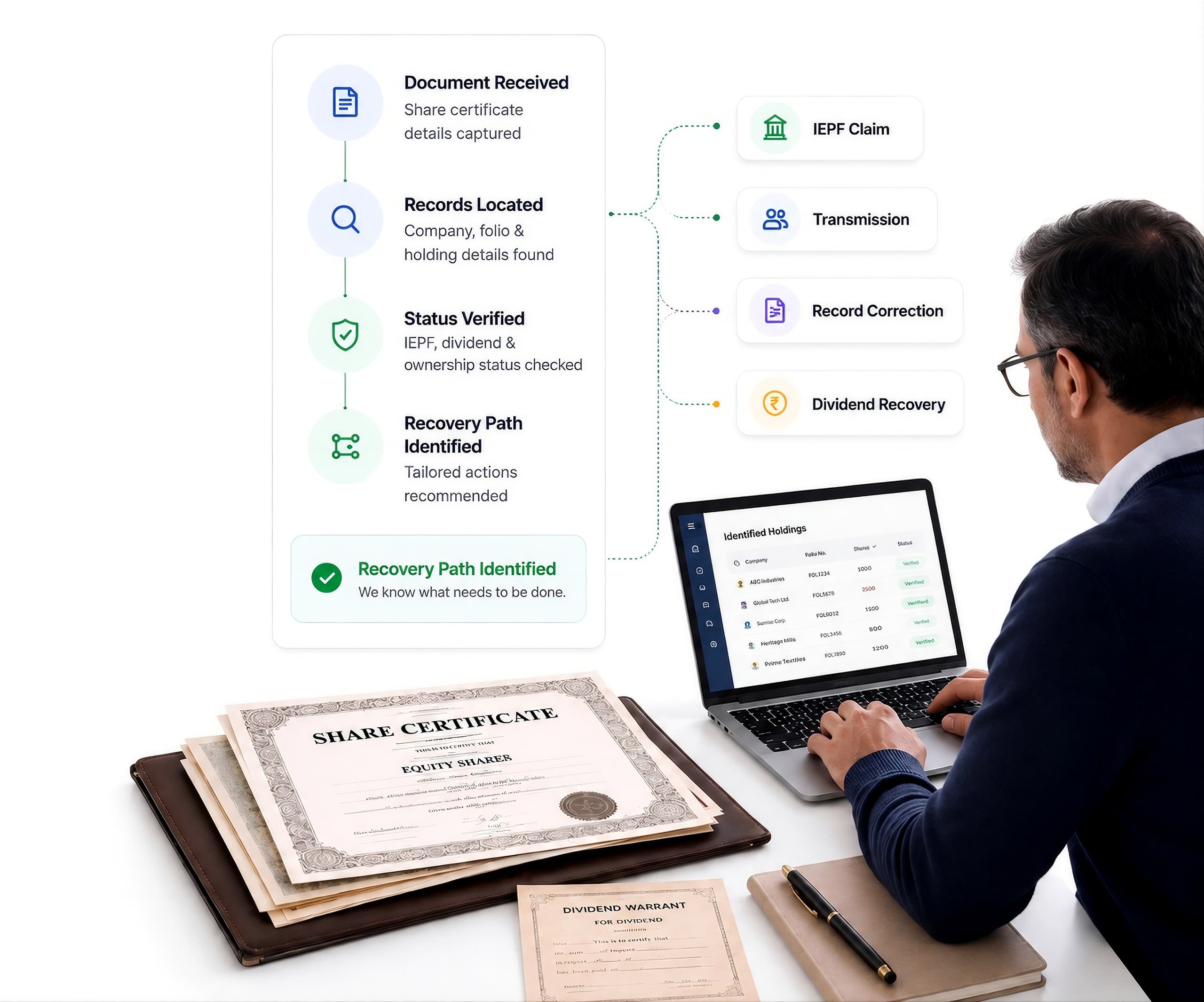
From IEPF claims and physical share certificates to ownership issues, dividend recovery and transmission after death, Kustodian helps investors and families navigate share recovery across India. We'll help identify the issue and guide the right recovery path.
Real Results
Solutions Shaped By Care
.png&w=640&q=75)
₹0 Cr+
Worth Claims Raised
10,000+
Families Supported
★★★★★
Over 100+
5 Star Google Reviews
Helping investors and families recover inaccessible shareholdings, resolve ownership issues and restore access to financial assets.

.png&w=640&q=75)
What Happened To Your Shares?
Most share recovery cases fall into one of four specific categories. Identifying the correct problem type is the critical first step to determining the resolution path.
Access Problems
The shares exist and ownership is known, but they have become completely inaccessible due to regulatory or institutional freezing.
- Shares moved to IEPF Authority
- Frozen Demat accounts
- Dividend payments abruptly stopped
Ownership Problems
The original shareholder cannot act, requiring a legal transfer of rights to heirs, survivors, or representatives.
- Original shareholder passed away
- Investments made with no registered nominee
- Multiple legal heirs requiring succession
Record Problems
Current identification documents do not strictly align with the historical records maintained by the company or registrar.
- PAN card details mismatch
- Signature mismatches from decades ago
- Name changes, misspellings, or initial variations
Discovery Problems
Evidence suggests shares exist, but the exact details, quantities, or physical documents are missing or incomplete.
- Lost or misplaced physical certificates
- Forgotten investments from past decades
- Discovering unknown holdings during estate settlement
Can These Shares Still Be Recovered?
Many people assume old or inaccessible shares are permanently lost to the system. The reality is that the financial system is designed to retain records indefinitely.
Recovery is legally established and often possible even when:
- Shares have been moved to the IEPF Authority
- Physical certificates are decades old
- The original shareholder passed away
- Dividends stopped arriving years ago
- The company name has changed
The Critical Insight
The challenge is usually not whether the shares exist. The system knows they exist. The challenge is strictly about proving ownership and navigating the correct institutional recovery path to claim them.
THE ASSET LIFECYCLE
Investment
Initial capital deployed.
Lost Track
Address changed, details forgotten.
Discovery
Old certificates or notices found.
Recovery
Legal ownership restored.
Why Share Recovery Becomes Complicated
Recovery is rarely a simple request to a single entity. It requires navigating a fragmented institutional ecosystem, often resolving multiple discrepancies simultaneously.
COMPANY RECORDS
The issuing corporation holding underlying data.
REGISTRAR (RTA)
KFintech, Link Intime processing transfers.
DEPOSITORY
NSDL / CDSL holding electronic balances.
IEPF AUTHORITY
Gov. body holding dormant funds.
LEGAL DOCS
Probates, affidavits, successions.
Compounding Issues
A physical certificate may require ownership verification, transmission due to death, record correction, and dematerialisation before recovery is possible.
Estate Discoveries
Physical certificates often surface during estate settlement, meaning the applicant has no prior knowledge of the company's dividend history or account status.
Record Rigidity
Record mismatches are a common cause of instant rejection. If a signature from 1995 does not perfectly match a 2024 application, the process halts entirely.
How Recovery Paths Differ
Every situation dictates a specific procedural framework. Identifying the correct path upfront prevents months of misdirected correspondence.

How Kustodian Helps
IEPF & Dividend Recovery
End-to-end management of IEPF-5 claims, tracking dormant dividends, and liaising with the Authority to unlock state-held assets.
Physical Share Resolution
Facilitating the complex KYC updates and dematerialisation mandates required for legacy paper certificates.
Inheritance & Ownership
Structuring legal succession, drafting indemnity bonds, and executing seamless share transmission for grieving families.
Record Corrections
Resolving structural mismatches in PAN, addresses, names, and historical signatures with Registrars.
NRI & Complex Cases
Handling remote recoveries, cross-border attestation, and multi-layered disputes requiring structured intervention.
Your Documents Stay Protected
Share recovery intrinsically requires handling sensitive, lifelong financial and personal records. We engineer our processes around absolute confidentiality.
Required Integrity
Recovery paths demand strict submission of:
- PAN & Aadhaar
- Original Share Certificates
- Death Certificates
- Succession Documents
- Legacy Financial Records
Our Operational Standards
Secure Document Management
Encrypted storage for all digital artifacts.
Controlled Access
Strict internal protocols on who views your files.
Privacy First Processes
Data is never shared outside operational mandates.
Family-Sensitive Support
Respectful handling of estate and death contexts.
Why Investors & Families Choose Kustodian
Investors and families often find themselves navigating companies, registrars, depositories, IEPF authorities and complex legal requirements independently, resulting in years of delays and rejections.
Kustodian exists to bring those fragmented pieces together into one guided, professional recovery journey.
Assessment Before Action
We analyze the feasibility and exact requirements before beginning, ensuring predictable outcomes.
Documentation Expertise
Precision in drafting affidavits, indemnities, and forms exactly as registrars demand them.
End-To-End Coordination
We act as your central point of contact across all necessary financial and legal institutions.
Built For Complex Cases
Equipped to handle compounding issues like multi-generational transmission combined with lost records.
Frequently Asked Questions
Clear answers to common questions about share recovery and documentation.
Missing records are one of the most common starting points. Shareholdings can often be traced using information such as the shareholder's name, PAN, address history, employer details, old dividend records, or company names. Once holdings are identified, the appropriate recovery process can begin.
A PAN can often help establish ownership records and identify associated holdings, although additional verification may be required depending on the company, registrar, or recovery process involved.
Many families discover old investments without knowing where they are held. Available records, historical documents, dividend references, and shareholder information can often help identify the companies involved.
Shares are generally transferred to IEPF after dividends remain unclaimed for seven consecutive years. Company records, registrar records, and IEPF databases can help determine whether a transfer has occurred.
Yes. In many cases, both the shares and associated unpaid dividends can be recovered after ownership is verified and the required claim process is completed.
Dividend payments often stop because shareholder records, bank details, KYC information, or communication addresses are outdated. If unresolved for several years, the holdings may eventually move to IEPF.
Depending on where the dividends are currently held, recovery may be possible through either the company or the IEPF process.
Yes. Shares can generally be transferred to nominees or legal heirs through the transmission process. The exact requirements depend on the ownership structure and available documentation.
When no nominee exists, ownership typically passes through the legal succession process. This may require legal heir certificates, succession certificates, probate, or other supporting documentation.
Not always. The documents required depend on factors such as the value of holdings, number of heirs, company requirements, and whether a valid will exists.
Yes. Many recovery cases involve multiple heirs. The process usually requires documentation from all eligible claimants and may involve consent or succession-related requirements.
Many physical share certificates remain valid and recoverable even when they were issued decades ago. Their current status depends on the company, ownership records, and any subsequent corporate actions.
Corporate restructurings do not automatically eliminate shareholder rights. Historical holdings can often be linked to successor companies through merger, demerger, acquisition, or name-change records.
Lost certificates do not necessarily mean the investment is lost. Depending on the circumstances, duplicate certificate procedures and ownership verification processes may help restore access.
Yes. Record mismatches are one of the most common causes of delays. Before recovery can proceed, shareholder records often need to be aligned with current identity documents.
In many situations, yes. Share recovery, transmission, dividend recovery, and IEPF claims can often be managed remotely with the required documentation and regulatory compliance.
Not Sure Where To Start?
Most people contact us before they know:
The first step is understanding what happened.
TRUSTED BY
EMPLOYEES AT:






And 100+ leading organisations across India.