Quick Answer
Employer-side EPS errors — wrong Date of Joining, missing ECR contributions, broken service history, Annexure K mismatches — usually trace back to one of four processes: onboarding, payroll configuration, monthly ECR filing, or exit/transfer handling. Most are correctable through the EPFO Joint Declaration mechanism (governed by the EPFO Circular of 26 March 2024, which classifies changes as "major" or "minor" and sets documentation requirements for each), but the correction path depends on which process broke and how long ago.
The government's own data shows employers are frequently the bottleneck: in FY 2024–25, only 40% of member correction/transfer requests were forwarded by employers within 5 days, 47% took more than 10 days, and the average employer response time was 28 days — which is why EPFO has since enabled employees with fully KYC-compliant accounts to self-approve many corrections via Aadhaar OTP, bypassing employer sign-off entirely for roughly 45% of cases.
Why These Errors Stay Hidden for Years
Salary errors get caught within a payroll cycle because employees check their bank balance monthly. EPS errors don't work that way — nobody reconciles pension service history until they need it.
The record-break almost always happens during routine operations — onboarding, a payroll software migration, a missed ECR line, an exit processed without checking service continuity — and produces no immediate warning. The ECR gets accepted, payroll runs normally, and the mistake compounds silently for years.
Onboarding → Payroll → Monthly ECR → Service History → Transfer/Exit → Claim Filed → Error DiscoveredBy the time an employee files Form 10C, Form 10D, or attempts a transfer, the employer isn't fixing a payroll line — they're reconstructing a multi-year record, often after the original payroll consultant, software, or HR staff has changed.
Where EPS Records Actually Break: A Diagnostic Table
Rather than treating every complaint as a contribution problem, map it to the process stage where the record most likely broke.
| Stage | Common Failure | Real Trigger | Typical Symptom | Correction Path |
|---|---|---|---|---|
| Onboarding | Wrong DOJ, UAN mismapped, wrong eligibility call | Bulk hiring, payroll migration, rushed Form 11 review | Pension service starts from wrong date; Annexure K won't reconcile | Joint Declaration (employer + employee), classified as "major" change under the March 2024 circular — requires 3 supporting documents (appointment letter, salary slips, Form 11) |
| Payroll | Wrong pension wages, salary revision not reflected, wage-ceiling error | Manual overrides, post-migration rule errors | Employee reports lower pension than expected; Account 10 looks inconsistent | Payroll correction + revised ECR for affected months; no EPFO filing needed if caught same-quarter |
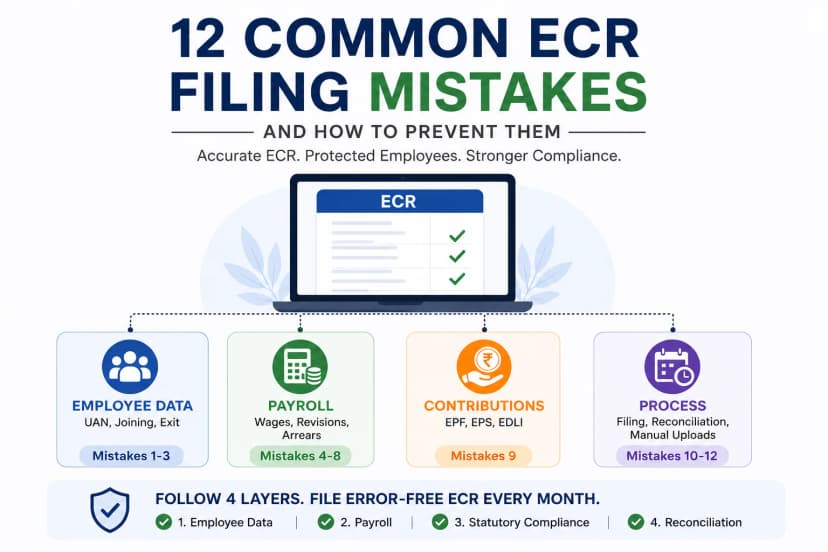
| Monthly ECR | Employee omitted, EPS allocation wrong, supplementary ECR skipped | Payroll-to-ECR reconciliation never performed | Missing Account 10 contributions; apparent service gap | Supplementary ECR filing for missed months; requires employer-side correction, not employee-initiated |
| Service History / Exit | Wrong DOE, broken continuity, Annexure K mismatch | Exit processed without service check; trust-to-EPFO transfer (as with exempted establishments) | Form 10C rejected; "previous EPS not present" transfer error | Annexure K now self-downloadable via Track Claim Status since 18 September 2025 — reconcile against passbook before filing a grievance; unresolved mismatches go through EPFiGMS |
| Claims (10C/10D) | Historical issue surfaces at filing | Employee applies for withdrawal, Scheme Certificate, or pension | Claim rejected citing service/eligibility mismatch | Full 5-step diagnostic (below) — this is a symptom, not the root cause |
Deeper mechanics: for exactly how a transfer break cascades into a missing-service problem, see Previous PF or EPS Service Not Showing?, which maps the ECR → transfer → Annexure K → service-merge chain link by link.
A rejected EPS claim is usually a symptom—not the real problem. Run a Free EPS Audit with Kustodian to identify hidden record gaps and receive expert guidance on the right corrective action.
Case: How One Missed Migration Step Produced Six Rejected Claims
A 220-employee manufacturing firm switched payroll software in its third year of operations. The migration vendor mapped UANs from the old system's employee IDs, but 40 records used a legacy ID format the mapping script didn't recognize — those 40 employees kept receiving salaries and PF deductions normally, but their EPS contributions were being filed against blank or mismatched UAN entries in the ECR.
Nobody noticed for two years. The company's ECRs were accepted every month — EPFO's system validates whether a file is structurally processable, not whether the underlying UAN mapping is correct. The first sign of trouble came when six employees who left the company in the same quarter had their Form 10C applications rejected, all citing "service history discrepancy."
HR initially treated each rejection as an isolated case and referred employees to file individual grievances. It took a payroll-to-ECR reconciliation — run only after the sixth rejection — to reveal the shared root cause: a single migration-script error affecting 40 active and former employees, some with two years of unrecorded EPS service.
The lesson: a successfully filed ECR is not proof of correct EPS records. It proves the file was processable, nothing more. Reconciling payroll against the ECR — not just confirming acceptance — is the only way to catch this class of error before it surfaces as a claim rejection.
The 5-Step Employer Diagnostic
When an EPS issue surfaces, work through these in order rather than jumping straight to "file a correction":
- Was the employee eligible for EPS during the relevant period? Check Form 11 declarations and eligibility rules applicable at the time. An incorrect eligibility call at onboarding invalidates every downstream record.
- Were contributions reported consistently? Cross-check monthly payroll against ECRs and Account 10 entries — look specifically for single missed months that were never corrected, the single most common root cause.
- Is service history complete? Verify DOJ, DOE, and continuity across employers using Annexure K (self-downloadable via Track Claim Status since September 2025).
- Do EPFO records match employer records? Compare payroll register, employee master, and ECR against the EPF passbook and Annexure K — the goal is finding where the mismatch first appeared, not just that one exists.
- Determine the correction mechanism. Most demographic and date errors route through Joint Declaration; missing contributions require supplementary ECR; unresolved transfer/service gaps go through EPFiGMS.
Which Errors Are Employer-Correctable vs. EPFO-Dependent
| Error | Correction Mechanism | Owner | Typical Timeline |
|---|---|---|---|
| Wrong DOJ/DOE | Joint Declaration (major change, 3 supporting documents per March 2024 circular) | Employer + employee jointly | ~20–25 days |
| Missing EPS contribution months | Supplementary ECR filing | Employer | Depends on payroll reconstruction |
| Annexure K mismatch | Self-download via Track Claim Status; reconcile, then EPFiGMS if unresolved | Employer-initiated, EPFO-verified | Varies — historically monthslong for exempted-trust transfers |
| Wrong EPS eligibility call | Historical reconciliation + Joint Declaration | Employer, EPFO review | Case-by-case |
| Name/DOB mismatch | Joint Declaration (minor change, 2 supporting documents) | Employer + employee | ~20–25 days |
| Employer non-response to correction request | No longer a hard blocker — employees with compliant KYC can self-approve via Aadhaar OTP | Employee-initiated where eligible | Immediate for eligible cases |
Who Owns EPS Accuracy: Payroll Software, Consultant, or Employer
Outsourcing payroll or EPF filing doesn't transfer legal accountability. Payroll software calculates; consultants file; only the employer can verify that the underlying employee data was correct in the first place.
| Activity | Payroll Team | Consultant | Employer |
|---|---|---|---|
| Employee master accuracy | Executes | — | Owns |
| EPS eligibility determination | Supports | Reviews | Owns |
| ECR generation | Executes | Often files | Reviews |
| Historical issue resolution | Supports | Supports | Owns |
| Employee escalation response | Supports | Supports | Owns |
Employer EPS Governance Checklist
Onboarding: DOJ verified · UAN mapped and confirmed against Form 11 · eligibility determination documented
Before each ECR submission: payroll-to-ECR reconciliation run · employee count matches payroll headcount · exception report reviewed before TRRN generation
Quarterly: service continuity spot-check · Annexure K reconciled for any transfers that quarter
Annually: long-tenure and near-retirement employees reviewed · full payroll-to-EPFO reconciliation for the year
Trigger points for a full audit — don't wait for the annual cycle if any apply: payroll software migration, consultant change, M&A, salary restructuring, an EPFO notice, or more than one Form 10C/10D rejection in the same quarter (as in the case above — that's a signal to reconcile, not to handle rejections individually).
Whether you're changing payroll software, switching consultants, or preparing for an EPFO inspection, expert guidance can reduce costly mistakes. Schedule a consultation with Kustodian to review your EPF governance and compliance framework.
FAQs
Why isn't an employee's EPS showing? Most often: an eligibility error at onboarding, a missed month in the ECR, or a break in service history during a transfer. Check Account 10 entries against payroll first — a single missed month is the most common single cause.
Why was Form 10C rejected? Usually a service-history or eligibility mismatch between what the employer reported and what EPFO holds — not a data-entry problem at the claim stage itself. See the Form 10C rejection reasons for the employee-facing breakdown.
Does an incorrect ECR affect EPS? Yes — but a successfully accepted ECR does not guarantee correct EPS records. EPFO validates whether the file is processable, not whether the payroll data behind it is accurate.
Can employers correct historical EPS records? Most demographic and date errors (DOJ, DOE, name) go through Joint Declaration. Missing contributions need a supplementary ECR. Service-history and transfer mismatches may need EPFiGMS if Annexure K reconciliation alone doesn't resolve them.
How often should employers audit EPS records? Monthly payroll-to-ECR reconciliation, quarterly service-history checks, and one full annual audit — more frequently after any payroll migration or consultant change.
Get a Written Diagnostic, Not a Generic Audit
Request an Employer EPS Audit — we map every flagged employee record to its root cause (onboarding, payroll, ECR, or service history) and hand you a written correction path for each, typically within 5–7 business days.
PF Interest Loss Calculator
See how much interest you lose every month your claim sits unresolved.