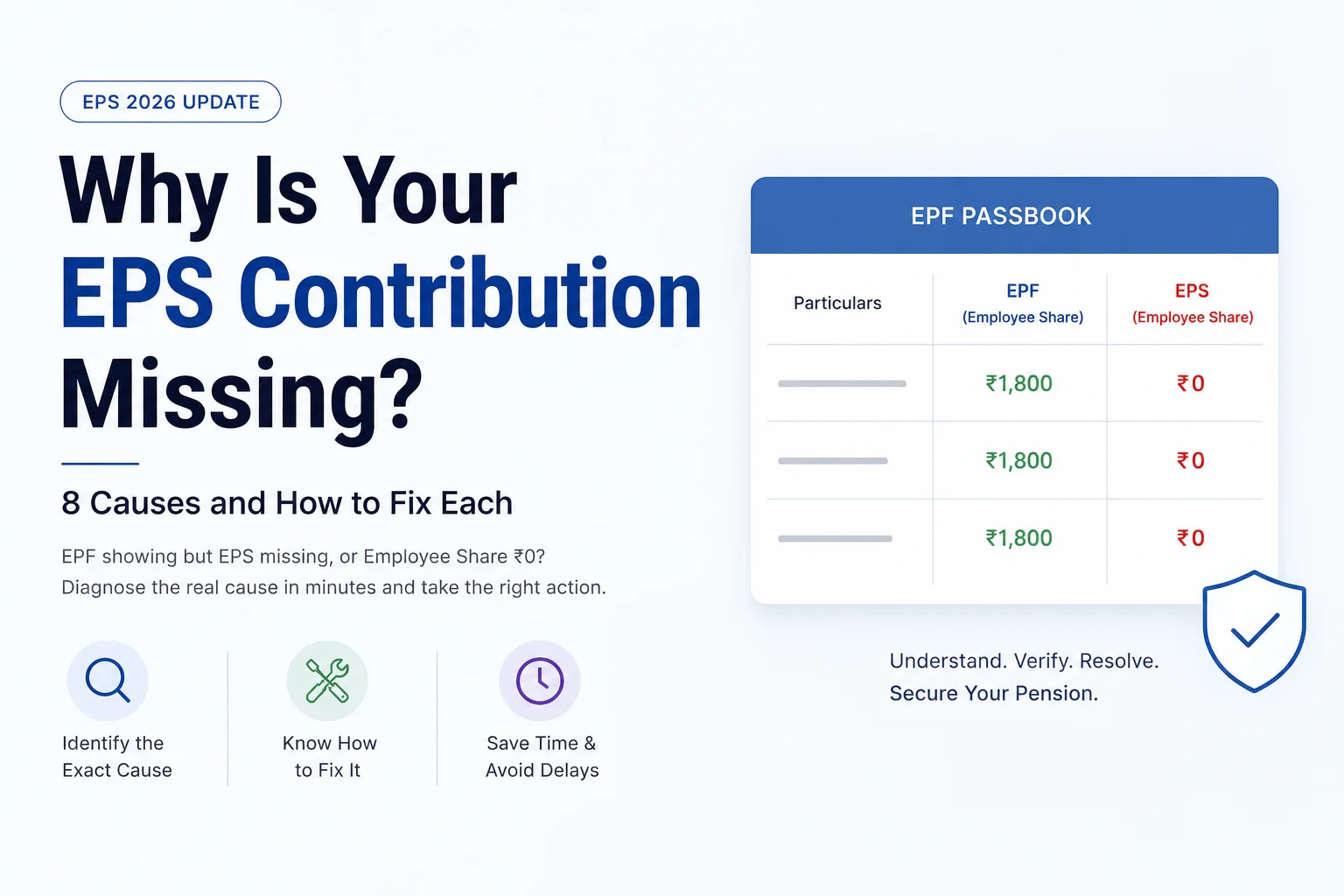
If your EPF passbook shows regular EPF contributions but no EPS entry — or "Employee Share" reads ₹0 — the cause is rarely a missing PF deposit. It's almost always one of eight things: an eligibility rule, an employer filing error, an incomplete service record, or a normal part of how EPS is funded that looks like an error but isn't.
This guide gets you to the right cause before you file an EPFO grievance, and covers what actually changed under the EPS 2026 notification.
Answer these three questions first
- Is your EPF contribution — not just EPS — also missing for the same month? If yes, your employer hasn't deposited PF at all. That's Cause 1 below, and it's an employer problem, not an EPS-specific one.
- Is "Employee Share" showing ₹0 under the pension component specifically? That's usually expected, not an error. Jump to Cause 4.
- Is it only a previous employer's EPS service missing, while your current job looks fine? That's a transfer or service-history issue, not a contribution issue. Jump to Cause 5.
If none of these match, work through the table below in order — don't jump straight to a fix before confirming the cause.
The causes, how to verify each, and who fixes it
| # | Cause | Verify by checking | Who fixes it | Self-fixable? | Typical time |
|---|---|---|---|---|---|
| 1 | The employer hasn't deposited PF at all | Salary slip vs. EPF passbook; ask for the monthly challan | Employer | No | 30-45 days |
| 2 | The employer filed the ECR incorrectly | UAN, Member ID, Date of Joining/Exit against the filed ECR | Employer | No | 15-45 days |
| 3 | You weren't EPS-eligible in that period | Your wage vs. the ₹15,000 EPS wage ceiling at the time | Usually, no fix is needed | Yes | — |
| 4 | Employee Share = ₹0 (expected) | Employer contributions are otherwise regular | No one — this is normal | Yes | — |
| 5 | The previous employer's EPS service was never transferred | EPF passbook, UAN Service History, Annexure K | Previous/current employer, EPFO | Partially | 30–60 days |
| 6 | Service history (DOJ/DOE) is wrong or incomplete | UAN Service History vs. appointment/relieving letters | Employer + EPFO | Partially | 30–60 days |
| 7 | Employer runs an exempted PF trust | Ask HR/payroll if the establishment is exempted | Trust administrator | No | Varies by trust |
| 8 | Contribution is still processing | The employer's filing cycle has actually been completed | Employer / EPFO | Wait, then verify | Days to a few weeks |
1. Employer hasn't deposited PF at all
Both EPF and EPS will be missing for the same month, even though your salary slip shows the deduction. Ask your employer for the monthly PF challan before raising a grievance — EPFO will generally send you back to the employer first anyway.
2. The ECR was filed incorrectly
The money can be deposited, but is unmapped to your account because the Electronic Challan-cum-Return (ECR) has a mismatched UAN, Member ID, or Date of Joining/Exit. Ask your employer to cross-check these four fields against what was actually filed with EPFO.
3. You weren't eligible for EPS in that period
EPS eligibility runs off the statutory wage ceiling — ₹15,000/month, unchanged under the EPS 2026 notification. If your wage exceeded this at the time and you didn't opt into the higher-pension contribution route, no EPS allocation is expected. Nothing needs correcting.
4. Employee Share = ₹0 — this is expected, not an error
Your own 12% EPF contribution goes entirely to EPF — none of it is credited to EPS. The pension fund is instead built from 8.33% of your employer's contribution (capped at the ₹15,000 ceiling — max ₹1,250/month) plus a 1.16% government contribution up to the same ceiling. So a ₹0 Employee Share under EPS is the standard structure, not a fault. → Full breakdown: [Employee Share Showing Zero in EPF Passbook]
5. The previous employer's EPS service was never transferred
Your current job shows correctly, but an earlier employer's service is missing from your UAN Service History. This is a transfer issue, not a missing-contribution issue — the fix depends on whether the previous employer, current employer, or EPFO holds the gap. → Full breakdown: [Previous EPS Service Missing]
6. Service history is wrong or incomplete
EPS pension calculations run off your employment history, not just monthly deposits. An incorrect Date of Joining or Date of Exit can make pensionable service look incomplete even when every contribution was deposited correctly. Cross-check your UAN Service History against your appointment and relieving letters before filing a pension claim.
7. Your employer runs an exempted PF trust
Some establishments maintain their own PF trust rather than routing through EPFO directly. If that's the case, contribution records follow the trust's own process before ever reaching EPFO's systems — go to the trust administrator first, not the EPFO grievance portal.
8. The contribution is still processing
Recent deposits don't always appear immediately. Confirm your employer's monthly filing cycle has actually closed, and check whether later months are also missing, before assuming there's a problem.
What changed under EPS 2026 — and what didn't
On 29 June 2026, the Ministry of Labour and Employment notified the Employees' Pension Scheme, 2026 (Notification No. G.S.R. 527(E)), replacing EPS-95 under the Code on Social Security, 2020. If you were already an EPS-95 member, you continue automatically - there's nothing to file, and your existing service record isn't affected.
Unchanged: the ₹15,000 wage ceiling, the 8.33%/1.16% contribution split, the pension formula (Pensionable Salary × Pensionable Service ÷ 70), and the ₹1,000 minimum monthly pension.
New: EPS 2026 introduces a formal claim-processing timeline. If a complete pension claim isn't settled within the notified period without a valid reason, 12% per annum interest becomes payable on the benefit amount, recovered from the responsible official's salary, not EPFO's general funds. If an EPS claim has been sitting unresolved, this gives you real leverage to push for a decision.
Does this affect your EPF withdrawal, or just your pension?
| What's missing | EPF withdrawal | Future pension |
|---|---|---|
| A contribution month | Possible delay | May reduce pensionable service |
| Service history | Needs verification | Directly affects pension calculation |
| Previous employer's record | Usually unaffected | Often the biggest pension-side impact |
| Employee Share = ₹0 | No impact | No impact — this is normal |
Your EPF balance depends on what's actually been deposited. Your pension depends on a complete, correctly-dated service history — which is why EPS problems often surface only at claim or retirement time, long after the underlying error occurred.
Common mistakes that slow this down
- Filing an EPFO grievance before checking Form 3A, ECR, and salary slips — EPFO typically routes you back to the employer first anyway.
- Assuming Employee Share = ₹0 means something's wrong — see Cause 4.
- Creating a new UAN instead of resolving the existing one — this splits your service history further and complicates the fix.
- Waiting until retirement to check — corrections get significantly harder once an employer has closed or records have aged.
FAQ
Why is my EPF contribution visible, but EPS is missing? Usually, eligibility, an ECR filing error, incomplete service history, or delayed processing. Check Form 3A and your UAN Service History before filing a complaint.
Is Employee Share = ₹0 normal? Yes, in most cases. Employees contribute only to EPF; EPS is funded by a share of the employer's contribution plus a government contribution. See Cause 4 above.
Can my employer correct old EPS filing errors? Yes — if the cause is an incorrect ECR or employment record, the employer can file a correction with EPFO.
Will missing EPS contributions affect my pension? Potentially. Missing contribution months or incomplete service history can reduce pensionable service if left uncorrected.
What if my previous employer has closed? Verify your service history and transfer records first. If employer assistance isn't available, you may need to work directly with EPFO using your own employment documents.
How long do EPS corrections typically take? Employer filing corrections often resolve in 2–6 weeks; service-history or transfer corrections can take longer, depending on verification needs.
Does EPS 2026 change anything about my existing pension record? No - continuation is automatic. The main practical change is a formal claim-processing timeline with a penalty for unexplained delays.
When should I get professional help instead of doing this myself? When multiple employers, an employer closure, a repeated EPFO rejection, or an approaching retirement claim are involved, these usually need several records reviewed together, not a single entry fixed.
Still can't pin down the cause?
If you've checked your passbook and UAN Service History and the cause still isn't clear, an EPS Record Audit can identify whether the issue is eligibility, employer filing, transfer, or an EPFO-side record — before you file anything.
Related guides
Sources
- EPFO Member Portal (passbook, UAN Service History) — https://unifiedportal-mem.epfindia.gov.in/
- EPFO Passbook Portal — https://passbook.epfindia.gov.in/
- Employees' Pension Scheme, 2026, Notification No. G.S.R. 527(E), dated 29 June 2026, Ministry of Labour and Employment
- EPFiGMS Grievance Portal — https://epfigms.gov.in/
This article is for general guidance only and isn't a substitute for a review of your specific records by EPFO, your employer, or a qualified professional.
PF Interest Loss Calculator
See how much interest you lose every month your claim sits unresolved.