An ECR (Electronic Challan-cum-Return) is the monthly return employers file through the EPFO Unified Portal to report employee PF contributions and generate the corresponding payment challan. It is also the single record that determines what shows up in an employee's EPF passbook — for that month, and for every month after.
Most ECR mistakes aren't dramatic. They're routine payroll errors — a wage miscalculation, a missed new joiner, a stale UAN — that the EPFO portal accepts without complaint, because the portal only checks that the file is well-formed. It does not check that the numbers are right.
Below are the 12 mistakes that account for most employer correction requests, employee grievances, and historical reconciliation projects, with the real financial exposure attached to each.
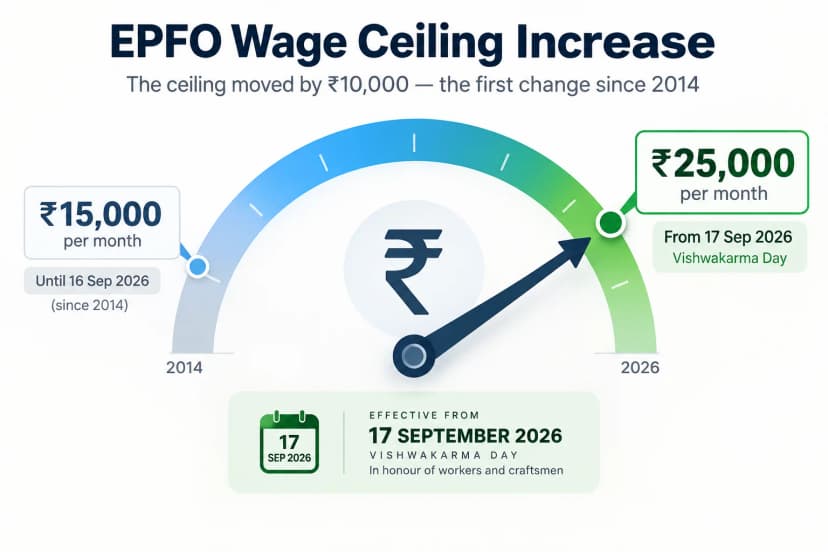
The PF wage ceiling of ₹15,000 was re-notified on 29 May 2026 under the Code on Social Security, 2020 — confirm this hasn't shifted again before publish, as a ₹25,000 ceiling proposal remains pending before the Labour Ministry.
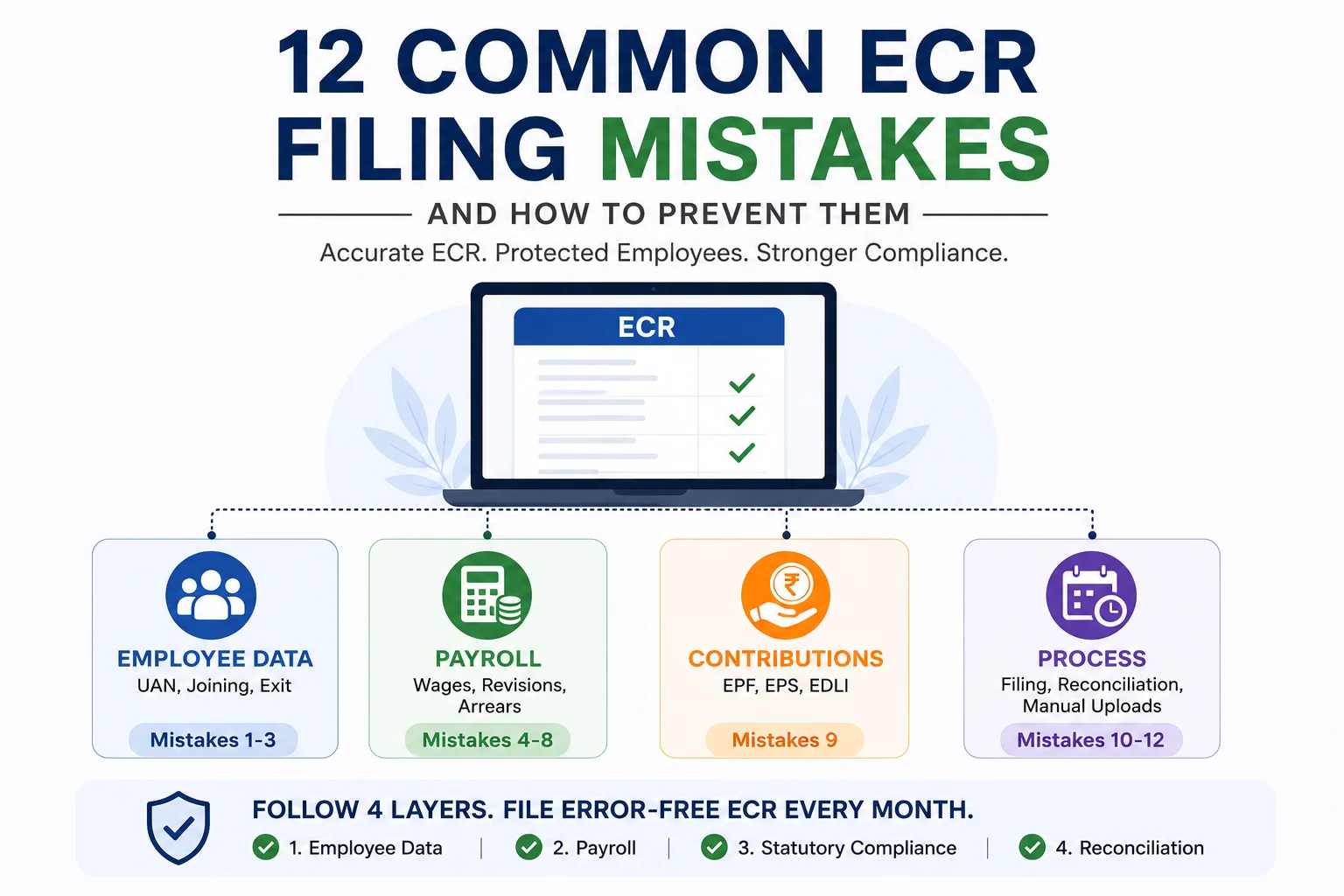
Quick Reference: The 4 Categories
| Category | Covers |
|---|---|
| Employee Data Errors | UAN, joining, exit |
| Payroll Errors | Wages, arrears, revisions |
| Contribution Errors | EPF, EPS, EDLI |
| Process Errors | Late filing, reconciliation, manual uploads |
1. Incorrect PF Wage Calculation
The single most expensive mistake on this list. Payroll teams misstate the PF wage due to salary restructuring, wage-ceiling misapplication, or manual overrides — and because contribution amounts scale directly off this number, even a small monthly gap compounds fast.
Worked example: An employee's PF wage is under-reported by ₹2,000/month. At the standard 12% employer + 12% employee contribution, that's ₹480/month under-credited. Left uncorrected for 6 years, that's ₹34,560 in missing principal alone — before EPF interest (currently 8.25% p.a. for FY 2025–26) that would have compounded on top of it.
Preventive control: Reconcile PF wages against the payroll register before generating the ECR, every month, not just at audit time.
2. Missing Employees in the ECR
Late joiners, onboarding gaps, and payroll migration errors can leave an employee out of a month's ECR entirely. It usually isn't caught until the employee checks their passbook or tries to transfer or withdraw.
Preventive control: Match employee master data against the payroll register and the ECR employee count every month — a simple headcount reconciliation catches this before submission.
Think you may have a PF wage calculation error or missing ECR entries?
Don't wait until an employee's claim gets rejected or an EPFO notice arrives. Book a free consultation with Kustodian. Our PF experts can review your payroll records, identify potential compliance gaps, and help you correct issues before they become costly liabilities.
3. Incorrect UAN Mapping
Contributions filed against the wrong UAN, or against a duplicate record, misdirect that month's money entirely. This spikes after payroll migrations, mergers and acquisitions, or a change of PF consultant.
Preventive control: Validate every active employee's UAN before generating the monthly ECR.
4. Incorrect EPS Allocation
Of the employer's 12% contribution, 8.33% is diverted to the Employees' Pension Scheme (EPS), capped against the ₹15,000 statutory wage ceiling regardless of actual salary. Misapplied eligibility rules or wage treatment errors here don't just misstate a monthly figure — they misstate pensionable service, which is far harder to unwind later.
Preventive control: Re-verify EPS eligibility every time an employee joins, exits, or gets a salary change.
→ Internal link: Employer EPS Compliance Guide
5. Salary Revisions Not Reflected
A revision gets approved and applied in payroll but doesn't make it into that month's ECR — usually a timing gap between the payroll cycle and the ECR generation step.
Preventive control: Reconcile all approved salary revisions before finalizing the ECR, not after.
6. Incorrect Date of Exit (DOE)
An exited employee stays active in the ECR, or exits with the wrong date recorded. This directly affects PF transfers, claim eligibility, and future employment record continuity for that person.
Preventive control: Verify exit data against HRMS records before every monthly filing.
7. Missing Arrear Contributions
Retrospective salary revisions generate PF arrears that payroll frequently forgets to carry into the ECR — leaving payroll and EPFO records permanently out of sync unless it's caught.
Preventive control: Make arrear validation a standing line item in monthly payroll reconciliation, not a special case.
8. Duplicate Employee Records
Usually a byproduct of HRMS migrations or manual spreadsheet consolidation. Duplicate submissions require investigation even after they're found, since it's not always obvious which record is authoritative.
Preventive control: Validate unique UAN and employee identifiers before every upload.
9. Incorrect EDLI or Administrative Charges
EDLI (Employees' Deposit Linked Insurance) and administrative charge miscalculations usually come from outdated payroll configuration or statutory-rate lag. Low direct employee impact, but a real audit finding.
Preventive control: Review statutory rates whenever EPFO issues an update or payroll systems change.
10. Late ECR Filing
Contributions are due by the 15th of the month following the wage month. Miss it, and Section 7Q of the EPF Act charges simple interest at 12% per annum on the overdue amount, calculated from the due date to the date of actual payment. The employer is liable to pay simple interest at the rate of twelve per cent per annum on any amount due from the date the amount becomes due until actual payment.
On top of that, Para 32A of the EPF Scheme adds damages — 1% per month on the outstanding amount for defaults after 14 June 2024 (previously a 5%–25% p.a. sliding scale based on delay length). EPFO reduced the rate of damages to 1 percent per month, effective from 14 June 2024, under amendments made via three separate gazette notifications.
Worked example: ₹1,00,000 in unpaid contributions, paid 8 months late: ₹8,000 in Section 7Q interest, plus ₹8,000 in Para 32A damages — ₹1,16,000 total liability on a ₹1,00,000 default. An employer with ₹1,00,000 in unpaid EPF contributions paid 8 months late owes ₹8,000 in Section 7Q interest and ₹8,000 in Section 14B/Para 32A damages, for a total liability of ₹1,16,000. Damages under Section 14B are capped and cannot exceed the total arrears amount.
Preventive control: Build internal payroll approval timelines with a buffer before the statutory due date — repeated late filings usually signal a governance gap, not a one-off slip.
11. Manual Spreadsheet Errors
Heavy reliance on Excel workflows brings copy-paste mistakes, overwritten formulas, and inconsistent employee data — all of which pass silently because the file format itself stays technically valid.
Preventive control: Reduce manual intervention through controlled payroll workflows and maker-checker review before every submission.
12. Payroll and ECR Don't Match
The clearest single signal of weak payroll governance: the total payroll register doesn't reconcile against the submitted ECR. This is rarely one error — it's usually several of the above, compounding.
Preventive control: Reconcile payroll totals, employee counts, statutory deductions, and ECR totals before generating the TRRN — every month, as a fixed step, not a periodic audit.
How many of these issues exist in your payroll today? Get a Free EPF Audit from Kustodian. Our experts review your ECR filings, UAN mapping, wage calculations, EPS allocation, and statutory compliance to identify risks before they turn into notices, penalties, or employee disputes.
Which Mistakes Matter Most
| Mistake | Employee Impact | Employer Risk | Correction Difficulty |
|---|---|---|---|
| Incorrect PF wages | High | High | High |
| Missing employees | High | High | High |
| Wrong UAN | High | High | High |
| Incorrect EPS allocation | High | Medium | High |
| Salary revision missed | Medium | Medium | Medium |
| Wrong exit date | High | Medium | Medium |
| Missing arrears | Medium | Medium | Medium |
| Duplicate records | Medium | Medium | Medium |
| Wrong EDLI/admin charges | Low | Medium | Low |
| Late filing | Medium | High | Medium |
| Manual spreadsheet errors | Medium | Medium | Medium |
| Payroll–ECR mismatch | High | High | High |
Kustodian's 4-Layer ECR Validation Framework
One framework, checked every month, before the file is generated:
| Layer | Question to Answer |
|---|---|
| Employee Data | Are the right employees, UANs, and employment statuses included? |
| Payroll | Are PF wages, salary revisions, arrears, and deductions accurate? |
| Statutory Compliance | Are EPF, EPS, EDLI, and admin charges calculated correctly? |
| Reconciliation | Does the submitted ECR exactly match payroll records and expected statutory contributions? |
This is the operating model behind the [Monthly ECR Validation Checklist] — the framework is the "why," the checklist is the "how, every month."
Frequently Asked Questions
What is an ECR in EPF? An Electronic Challan-cum-Return (ECR) is the monthly return employers submit through the EPFO Unified Portal to report employee PF contributions and generate the corresponding challan for payment.
Is a TRRN proof that the ECR is correct? No. A TRRN confirms successful submission and payment processing — it says nothing about whether the underlying employee data, wages, or statutory calculations were accurate.
What's the penalty for late ECR filing? Simple interest at 12% per annum under Section 7Q, plus damages at 1% per month under Para 32A (post-June 2024), calculated on the overdue amount from the due date to actual payment. Total damages cannot exceed the arrears amount under Section 14B.
Can payroll software prevent ECR mistakes on its own? No. Payroll software reduces manual effort but can't independently verify business decisions, employee eligibility, or salary revisions — that still requires a validation layer on top.
Still have questions about your EPF compliance or ECR filings? Schedule a consultation with Kustodian. Our EPF experts can review your payroll processes, identify compliance risks, and help you strengthen your monthly ECR filings before they lead to notices or penalties.
PF Interest Loss Calculator
See how much interest you lose every month your claim sits unresolved.