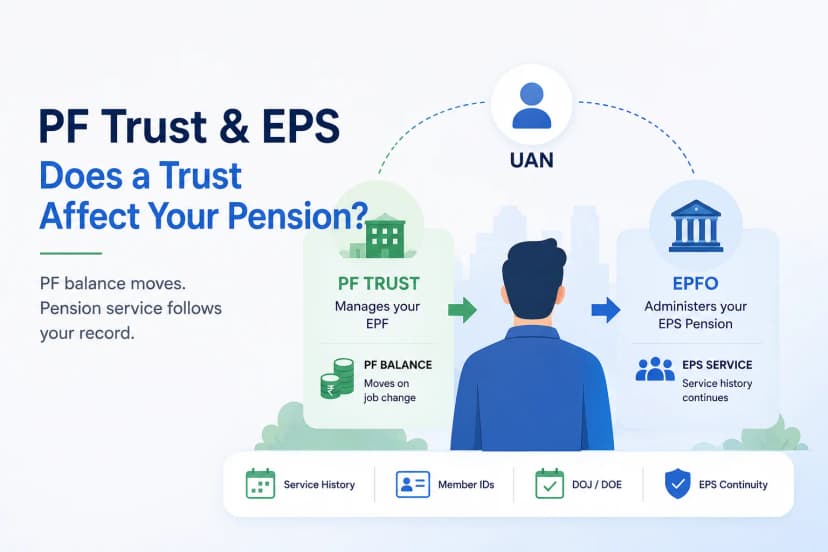
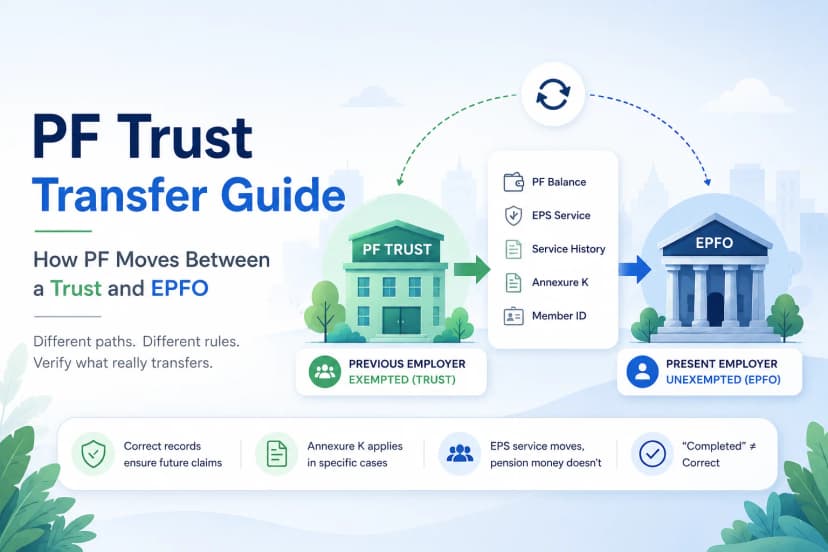
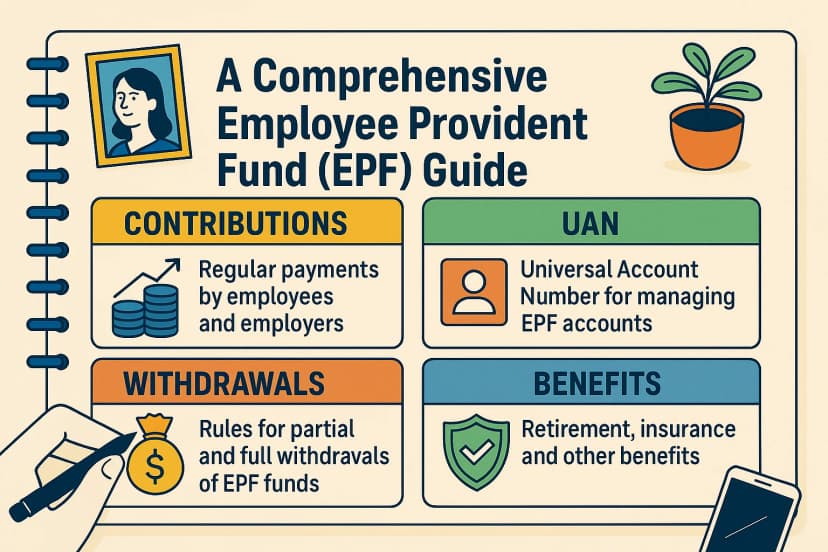
A transfer marked "completed" with the old balance nowhere in sight. Fifteen years of service that no longer show up. A pension claim that returns "Claim Already Settled – ₹0." Different symptoms, and almost always the same handful of causes: an incomplete transfer, a Member ID that never got linked, missing service history, or an employer filing that was never reconciled with EPFO.
This page maps the real complaints EPF Trust members report — on EPFO's own grievance forums, in public discussion threads, and in the audits we run at Kustodian — back to their root cause, using one consistent framework:
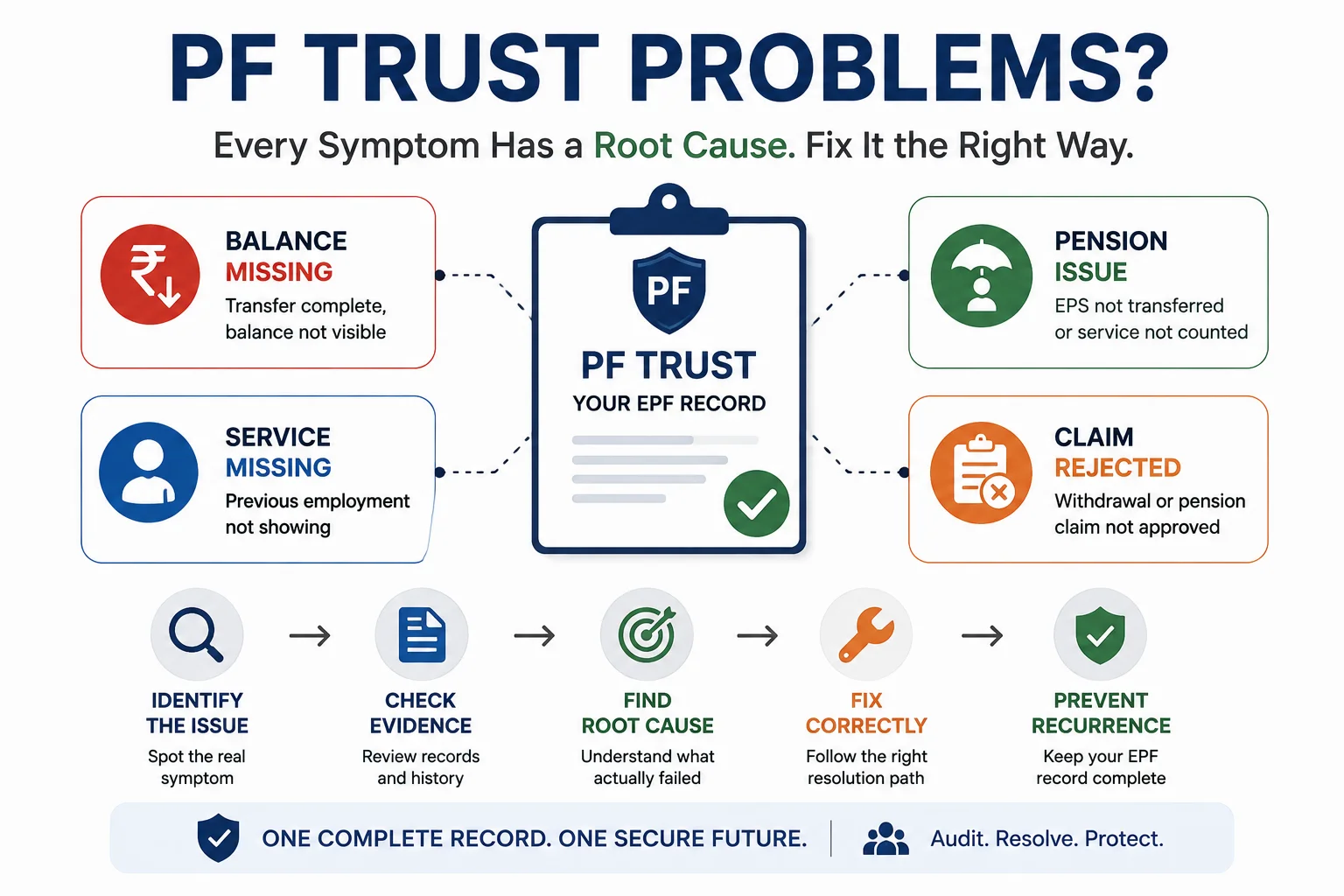
Problem → Symptom → Evidence to check → Root cause → Resolution path → How to prevent it
Not sure which bucket you're in? Run a free EPF audit and we'll map your UAN, Member IDs, transfer history, and service record before you file anything.
The 8 Problems Behind Most PF Trust Complaints
| Problem | What It Usually Breaks |
|---|---|
| 1. Missing service history | Pension continuity, transfer completeness |
| 2. Employer verification delay | Withdrawal and transfer timelines |
| 3. Annexure K not issued | Transfer stuck mid-process |
| 4. Incorrect Member ID | Balance visibility, fragmented records |
| 5. Incorrect Date of Exit | Claim rejection, transfer delay |
| 6. Multiple UANs | Split employment history |
| 7. Trust migration / closure | Records orphaned after employer changes |
| 8. Incomplete EPS records | Pension eligibility disputes |
One root cause frequently produces several of these symptoms at once — a wrong Member ID, for instance, can simultaneously hide a balance, break service continuity, and delay a withdrawal. That's why treating each symptom in isolation often wastes weeks: fixing the visible complaint without checking the record behind it just produces a second, related complaint a few months later.
Find Your Issue
| You're seeing... | Start here |
|---|---|
| Transfer shows complete, balance missing | Transfer Problems |
| Pension not carried over | Pension Problems |
| Claim rejected or returned | Withdrawal Problems |
| Service years look wrong | Record Problems |
Can't figure out which issue applies to you?
Book a free consultation with Kustodian and let our EPF experts identify the root cause.
Search by Error Message
| Portal message | What it usually means |
|---|---|
| Claim Already Settled – ₹0 | References a past EPS action, not necessarily your current entitlement |
| Pending Employer Approval | Employer or Trust verification hasn't been completed |
| Transfer Rejected | Validation failed during processing — usually a data mismatch |
| Service History Not Available | Employment records across UANs/Member IDs haven't merged |
| Member ID Invalid | Member ID isn't correctly mapped to your UAN |
| No Eligible Service | Pensionable service needs manual review |
Transfer Problems
Transfer issues are the most common entry point into every other problem on this page — a transfer marked "successful" only confirms the request was logged, not that every underlying record moved with it.
Transfer completed, balance never appeared
Symptoms: Transfer request shows "completed." Previous balance isn't visible in the passbook. Employer insists the transfer went through.
Evidence to check: Previous Member ID, transfer history, passbook, Annexure K (if the previous employer operated a Trust), employment dates.
Root cause: The transfer request was accepted, but the underlying balance movement between the old Trust/EPFO account and the new one was never fully reconciled — often because Annexure K was never issued or the previous Member ID wasn't correctly closed out.
Resolution path: Confirm the previous transfer actually completed on both ends (not just "requested"), pull Annexure K if applicable, and reconcile the old Member ID before re-filing anything.
Prevention: Don't treat "Transfer Completed" as the finish line — check the passbook balance itself before you stop following up.
Public complaint threads on this pattern are common: EPFO member forums repeatedly show cases where a transfer was confirmed as "processed" while the pension portion specifically never appeared, months after the PF balance itself had moved — see the pension section below for why EPF and EPS often desynchronize.
Annexure K never issued
Symptoms: Transfer delayed for weeks with no clear status change. Previous employer can't locate the transfer paperwork.
Evidence to check: Transfer request record, previous employer's Trust records, EPFO transfer history.
Root cause: When a transfer originates from an exempted establishment's PF Trust, Annexure K is the document that reconciles the Trust's records with EPFO's. If it was never generated or never submitted, the transfer stalls indefinitely without an explicit rejection.
Resolution path: Identify which party — the exempted Trust or EPFO — is currently responsible for issuing Annexure K, and chase that specific step rather than re-submitting the transfer request.
Prevention: If your previous employer operated a PF Trust, confirm Annexure K was issued before you consider the transfer done — this is the step most commonly skipped.
Previous employer never approved the transfer
Symptoms: Transfer stuck at "pending employer verification" with no movement despite follow-up.
Evidence to check: Transfer status, employer communication trail, Date of Exit, employment records.
Root cause: Employer-side digital approval (via DSC on the unified portal) hasn't happened — sometimes because the employer's authorized signatory has changed or the company's compliance filings have lapsed.
Resolution path: Confirm whether the delay is genuinely awaiting employer sign-off or whether a data mismatch (DOE, Member ID) is quietly blocking it before escalating to the EPFO grievance portal.
Pension Problems
EPS (pension) and EPF (provident fund) are maintained as related but separately reconciled records. A completed PF transfer says nothing about whether your pension service history moved with it — this is the single most repeated point of confusion in public EPF complaints.
Pension not transferred after a job change
Symptoms: PF balance transferred successfully. EPS doesn't show in the new passbook. Employer says pension "doesn't show" in the current account.
Evidence to check: Service history, Member IDs, employment dates, transfer records.
Root cause: This is a documented, common pattern rather than an edge case. In one representative public account, an employee described transferring PF successfully across three employers, only to find EPS contributions from a middle employer had never carried over — and was told the pension amount simply "will not show in current passbook," with no resolution path offered beyond filing a grievance.
Resolution path: Don't assume EPS moved because EPF did. Check whether the employer contributed to EPS at all during that employment (via the old passbook) before filing a grievance — a grievance filed against the wrong stage adds delay rather than removing it.
Related guide: Pension Transfer Guide
Source: employee account reported on HR forum discussion of PF-transferred-but-pension-not-transferred cases.
"Claim Already Settled – ₹0"
Symptoms: Portal shows "Claim Already Settled – ₹0." Member assumes their pension has vanished.
Evidence to check: Previous EPS actions, earlier claims filed under any prior Member ID, full employment history.
Root cause: This message usually references a prior EPS transaction — sometimes a scheme certificate issued years earlier, sometimes a partial action tied to a different employer — not a statement that current entitlement is zero. Complaint forums show this exact message triggering unnecessary panic because it reads as a final balance rather than a historical reference.
Resolution path: Reconstruct full service history before treating this as evidence of lost pension. In most public cases, resolution comes from identifying which prior action the message is referencing, not from disputing the ₹0 figure itself.
Service years appear to have disappeared
Symptoms: Total service years shown is lower than actual. An entire past employer is missing from the record.
Evidence to check: Member IDs across all employers, service history, Date of Joining/Exit for each employment.
Root cause: Historical employment under an old Member ID was never linked to the current UAN — commonly because that employment predates UAN-based tracking, or a duplicate UAN was created at some point.
Resolution path: Reconstruct the full employment timeline across every Member ID before assuming service is lost — most "missing" service exists on record, just unlinked.
Prevention: Check service history after every transfer, not only when you're close to retirement — by then, some previous employers may be unreachable or dissolved.
Withdrawal Problems
EPFO's own data gives useful context here: final-settlement claim rejection rates rose from roughly 13% in 2017–18 to about 34% in 2022–23, according to EPFO data reported by The Indian Express — meaning roughly one in three final-settlement claims was turned down that year, with mismatched Aadhaar/KYC details and incomplete documentation cited as leading causes. <cite index="32-1">Rejection rates for EPF final settlement climbed from around 13% in 2017-18 to nearly 34% in 2022-23</cite>. By late 2024, EPFO reported the combined rejection-and-return ratio had improved to <cite index="34-1">21.59% as of November 26, 2024, including 13.77% inadmissible claims and 7.82% returns for deficiencies</cite> — meaning the problem is real, documented, and improving, but still affects roughly 1 in 5 claims.
That context matters: a rejected or returned claim is rarely random. It almost always traces to one specific, checkable record.
Claim returned
Symptoms: Status changes to "Returned." No payment issued. Portal requests a correction.
Evidence to check: Return remarks (read these literally — they usually name the exact field), KYC status, employment records.
Root cause: A specific data point — commonly a name/DOB mismatch against Aadhaar, incomplete KYC, or a bank account not linked correctly — failed validation.
Resolution path: Fix the specific field named in the return remark. Re-filing without reading the remark is the most common reason claims get returned a second time.
Don't refile until you know what went wrong.
Book a free consultation with Kustodian's EPF experts to identify the exact issue before submitting your claim again.
Claim rejected
Symptoms: Claim rejected outright after submission; employee immediately files again without changes.
Evidence to check: Eligibility criteria, service history, employer records, KYC, prior transfers.
Root cause: An underlying record issue — not the claim form itself — caused the rejection. Common documented causes include name mismatches against Aadhaar records, date-of-birth mismatches, incomplete KYC, and bank account details that don't match EPFO's records.
Resolution path: Identify which specific check failed before refiling — a second claim filed against the same unresolved issue will fail the same way.
Prevention: Never resubmit without knowing why the first claim failed.
Related guide: Claim Rejected Guide
Employer approval pending
Symptoms: Claim stuck at "employer approval required," no progress on follow-up.
Evidence to check: Exit date, employer verification history, employer communication.
Root cause: Employer-side digital sign-off hasn't happened — could be genuine delay, or a Date of Exit mismatch quietly blocking approval from being possible at all.
Resolution path: Distinguish "employer hasn't acted yet" from "employer can't act because a record is wrong" before escalating.
Record Problems
Most downstream PF issues — missing balances, broken service history, rejected claims — trace back to one of these four record-level problems.
| Issue | Typical symptom | Root cause |
|---|---|---|
| Wrong Member ID | Balance or service missing | Employment linked to an incorrect Member ID |
| Multiple Member IDs | Fragmented history, incomplete transfers | Not all employment records linked to one UAN |
| Multiple UANs | Split balances, duplicate history | Separate UANs created across different jobs |
| Incorrect Date of Exit | Withdrawal blocked, transfer delayed | Employer's filed exit date doesn't match EPFO's record |
Related guides: Member ID Correction · Multiple UANs · Date of Exit Correction
Employer & Trust Problems
Previous company closed
Symptoms: Employer unreachable. Transfer or withdrawal stalled with no one to verify it.
What to check: Who currently holds the records — the dissolved Trust's records may have transferred to EPFO directly, or to a successor Trust.
Trust merged or dissolved
Symptoms: Historical records unavailable; transfer delayed; balance missing.
What to check: Which entity now administers the Trust's obligations — this is usually discoverable via EPFO's regional office even when the original employer no longer exists.
The Patterns Behind Most Complaints
Across public EPFO grievance discussions and the audits we run, the same handful of root causes account for most of what looks, on the surface, like a wide variety of problems:
- Incomplete employment records across employers
- Incorrect Member IDs or multiple UANs
- Missing or unlinked service history
- Incomplete Trust-to-EPFO reconciliation (often an Annexure K gap)
- Employer verification delays
- Unresolved dependencies from an earlier, incomplete transfer
The assumption that usually costs the most time: believing a "completed" status confirms everything moved correctly. In practice, transfer completion, balance accuracy, service history, and EPS continuity are four separate checkpoints that can each independently succeed or fail.
| Stage | What to verify |
|---|---|
| Before leaving a Trust employer | Member ID, Date of Exit, KYC, employer type |
| After joining a new employer | Transfer request filed, service history linked, EPS continuity |
| After a transfer "completes" | Balance, previous employment, Member IDs, EPS — check all four independently |
| Before filing a withdrawal | KYC, bank details, exit date, prior transfers, service history |
| Before retirement | Full pension continuity, total service history |
Not Sure Which Problem You Have?
Changed jobs?
│
├── Balance missing after transfer      → Transfer Problems
├── Pension not carried over            → Pension Problems
├── Claim rejected / returned           → Withdrawal Problems
├── Employer unresponsive               → Employer & Trust Problems
└── Service years / Member ID / UAN     → Record Problems
What a Kustodian EPF Audit Actually Checks
Unlike a balance checker, the audit reviews the records that determine why a problem is happening, not just that it is:
UAN and Member ID mapping · Employment history · Service continuity · Prior transfers · Trust-to-EPFO reconciliation · Annexure K status · Pension continuity · Withdrawal readiness
Your PF issue is rarely caused by a single record.
A missing Member ID, incomplete service history, pending Annexure K, or an old transfer can all affect your claim. Schedule a free consultation with Kustodian, and our EPF experts will help you understand your audit findings and the right path forward.
This page is maintained as a living reference and updated as new patterns emerge from EPFO grievance data and Kustodian's own audit work.
PF Interest Loss Calculator
See how much interest you lose every month your claim sits unresolved.