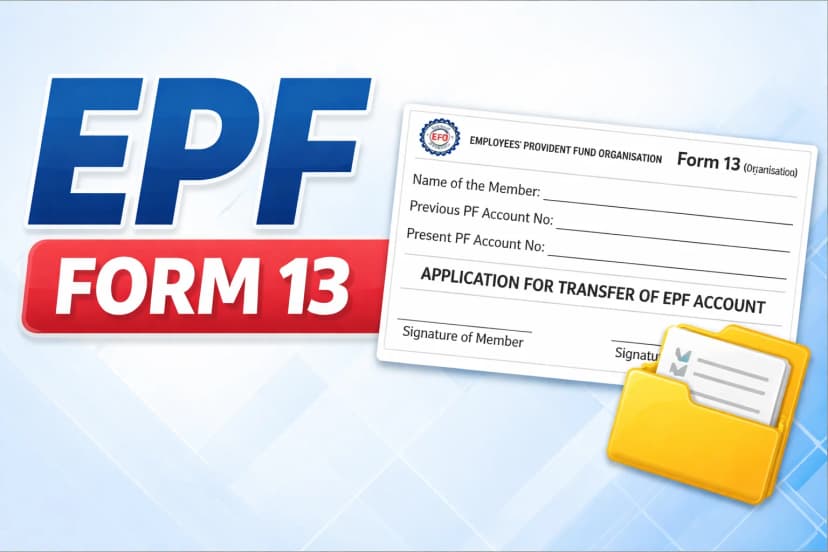
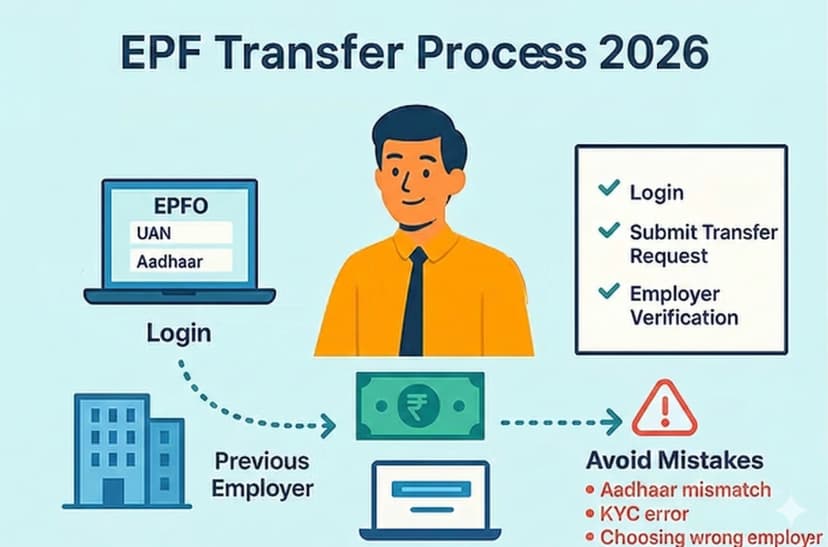
You submitted a PF transfer request, expected the balance to move to your latest EPF account, and then nothing happened. The status still shows Pending at Employer. It has been stuck at the Field Office for weeks. Or worse, the transfer was rejected without a clear explanation. If you're searching for your PF transfer status, the real question usually isn't:
"How do I transfer PF?"
It's:
"Why is my PF transfer not moving forward?"
Most delayed or rejected PF transfers are not caused by the transfer request itself. They are caused by an underlying verification issue that EPFO, your employer, or the transfer system cannot automatically resolve.
Common examples include: Employer approval delays, Multiple UANs, Aadhaar mismatches, Date of birth discrepancies, Incorrect member IDs, and Incomplete service history. The good news is that the transfer status usually tells you where the process is blocked. Once you identify the bottleneck, the next step often becomes much clearer.
Is Your PF Transfer Stuck?
Most delayed transfers are caused by record mismatches, employer verification issues, or duplicate UANs—not the transfer request itself.
Why This Guide Matters
At Kustodian, we've worked across thousands of EPF-related cases involving PF transfers, withdrawals, KYC corrections, UAN issues, and employer-verification challenges. Many PF transfer delays initially appear to be processing issues but are ultimately caused by record mismatches, duplicate UANs, incomplete service history, or verification failures. This guide combines official EPFO processes with common transfer issues we frequently encounter in practice.
Quick Answer
Most PF transfers are completed through the One Member One EPF Account facility and are typically processed within 30 days. If your PF transfer is pending, the delay is usually related to employer verification, EPFO review, or a mismatch in your records. If your transfer is rejected, the most common causes are name mismatches, Aadhaar discrepancies, multiple UANs, member ID issues, or incomplete KYC.
Quick Diagnosis
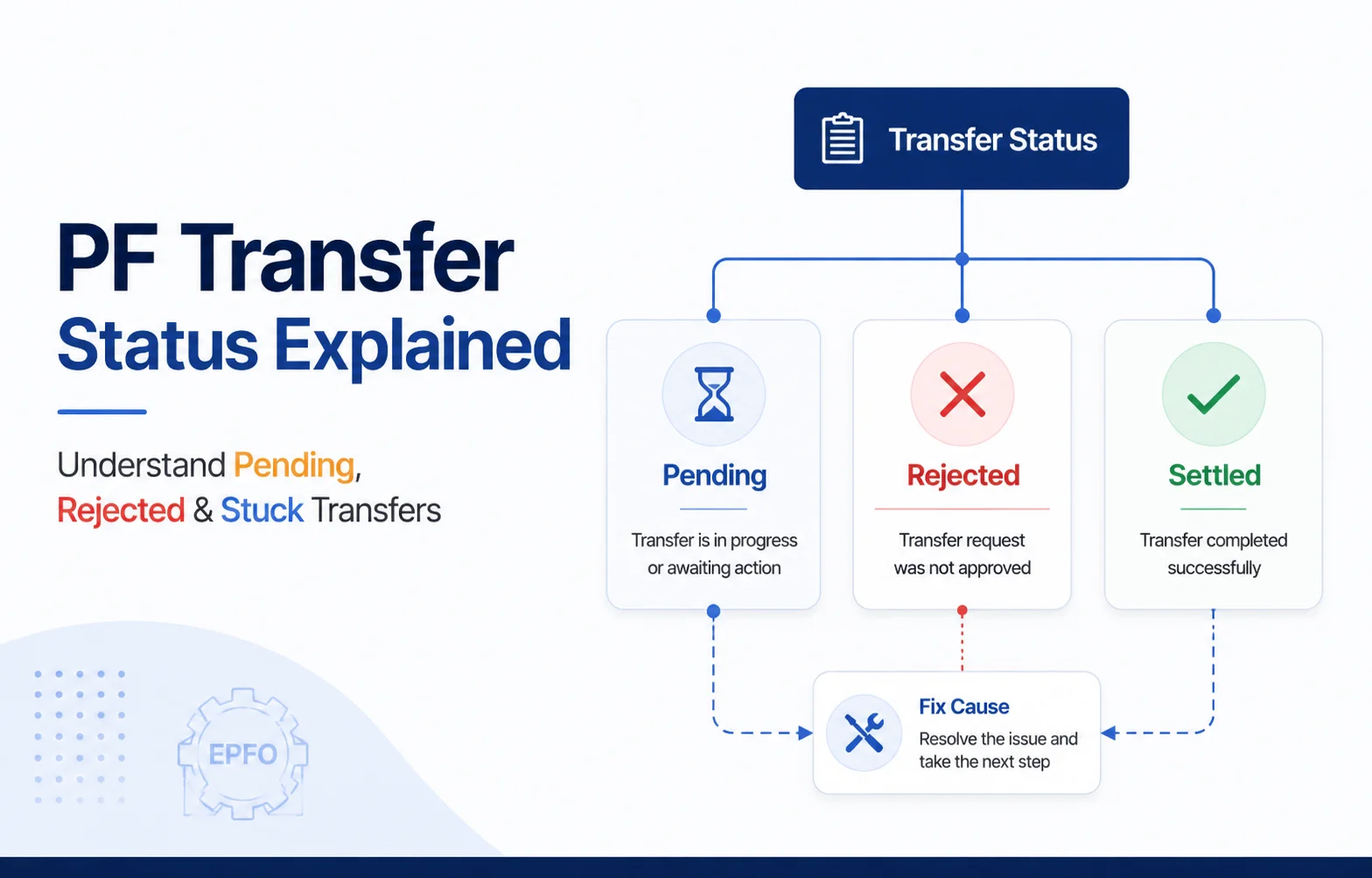
| Status | Most Likely Next Step |
|---|---|
| Pending at Employer | Follow up with the employer |
| Pending at Field Office | Monitor EPFO review |
| Rejected | Identify and fix the rejection reason |
| Settled | Verify the transferred balance |
The fastest way to resolve a PF transfer problem is not to resubmit the request. It is identifying the exact reason the transfer is stuck and fixing that issue first.
1. How to Check PF Transfer Status
Before trying to fix a PF transfer problem, confirm the exact status of your request. The action you should take depends entirely on whether the transfer is:
- Pending at Employer
- Pending at Field Office
- Rejected
- Settled
Many employees spend weeks following up with EPFO when the transfer is actually waiting for employer verification. Others repeatedly submit new requests when the original request was rejected due to a record mismatch. Checking the status first helps identify where the process is blocked.
PF Transfer Not Moving Forward?
Before chasing EPFO or submitting a fresh request, find out where the process is blocked and what may be causing the delay.
Method 1: Check PF Transfer Status Through the EPFO Member Portal
The EPFO Member Portal is the most reliable source for transfer status updates.
- Log in using your UAN credentials.
- Navigate to Online Services.
- Open your transfer request or transfer claim history.
- Locate the latest transfer application.
- Review the status displayed against the request.
Pay attention to the exact wording shown. Small differences in status often indicate very different underlying issues.
Method 2: Check PF Transfer Status Through UMANG
You can also track transfer requests through the UMANG application.
- Open EPFO services in UMANG.
- Access transfer or claim-related services.
- Locate your transfer request.
- Review the latest update.
UMANG is useful for quick checks, but the EPFO portal usually provides better context for troubleshooting.
What Information Should You Note?
Before moving to the next section, record:
- Current transfer status
- Date of submission
- Any rejection message
- Whether employer approval has been completed
These four details are usually enough to identify the most likely cause of a transfer delay. The next step is understanding what your PF transfer status actually means—and whether you need to wait, follow up, correct your records, or escalate the issue.
2. What Does Your PF Transfer Status Mean?
Your PF transfer status tells you where the transfer process is currently blocked or whether it has already been completed. The mistake many employees make is treating every pending status the same way.
A transfer that is Pending at Employer requires a very different response from a transfer that is Pending at Field Office or Rejected. Understanding the status is the fastest way to identify the next action.
PF Transfer Status Meaning
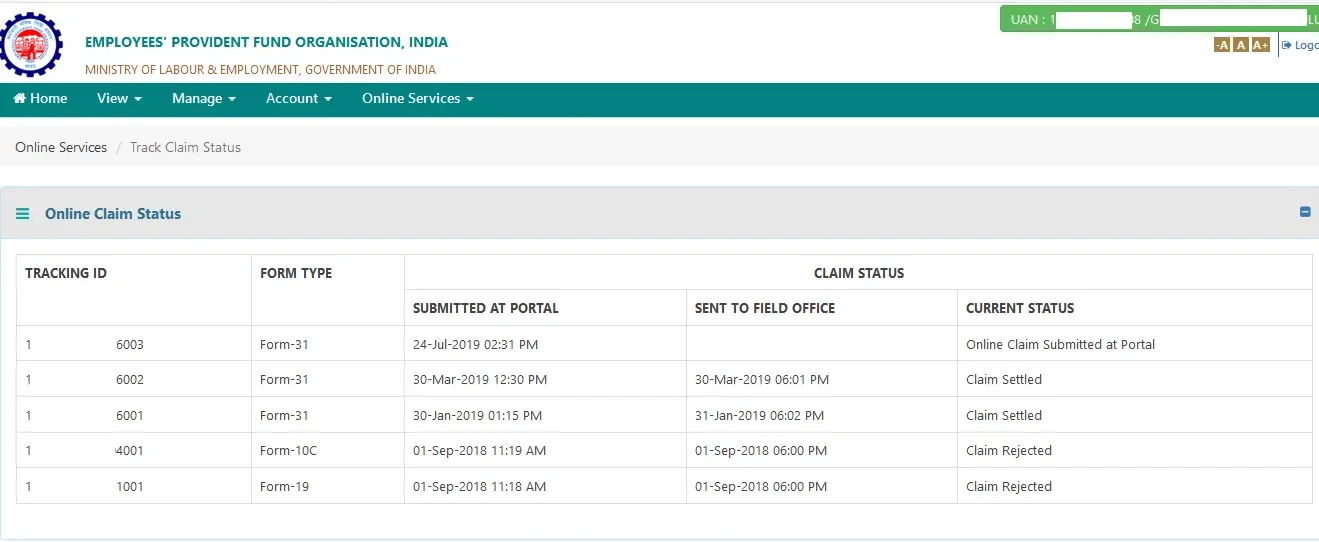
| Status | What It Means | What You Should Do |
|---|---|---|
| Submitted | Request successfully received | Wait for processing |
| Pending at Employer | Employer verification is required | Follow up with the employer |
| Pending at Field Office | EPFO is reviewing the request | Monitor progress |
| Rejected | Validation failed | Identify and fix the issue |
| Settled | Transfer completed successfully | Verify the transferred balance |
Key Takeaway: A pending status does not automatically mean something is wrong. The important question is: Where is the transfer pending? That answer determines what you should do next.
3. PF Transfer Decision Tree
Use the table below to quickly identify the most appropriate next step based on your current transfer status.
| If Your Status Shows | Likely Situation | Recommended Next Step |
|---|---|---|
| Submitted | Request recently filed | Wait |
| Pending at Employer | Verification awaiting employer action | Contact HR or the payroll team |
| Pending at Employer for 30+ days | Approval bottleneck | Escalate and document follow-ups |
| Pending at Field Office | EPFO review underway | Monitor status |
| Pending at Field Office for 30+ days | Verification issue or backlog | Investigate and consider escalation |
| Rejected due to Name Mismatch | Personal details do not match | Correct records |
| Rejected due to DOB Mismatch | Date of birth inconsistency | Update records |
| Rejected due to Multiple UANs | Duplicate UAN problem | Resolve the UAN issue first |
| Employer Closed | Verification challenge | Gather records and escalate |
| Settled | Transfer completed | Verify balance and service history |
For most users, this table alone identifies the next action more quickly than reading detailed explanations.
Found Your EPF claim Status, but Still Not Sure What It Means?
A transfer can remain pending for very different reasons depending on whether it's stuck at the employer, the field office, or due to a record mismatch.
4. PF Transfer Troubleshooting Matrix
The status tells you where the transfer is blocked. The troubleshooting matrix helps identify why.
| Problem | Most Likely Cause | Recommended Fix |
|---|---|---|
| Pending at Employer | The employer has not completed verification | Follow up with the employer |
| Pending at Field Office | EPFO review backlog or verification check | Wait and monitor |
| Rejected due to Name Mismatch | Personal records differ across systems | Correct records and reapply |
| Rejected due to Aadhaar Mismatch | Aadhaar details do not match EPFO records | Update KYC information |
| Rejected due to Multiple UANs | Duplicate UANs detected | Resolve the duplicate UAN issue |
| Rejected due to Member ID Mismatch | Service records are inconsistent | Verify employment history |
| Employer Closed | Verification cannot be completed normally | Escalate with supporting documents |
| Transfer Pending for Months | The underlying issue remains unresolved | Investigate and escalate |
Before You Submit Another Transfer Request
Many employees assume the solution is to submit a fresh transfer request. In most cases, that does not solve the problem. If the underlying issue is a name mismatch, duplicate UAN, Aadhaar discrepancy, or verification failure, the new request is likely to fail for the same reason. The fastest route to resolution is identifying the bottleneck first and correcting it before taking further action.
5. How Long Does PF Transfer Take?
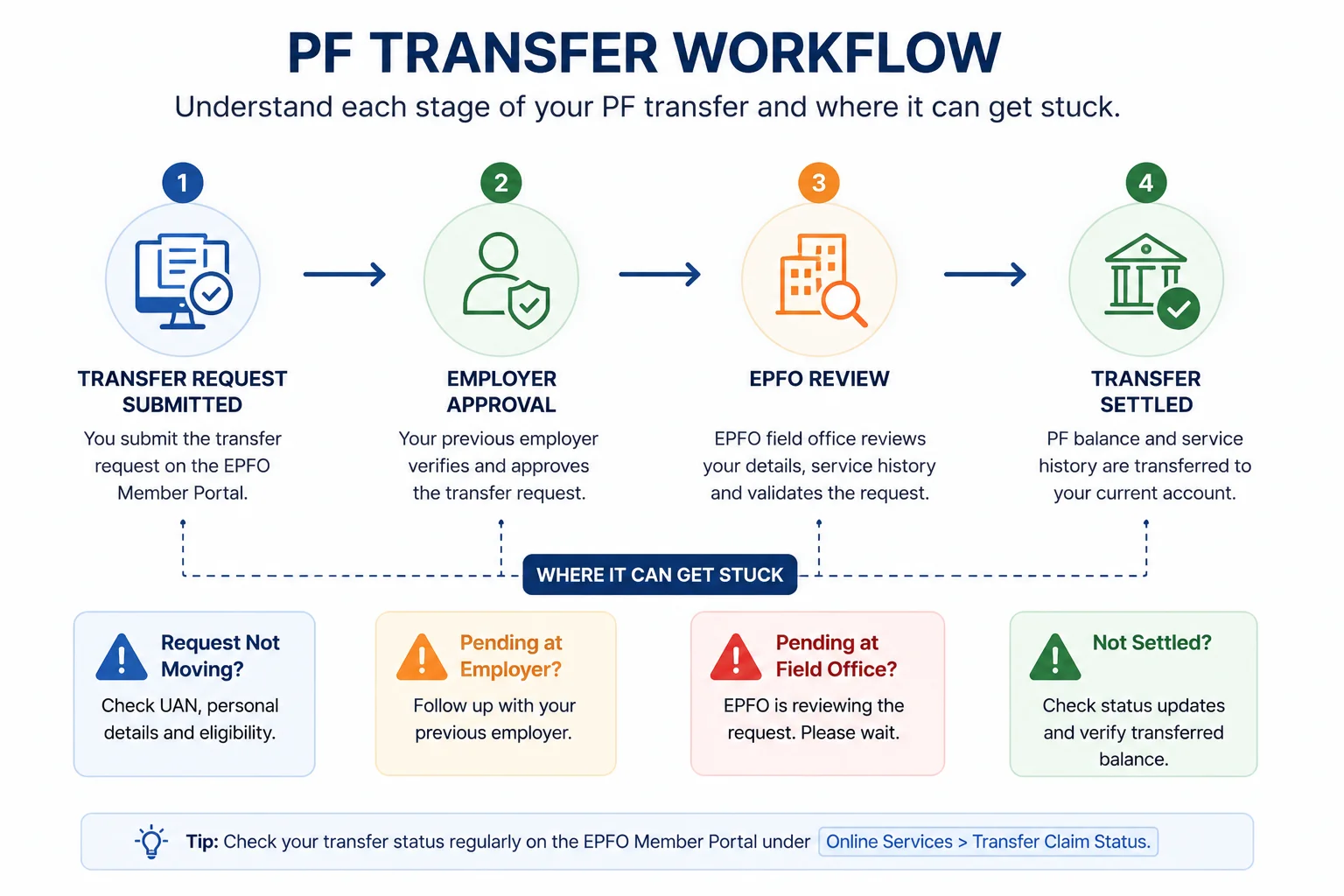
Most PF transfers are completed within 30 days, provided employer verification, EPFO review, and member records are all in order. In our experience, transfers that remain pending beyond 60 days often involve an underlying record issue rather than routine processing delays. Common examples include duplicate UANs, Aadhaar mismatches, incomplete service history, and employer-verification problems.
However, the actual timeline depends less on the transfer request itself and more on whether any verification issues are discovered during processing. For example, a transfer with correct records may be completed quickly, while a transfer involving multiple UANs, mismatched personal details, or employer verification delays can remain pending for several weeks.
Typical PF Transfer Timeline
| Stage | What Happens | Typical Time |
|---|---|---|
| Transfer Request Submitted | Request enters the EPFO workflow | Immediate |
| Employer Verification | Employer reviews and approves the request | 3–10 working days |
| EPFO Review | Records and transfer details are verified | 5–15 working days |
| Transfer Settlement | Balance and service history are transferred | Usually within 30 days |
These timelines are indicative and may vary depending on employer responsiveness, field office workload, and record accuracy.
When Is A PF Transfer Still Normal?
In most cases, a transfer is not considered delayed if:
- The request was submitted within the last 15 days
- Employer verification is still underway
- The status continues to move through normal stages
- No rejection or error message has been issued
Many employees become concerned too early, even though the transfer remains within standard processing timelines.
When Is A PF Transfer Delayed?
A transfer may require investigation when:
- The status has not changed for more than 30 days
- Employer verification remains pending for weeks
- EPFO review appears stuck without explanation
- The request repeatedly encounters validation issues
At this stage, the goal should not be to wait longer. The goal should be to identify what is preventing the transfer from progressing.
Still Waiting for Your PF Transfer to Move?
When a transfer remains stuck for more than 30 days, there is often a specific verification or record issue blocking progress behind the scenes.
Kustodian helps individuals identify transfer bottlenecks involving multiple UANs, Aadhaar mismatches, employer verification delays, and missing service history.
PF Transfer Escalation Timeline
Use the table below as a practical guide.
| Time Since Submission | Recommended Action |
|---|---|
| 0–15 Days | Wait and monitor |
| 15–30 Days | Follow up with the employer if verification is pending |
| 30–60 Days | Investigate the reason for the delay |
| More Than 60 Days | Raise a grievance and actively pursue resolution |
Key Takeaway: The number of days alone does not determine whether a transfer is delayed. A transfer pending for 20 days due to employer verification may be completely normal. A transfer pending for 20 days because of a hidden mismatch issue may never move forward until the underlying problem is corrected. Focus on the reason for the delay, not just the number of days that have passed.
6. Why Is My PF Transfer Pending?
A pending PF transfer is not a diagnosis. It is a symptom. The real question is: What is preventing the transfer from moving to the next stage? In many cases, the status itself reveals where the bottleneck exists. Once you identify that bottleneck, the path to resolution becomes much clearer. The three most common pending-transfer situations are:
- Pending at Employer
- Pending at Field Office
- Employer No Longer Exists
Each requires a different approach.
i. Transfer Request Pending at Employer
If your PF transfer status shows Pending at Employer, the request is waiting for verification from the employer responsible for approving the transfer. This is one of the most common causes of transfer delays.
a. What Does This Usually Mean?
In practice, it often means:
- The request has not been reviewed yet
- The approval workflow is still pending
- Employment records require verification
- The responsible person has not completed the process
Many employees assume EPFO is responsible for the delay when the transfer has not yet reached EPFO review.
b. What Should You Do?
Start by contacting the HR, payroll, or compliance team responsible for EPF administration. When following up, provide:
- UAN number
- Transfer request details
- Date of submission
Ask a simple question:
Has the transfer request been reviewed and approved?
This often provides more useful information than repeatedly checking the status page.
c. When Should You Escalate?
Consider escalation when:
- The transfer has remained pending for more than 30 days
- Multiple follow-ups have gone unanswered
- The employer cannot explain the delay
- The employer appears inactive
At this point, gathering documentation and preparing for escalation becomes important.
ii. Transfer Pending at Field Office
A Pending at Field Office status means employer verification has already been completed and the transfer is now being reviewed by EPFO. This is usually a better position than being pending at an employer because the request has moved further through the process.
a. Why Does This Happen?
Common reasons include:
- Verification of employment records
- Service history validation
- UAN-related checks
- Record inconsistencies
- Processing backlogs
A field-office delay does not automatically mean something is wrong. Many transfers remain at this stage for several days before being settled successfully.
b. What Should You Do?
Monitor the status and avoid submitting duplicate transfer requests. Submitting multiple requests often creates additional confusion and rarely solves the underlying issue. If the status remains unchanged for more than 30 days, begin investigating whether a mismatch or verification issue exists in your records.
c. When Should You Escalate?
Escalation becomes reasonable when:
- No progress occurs for more than 30 days
- EPFO requests information that has already been provided
- The request repeatedly fails to move forward
- You suspect a record mismatch is blocking approval
The objective is to identify the bottleneck, not simply speed up the queue.
iii. What If Your Previous Employer Has Closed Down?
This is one of the most common situations where a transfer becomes genuinely difficult. Many employees discover the problem only after trying to transfer PF years after leaving the organisation.
a. Why Closed Employers Create Transfer Problems
A transfer may become difficult when:
- Verification requests receive no response
- Historical records are incomplete
- Contact points no longer exist
- Employment history requires additional validation
The transfer is not necessarily impossible.
However, the standard verification path may no longer work as intended.
b. What Should You Do?
Before escalating, gather:
- UAN details
- Previous Member ID
- Appointment letter (if available)
- Salary slips
- Relieving letter
- Previous PF-related correspondence
The stronger your documentation, the easier it becomes to establish employment history if additional verification is required.
c. Employer Closed? Read This First
If your previous employer has shut down and the transfer has been pending for months, avoid repeatedly submitting new transfer requests. In many cases, the issue is not the request itself but the inability to complete verification through normal channels. Understanding exactly what records are missing usually saves far more time than repeatedly restarting the process.
Quick Diagnosis
| Current Status | Most Likely Issue | Recommended Next Step |
|---|---|---|
| Pending at Employer | Verification awaiting employer action | Follow up with HR |
| Pending at Employer for 30+ days | Approval bottleneck | Escalate |
| Pending at Field Office | EPFO review underway | Monitor |
| Pending at Field Office for 30+ days | Verification issue or backlog | Investigate |
| Employer Closed | Verification challenge | Gather records and escalate |
The status tells you where the transfer is stuck. The next step is identifying why it is stuck.
7. Why Was My PF Transfer Rejected?
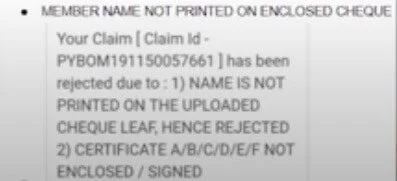
A rejected PF transfer does not usually mean the transfer request was submitted incorrectly. More often, it means EPFO could not verify the information required to complete the transfer. In most cases, the rejection is a symptom of a deeper issue involving your identity records, employment history, UAN information, or KYC details.
The fastest way to resolve a rejected transfer is to identify the exact rejection reason before submitting another request. Submitting the same request again without fixing the underlying issue often leads to another rejection.
Transfer Rejected More Than Once?
Repeated PF transfer rejections often indicate a deeper issue within your EPF records that has not yet been identified or corrected.
Kustodian helps individuals investigate transfer failures involving multiple UANs, Aadhaar mismatches, service-history issues, employer-verification challenges, and other EPF record discrepancies.
i. PF Transfer Rejected Due to Name Mismatch
Name mismatches are one of the most common transfer rejection reasons.
Even small differences between records can prevent EPFO from confirming that the accounts belong to the same person.
a. Common Examples
| Aadhaar Record | EPF Record |
|---|---|
| Rahul Kumar Sharma | Rahul Sharma |
| P Ravi Kumar | Ravi Kumar |
| Suresh Kumar | Suresh K |
b. What Usually Causes It?
- Spelling differences
- Missing middle names
- Initials expanded differently
- Old employer records
- Data-entry errors
c. What Should You Check?
Compare:
- Aadhaar details
- UAN profile
- Previous employer records
- Current employer records
If the details are inconsistent, the records generally need correction before the transfer can succeed.
Related: Learn how to correct name mismatches using the Joint Declaration Form.
ii. PF Transfer Rejected Due to Date of Birth Mismatch
EPFO uses date of birth as a critical verification field.
If different records show different dates, the transfer may fail validation.
a. Common Causes
- Incorrect employer records
- Legacy EPF data
- Aadhaar updated after employment
- Historical documentation errors
b. What Should You Check?
Verify the date of birth across:
- Aadhaar
- UAN profile
- Employer records
A mismatch in even one location can prevent successful transfer verification.
Related: Learn how to correct EPF date-of-birth mismatches.
iii. PF Transfer Rejected Due to Aadhaar Mismatch
Aadhaar-related rejections have become increasingly common because Aadhaar is now used as a primary identity verification layer.
a. Typical Aadhaar Issues
- Name mismatch
- Date of birth mismatch
- Gender mismatch
- Incorrect Aadhaar linkage
- Aadhaar not fully verified
b. How To Confirm This Is The Problem
Check whether:
- Aadhaar is linked to UAN
- KYC status is approved
- Personal details match exactly across records
If Aadhaar information does not match EPFO records, the transfer will often continue failing until the discrepancy is corrected.
Related: Learn how to verify and correct EPF KYC details.
iv. PF Transfer Rejected Due to Bank KYC Issues
Bank details do not usually cause transfer problems directly, but incomplete or inconsistent KYC records can trigger validation failures.
a. Common Issues
- Unverified bank account
- Incorrect account number
- Name mismatch with bank records
- Pending KYC approval
b. What Should You Do?
Review your KYC status and ensure all submitted information has been verified and approved. If a bank-related discrepancy exists, correct it before attempting another transfer.
v. PF Transfer Rejected Due to Multiple UANs
Multiple UANs create some of the most difficult PF transfer cases.
a. What Does This Mean?
Instead of having one UAN throughout your career, duplicate UANs have been created for different periods of employment. As a result, EPFO may struggle to connect service history and account information correctly.
Common Warning Signs
- Previous employment is missing from the service history
- Multiple PF accounts visible
- Different UANs are linked to different employers
- Repeated transfer failures
b. What Should You Do?
Before submitting another transfer request, confirm whether multiple UANs exist. If duplicate UANs are present, resolving the duplication issue should usually be the first priority.
Related: Learn how to identify and resolve multiple UAN issues.
vi. PF Transfer Rejected Due to Member ID Mismatch
Member IDs connect individual employment records to EPF accounts. When those records are inconsistent, transfer validation may fail.
a. Common Causes
- Incorrect employer information
- Wrong member ID selected
- Missing service history
- Incomplete employment records
b. What Should You Check?
Review:
- Previous employer details
- Member IDs
- Service history records
Many transfer rejections can be traced back to inconsistencies in employment records rather than problems with the transfer request itself.
Related: Learn how Member IDs work and how to identify mismatches.
8. Rejection Reason → Fix Matrix
Use this table to identify the most likely next step.
| Rejection Reason | Most Likely Fix |
|---|---|
| Name Mismatch | Correct personal records |
| Date of Birth Mismatch | Update DOB records |
| Aadhaar Mismatch | Correct Aadhaar-linked information |
| Bank KYC Issue | Update and verify KYC |
| Multiple UANs | Resolve the duplicate UAN issue |
| Member ID Mismatch | Verify employment history |
Before You Submit Another Transfer Request
Ask yourself one question:
Has the underlying problem actually been fixed?
If the answer is no, submitting another transfer request is unlikely to produce a different outcome. The transfer request is rarely the problem. The records being validated usually are. The next step is understanding whether the issue requires a simple correction, an EPFO grievance, or a more detailed investigation.
9. What Happens If You Do Not Transfer Your PF?
Many employees delay transferring PF after changing jobs because the balance remains visible and nothing appears urgent. In most cases, your PF balance does not disappear simply because it has not been transferred. However, postponing transfers for years can create avoidable complications later.
Common Problems Caused by Delayed Transfers
- Multiple PF accounts across employers
- Fragmented service history
- Difficulty tracking old balances
- Higher chance of record mismatches
- More complex withdrawal and settlement processes
The risk is usually not losing money. The risk is creating a more difficult record-reconciliation problem in the future.
Should You Transfer Old PF Accounts?
If you have joined a new employer and intend to continue working, consolidating PF accounts is generally simpler than maintaining multiple disconnected records across different employers. The earlier records are consolidated, the easier future claims, withdrawals, and service-history verification become.
10. One Member One EPF Account Transfer Request Explained
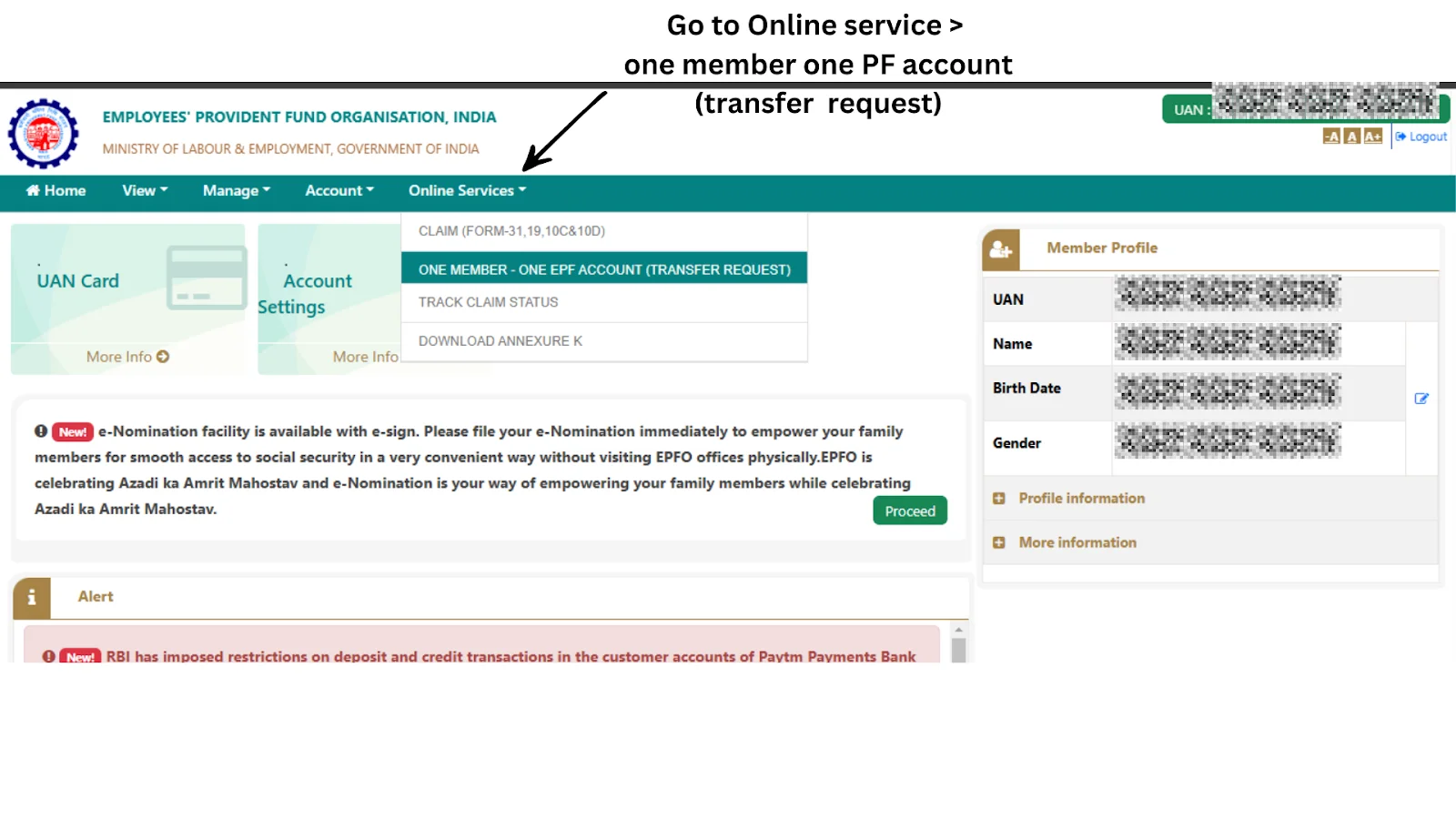
The One Member One EPF Account facility is the primary online mechanism used to transfer PF balances from a previous employer's account to your current EPF account. The objective is straightforward:
One employee → One UAN → Consolidated PF records.
When Does It Work Smoothly?
Transfers are usually completed without major issues when:
- Aadhaar details match
- UAN records are accurate
- Service history is complete
- Employer verification is successful
Why Do One Member One EPF Account Requests Fail?
Most failures occur because of:
- Name mismatches
- Date-of-birth discrepancies
- Multiple UANs
- Member ID issues
- Employer verification problems
In other words, the transfer facility itself is rarely the problem. The underlying records usually are.
11. Should You Transfer PF or Withdraw It?
One of the most common questions after changing jobs is whether you should transfer your PF balance or withdraw it. The answer depends on your employment situation and long-term plans.
Transfer vs Withdrawal
| Transfer PF | Withdraw PF |
|---|---|
| Balance moves to your current PF account | Funds are paid out |
| Service history remains consolidated | Service continuity may be interrupted |
| Suitable when continuing employment | Suitable when eligible and funds are needed |
| Supports long-term retirement savings | Provides immediate access to money |
A Simple Rule: If you have joined another employer and plan to continue working, transferring PF is often the cleaner long-term option. If you qualify for withdrawal and need access to the funds, withdrawal may be appropriate.
Related: Learn more about PF withdrawal eligibility and timelines.
Considering PF Withdrawal Instead?
Before submitting a withdrawal claim, review the eligibility requirements, tax implications, and potential impact on your service history and retirement savings.
12. When Should You Raise an EPFO Grievance?
A grievance is most useful when you understand the problem but cannot move the case forward. Many employees raise grievances too early. Others wait too long. The table below provides a practical framework.
Escalation Guide
| Situation | Recommended Action |
|---|---|
| Transfer submitted within the last 15 days | Wait |
| Pending for 15–30 days | Follow up |
| Pending for more than 30 days | Investigate and consider the grievance |
| Employer unresponsive | Escalate |
| Repeated rejection | Fix the root cause before escalating |
Before Raising a Grievance
Make sure you have:
- UAN number
- Transfer reference details
- Screenshots of the current status
- Any employer communication records
The more specific your grievance, the easier it becomes for EPFO to identify the issue.
13. Frequently Asked Questions About PF Transfer Status
Why is my PF transfer pending at the employer?
A PF transfer remains pending at the employer when EPFO is waiting for verification from the employer responsible for approving the request. In most cases, the delay is caused by internal approval workflows, pending verification, or a lack of action from the employer. If the status remains unchanged for more than 30 days, follow up with the employer and consider escalation if necessary.
Why is my PF transfer pending at the field office?
A pending-at-field-office status means employer verification has already been completed, and the request is under EPFO review. This stage may involve service-history validation, record verification, or processing backlogs. Short delays are common, but extended delays may require investigation.
How long does PF transfer take?
Most PF transfers are completed within approximately 30 days when employer verification and EPFO review proceed normally. Delays are more likely when records contain mismatches, multiple UANs exist, or employer verification remains incomplete.
Can a PF transfer happen automatically?
In some cases, EPFO systems may facilitate smoother transfers when records are properly linked and verified. However, many employees still need to initiate a transfer request and complete the required verification steps.
Can a PF transfer be rejected after employer approval?
Yes. Employer approval does not guarantee successful transfer completion. EPFO may still reject a transfer if it identifies issues such as name mismatches, Aadhaar discrepancies, multiple UANs, incorrect member IDs, or incomplete service records.
What if my previous employer has closed down?
A closed employer does not automatically make a PF transfer impossible. However, additional verification and documentation may be required because the normal employer-verification route may no longer be available. Employment records, salary slips, and historical documents often become more important in such cases.
What happens if I have two UAN numbers?
Multiple UANs can create transfer failures, missing service history, and verification problems. If duplicate UANs exist, resolving that issue is often necessary before a transfer can be completed successfully.
Can I transfer PF without employer approval?
The answer depends on the transfer workflow applicable to your case. While EPFO has simplified many processes over time, employer verification may still be required in certain situations. Always review the specific requirements shown in your transfer workflow.
Can the PF transfer be reversed?
Transfer reversals are uncommon and depend on the circumstances involved. If a transfer appears incorrect or service history has not been reflected properly, further review may be required to determine the appropriate corrective action.
How do I know if my PF transfer is successful?
A successful transfer generally shows a Settled status. You should also verify that:
- The transferred balance appears correctly
- Previous service history is visible
- Old account records reflect the transfer
Checking only the status is not enough. Confirm that the balance and employment history have been updated correctly.
PF Transfer Pending for More Than 60 Days?
If your transfer has remained unchanged for more than 60 days, the issue is often no longer routine processing.
Common causes include:
- Duplicate UANs
- Aadhaar mismatches
- Missing service history
- Employer-verification failures
- Member ID inconsistencies
At this stage, investigating the underlying records is usually more effective than waiting or submitting another transfer request.
14. When Should You Get Professional Help?
Many PF transfer problems can be resolved independently. However, some situations involve multiple moving parts and become significantly harder to diagnose.
Cases That Often Require Deeper Investigation
If your transfer has been stuck for several months, involves multiple UANs, a closed employer, missing service history, or repeated rejections, identifying the root cause often becomes more important than submitting another request. In these situations, a detailed review of your EPF records can help determine exactly what is preventing the transfer from progressing.
Need Help Investigating a Stuck PF Transfer?
If your transfer has been pending, rejected, or stuck for months, Kustodian can help identify underlying issues involving UAN records, Aadhaar verification, employer history, and EPF account reconciliation.
Why Trust Kustodian?
Kustodian works with individuals and families to resolve complex EPF, inheritance, and financial-account challenges. Our team has reviewed thousands of EPF-related cases involving PF transfers, withdrawals, KYC corrections, employer-verification issues, service-history discrepancies, and duplicate UANs. This experience allows us to focus on the underlying causes of transfer failures rather than simply helping users submit another request.
15. Quick Recap
PF Transfer Resolution Cheat Sheet
| Status / Problem | Most Likely Cause | First Action |
|---|---|---|
| Pending at Employer | Employer verification delay | Contact HR |
| Pending at Field Office | EPFO review | Monitor progress |
| Pending for 30+ Days | Bottleneck exists | Investigate cause |
| Name Mismatch | Record inconsistency | Correct records |
| Aadhaar Mismatch | KYC discrepancy | Verify Aadhaar details |
| Multiple UANs | Duplicate UAN issue | Resolve UAN duplication |
| Employer Closed | Verification challenge | Gather documentation |
| Rejected Transfer | Validation failure | Fix the root cause before reapplying |
| Settled | Transfer completed | Verify balance and service history |
If your PF transfer is stuck:
- Check the exact status.
- Identify where the transfer is blocked.
- Determine whether the issue is employer-related, EPFO-related, or record-related.
- Fix the underlying problem before submitting another request.
- Escalate only when normal resolution paths have been exhausted.
Most PF transfer problems are solvable. The fastest resolutions usually come from understanding the root cause rather than repeatedly restarting the process.
PF Interest Loss Calculator
See how much interest you lose every month your claim sits unresolved.