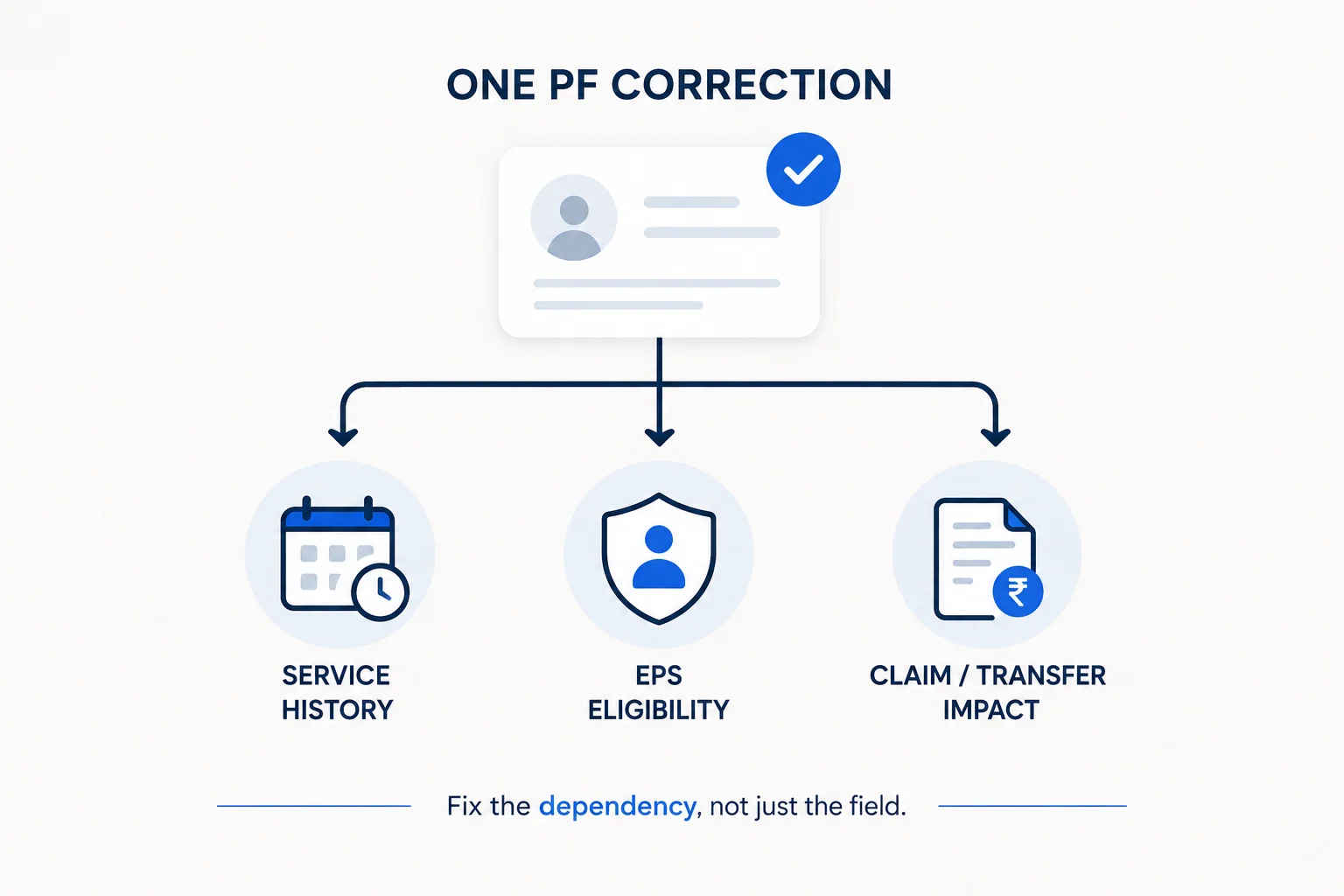
An employer discovers a rejected claim, a pension shortfall, or a duplicate UAN. The instinct is to fix that one record.
That instinct is usually wrong.
A wrong Date of Joining doesn't just sit in one field — it can misstate an employee's service history, which can misstate EPS pension eligibility, which can delay a transfer or a retirement claim years later. Correcting the visible error without checking what it fed into means the underlying problem often resurfaces in a different form.
This guide gives employers the Connected Record Recovery Framework for finding and sequencing historical PF corrections — not the procedure for any single fix. For step-by-step correction processes, see the linked guides below for Date of Joining, Date of Exit, duplicate UAN, contributions, and EPS errors.
Which Historical PF Records Can Employers Correct?
Yes, most historical PF records can be corrected — but each correction type follows a different EPFO process, involves different documentation, and sometimes different approval authorities. Some corrections are filed at the employee's Member Profile level on the EPFO Unified Portal; others — like Establishment ID or Annexure K issues — are filed by the employer through the Employer Portal, and some require both.
EPFO's own Joint Declaration mechanism — a combined employer-employee request used to correct member profile fields including Date of Joining, Date of Exit, and reason for leaving — was itself revised in July 2024 specifically because unresolved profile mismatches were causing claim rejections at scale. That's a useful signal in itself: even the regulator treats record correction as a systemic data-quality problem, not a one-off fix.
The employer's job before touching any single record:
- Identify every record the visible issue might have touched.
- Map how those records depend on each other.
- Prioritise by employee impact and compliance exposure, not by discovery order.
- Run the correction workflow specific to each issue.
- Confirm the full record set is internally consistent afterward.
How One Error Cascades Into Others
Wrong Date of Joining → Incorrect Service History → EPS Eligibility Error → Delayed/Rejected Pension or Transfer ClaimPayroll Configuration Error → Incorrect Monthly Contribution → Contribution History Mismatch → Withdrawal/Transfer IssueConsultant Transition → Missing Documentation → Delayed Correction → Employee Complaint → EPFO EscalationWorked example: During a 2024 HRMS migration, one manufacturing employer's payroll team found a single employee's Date of Joining was off by four months — a data-entry error from onboarding a decade earlier. Tracing it back through the same onboarding batch surfaced eleven more affected records. Three of those employees had already crossed the ten-year mark required for EPS pension eligibility under the wrong DOJ — meaning their actual eligible-service calculation was wrong, not just their paperwork. Fixing the original complaint alone would have closed one ticket and left three miscalculated pensions undiscovered.
This is the pattern worth internalising: the record that generates the complaint is rarely the only record affected by the underlying error.
What employers typically check, and what they miss:
| Employers Check | Employers Often Miss |
|---|---|
| Date of Joining | Service history |
| Date of Exit | Pension impact |
| Contributions | Payroll source of the error |
| Duplicate UAN | Annexure K / transfer records |
| Identity fields | Member Profile / KYC dependency on the EPFO Unified Portal |
Not sure whether one issue affects other records? A Kustodian Employer PF Record Audit maps connected records before any correction begins.
Which Records Can Be Corrected, Who Leads, and What to Fix First
Sequence by what blocks an employee or exposes the company — not by what was reported first, and not alphabetically by category.
| Category | Typical Records | Who Leads | Priority |
|---|---|---|---|
| Contributions | Missing, short, excess, or incorrect amounts | Employer | Immediate |
| Payroll & ECR | Wage data, ECR filings, reconciliation | Employer | Immediate |
| Pension (EPS) | Eligible service, scheme membership | Employer + EPFO | High |
| Employment History | DOJ, DOE, service history, Annexure K, duplicate UAN | Employer | High → Medium* |
| Employee Identity | Name, DOB, gender, Aadhaar, PAN, bank details | Employer + employee | Planned |
| Governance | Joint Declaration, nomination, portal/DSC access | Employer | Planned |
*Within Employment History: Date of Exit errors and duplicate UANs are High (they actively block claims and transfers); Date of Joining errors are Medium — unless the error crosses the 10-year EPS eligibility line, which pushes it to High.
A pending EPFO proceeding overrides this table — it's Critical regardless of category, since an open proceeding can constrain what's even correctable until it resolves.
Identity and DOJ/DOE corrections generally route through EPFO's Joint Declaration mechanism, which since its 2024 SOP revision classifies changes as "minor" or "major" — minor changes need two supporting documents, major changes need three. EPS eligible-service corrections are more constrained: under Section 6A of the EPF Act, 1952, which establishes the Employees' Pension Scheme, 1995, pension eligibility depends on a minimum of ten years of eligible service — so a DOJ correction that shifts someone across that ten-year line isn't paperwork, it's a benefit-eligibility change, and EPFO scrutiny follows accordingly.
When Should Employers Audit Historical PF Records?
| Trigger Event | Why It Matters |
|---|---|
| Multiple employee complaints | Signals a pattern, not an isolated case |
| Payroll or HRMS migration | Old errors surface when systems change |
| Consultant transition | Confirms nothing carried over incorrectly |
| Internal compliance review | Catches issues before an external one does |
| EPFO notice or inspection | Time-sensitive; prioritise accordingly |
| M&A due diligence | Historical PF liability affects deal terms |
| Large-scale hiring | Prevents compounding existing operational debt |
The Connected Record Recovery Framework
Sequencing corrections by dependency, not discovery order, is the difference between a project that closes and one that reopens six months later. Kustodian's Connected Record Recovery Framework:
FIND → MAP → LINK → PRIORITISE → CORRECT → VALIDATE → GOVERN
| Stage | What Happens |
|---|---|
| Find | Surface every known issue — complaints, reconciliation gaps, audits, notices |
| Map | Classify each issue by category: identity, employment history, contributions, pension, payroll, governance |
| Link | Trace dependencies (e.g., DOJ → service history → EPS) so one fix doesn't miss its downstream effects |
| Prioritise | Rank by employee impact, compliance exposure, and operational dependency |
| Correct | Run the issue-specific workflow — see the related guides below |
| Validate | Confirm related records are consistent and no downstream issue was missed |
| Govern | Put reconciliation and review processes in place so the same errors don't recur |
Most correction projects fail at Validate, not Correct — a field gets updated, but nobody checks whether the fields it was feeding into (a pension calculation, a transfer record) were updated to match.
Where to Start: What You Need vs. What to Read
| I need to... | Read |
|---|---|
| Fix one employee's Date of Joining or Exit | DOJ / DOE Guide |
| Resolve a duplicate UAN | Duplicate UAN Guide |
| Fix contribution or ECR errors | Contribution Corrections |
| Resolve an EPS eligibility or pension issue | EPS Errors Guide |
| Investigate multiple employees or a systemic pattern | Stay on this guide |
| Assess a payroll or HRMS migration | Contribution Corrections |
| Assess a consultant transition | Previous Consultant Made Mistakes? |
| Audit all PF records across the company | Employer PF Record Audit |
Mistakes That Restart the Clock — and the Controls That Prevent Them
| During Correction: Avoid | Instead | After Correction: Put in Place |
|---|---|---|
| Fixing one record without checking dependencies | Map dependencies first | Quarterly PF health reviews |
| Investigating employee-by-employee | Start at category level, then drill down | Payroll-to-EPFO reconciliation |
| Starting before documentation is ready | Assemble documents up front | Employer-controlled portal/DSC access |
| Treating every issue as equally urgent | Prioritise by impact, not order found | Documented internal PF procedures |
| Closing the ticket once the field is updated | Validate downstream records too | Annual historical record review |
The left two columns prevent rework on the correction you're doing now. The right column prevents the next one.
FAQ
Can employers correct PF records that are years old? Yes, in most cases — subject to the correction type, available supporting documentation, and EPFO's applicable process for that record.
Should employers fix issues one at a time? Not by default. Where records are likely connected — DOJ, service history, and EPS eligibility, for instance — map the dependency first so one correction doesn't leave a related error unresolved.
Can historical PF issues be reviewed in bulk? Yes. Bulk review is common after payroll/HRMS migrations, consultant transitions, mergers, or recurring complaints, though individual documentation requirements can still differ per employee.
Who is responsible for correcting historical PF records? The employer remains accountable for record accuracy. Depending on the correction type, employees, consultants, or EPFO may also need to act — Joint Declaration corrections, for example, explicitly require both employer and employee sign-off.
What if a previous consultant filed something incorrectly — can it be reversed? Generally yes, though the correction path depends on what was filed and whether it already affected downstream records like contributions or EPS eligibility. This is exactly the kind of case where mapping dependencies first — rather than re-filing the same form — avoids a repeat error.
Need help reviewing or correcting historical PF records?
Whether you're dealing with old DOJ/DOE errors, service history mismatches, EPS issues, Joint Declarations, or legacy records from a previous consultant, Kustodian helps employers identify the root cause, map record dependencies, and guide the correction process.
Book a free PF record assessment with Kustodian before filing corrections. In many cases, identifying the right sequence of corrections can save significant time and prevent repeated rejections.
Restore the System, Not Just the Field
A wrong Date of Joining can misstate service history. A payroll error can misstate contributions. A duplicate UAN can misstate a transfer. Fixing the record that generated the complaint, without checking what else it touched, usually leaves the real problem in place.
The audit covers: historical record health assessment, correction dependency mapping, priority ranking, bulk-correction opportunity assessment, root cause analysis, and a governance review — a sequenced correction roadmap, not a list of individual fixes.
PF Interest Loss Calculator
See how much interest you lose every month your claim sits unresolved.