Most companies don't set up a Provident Fund Trust expecting to close it one day. But priorities change — compliance requirements grow, teams get leaner, businesses merge or restructure — and a Trust that once offered control can turn into an administrative burden.
At that point, employers start asking the same questions: Can we surrender our PF Trust? What happens to employees? Does the pension continue? What approvals are required, and how long does it take?
This guide answers those questions from an employer's perspective — the legal basis, the end-to-end process, the documents EPFO expects, and the mistakes that most often delay a de-exemption.
Planning to surrender your PF Trust? Kustodian helps organisations assess readiness, reconcile member records, and manage the Trust-to-EPFO transition.
Quick Answer
Can a PF Trust be surrendered?
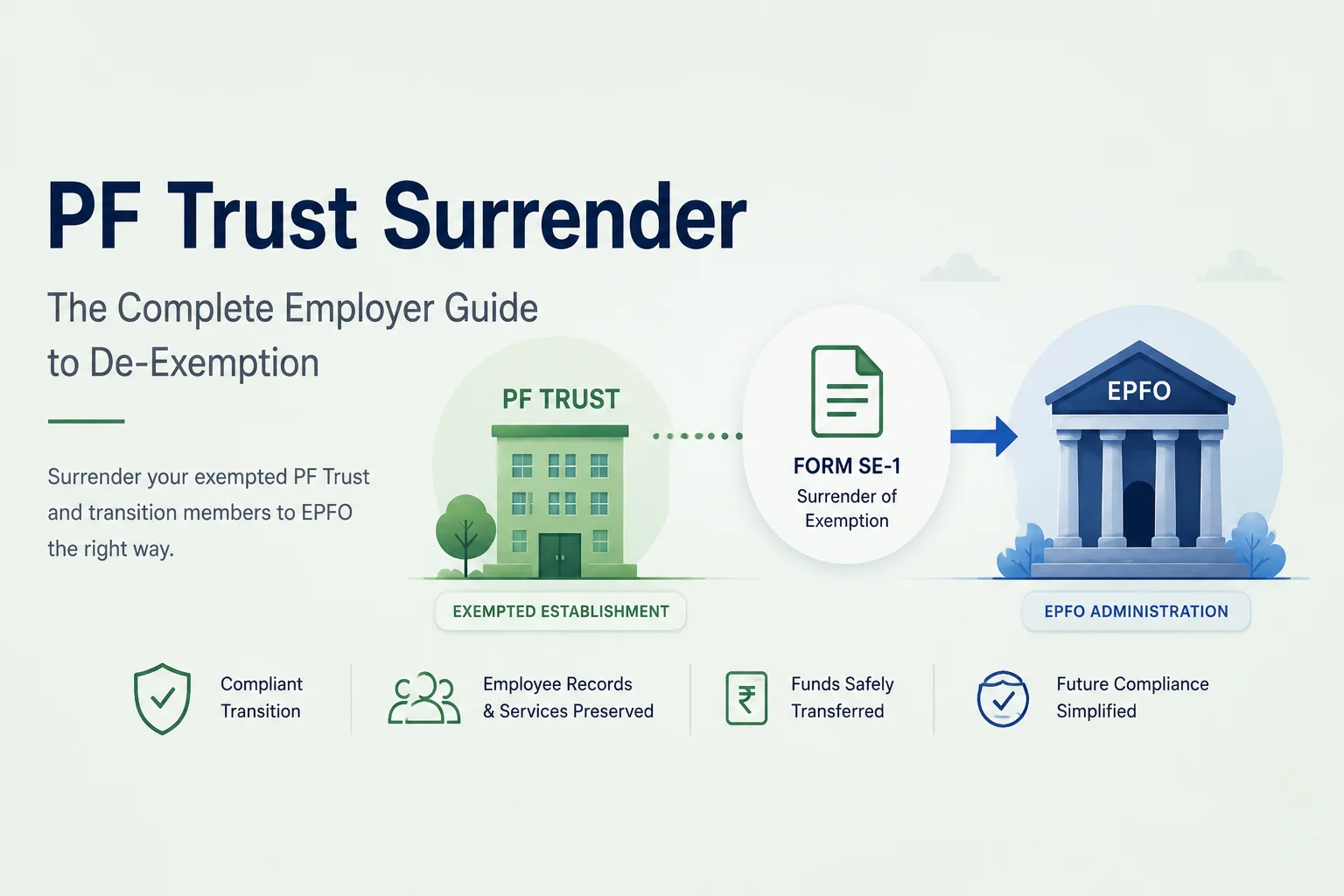
Yes. An employer operating an exempted Provident Fund Trust can apply to surrender its exemption and transition members to EPFO, under Section 17(5) of the EPF Act, 1952, read with Paragraph 28 of the EPF Scheme, 1952, and EPFO's Standard Operating Procedure for Surrender of Exemption.
Before EPFO approves the de-exemption, the organisation typically needs to:
- File an application in Form SE-1, addressed to the appropriate Government and copied to the Regional PF Commissioner (RPFC), at least 30 days before the intended surrender date
- Complete a third-party audit, done in consultation with the RPFC, to validate the funds being transferred
- Transfer accumulated funds — including any undistributed interest held in reserves — to EPFO
- Resolve pending transfers and claims where possible before the cut-off
- Ensure employees transition without losing provident fund or pension continuity
For most organisations, the project is as much about data quality and operational readiness as it is about the regulatory filing itself.
Planning to surrender your PF Trust or preparing for de-exemption? Schedule a consultation with Kustodian. Our experts can help you assess compliance readiness, review fund transfers, identify record gaps, and support a smoother transition to EPFO.
Should Your Company Surrender Its PF Trust?
This is usually the first decision — not the process itself.
Kustodian Trust Decision Matrix
| Situation | Continue Operating the Trust | Evaluate Surrender |
|---|---|---|
| Large workforce with dedicated Trust administration | ✓ | |
| Strong internal governance and compliance capability | ✓ | |
| Significant operational value from managing the Trust internally | ✓ | |
| High administrative and audit costs | ✓ | |
| Organisation undergoing merger or acquisition | ✓ | |
| Declining employee population | ✓ | |
| Difficulty maintaining trustee governance | ✓ | |
| Compliance effort outweighs operational benefit | ✓ | |
| Desire to centralise statutory administration with EPFO | ✓ |
This isn't a legal test — it's a strategic starting point. The right call balances operational efficiency, governance load, employee experience, and long-term compliance cost, not just how hard the Trust is to run today.
Why Employers Choose to Surrender
- Rising compliance load — Exempted Trusts carry ongoing governance, annual audits, investment oversight, and statutory reporting that scale with regulatory scrutiny, not headcount.
- Mergers and acquisitions — Post-acquisition, running two or more Trusts with different trustees, investment mandates, and audit cycles rarely stays practical; many acquirers consolidate onto EPFO instead.
- Cost outpacing benefit — Trust administration, legal, and audit costs are largely fixed. For a shrinking or mid-sized workforce, that fixed cost can exceed what the Trust delivers in flexibility.
- Governance risk — Trustees carry statutory responsibility for the Trust's compliance. Trustee turnover or thinning internal governance capacity makes that risk harder to carry.
- Focus — Some employers would rather point internal HR/Finance capacity at the business than at running a retirement fund, especially across multi-location operations.
What Happens to Employees?
| Area | What Typically Happens |
|---|---|
| UAN | Continues unchanged |
| EPF balance | Transferred to EPFO as part of the approved migration |
| EPS (pension) | Continues under EPFO, provided service records are accurate and complete |
| Future contributions | Deposited directly with EPFO after transition |
| Claims | Processed through EPFO once migration is complete |
| Service history | Stays intact only if records are reconciled and mapped correctly before migration |
A transition is only as clean as the member records behind it. Incomplete service history, incorrect Member IDs, or unresolved transfers surface as EPFO queries if they aren't caught beforehand — which is why most well-run surrenders start with a full record review, not with the application.
Assessing Readiness Before You Decide
Kustodian Trust Readiness Framework™
- Strategic need — Is there a genuine business driver, or just Trust fatigue?
- Governance readiness — Can trustees and management commit to seeing the transition through?
- Financial reconciliation — Are contribution, interest, and investment records accurate and complete?
- Member record readiness — Are UANs, Member IDs, KYC, and service history clean?
- Compliance readiness — Are audit observations and regulatory filings current?
- Migration planning — Is there a defined timeline, owner, and validation plan?
Each stage builds on the one before it — there's little value preparing the Form SE-1 filing while Member IDs are still unresolved, and financial reconciliation is far easier once member mapping is already clean.
How the Surrender Process Works
Kustodian Trust Transition Framework™
Strategic decision → Readiness assessment → Member & fund reconciliation → Compliance review → Form SE-1 filing → EPFO review → Fund & record migration → Employee transition → Post-migration validation
Skipping or rushing an earlier stage is what creates delay later — most of the real work happens before the application is even filed.
Stage 1 — Strategic Decision
Confirm surrender is the right long-term call: weigh the operational benefit of continuing the Trust against compliance cost and governance load, identify the actual business driver (merger, restructuring, centralisation), and get management sign-off.
Common mistake: treating this as a compliance exercise instead of a business decision, and only looping in Legal instead of also involving Finance and HR leadership upfront.
Stage 2 — Trust Readiness Assessment
Review member records, contribution history, investment records, pending claims and transfers, service history, any litigation, trustee governance, and open compliance observations.
Kustodian Insight: Trusts that catch record inconsistencies at this stage — before Form SE-1 goes in — consistently move through EPFO review faster than those that discover them mid-review.
Stage 3 — Member & Fund Reconciliation
Usually the most time-consuming stage. Every employee account should be validated before migration:
- Member records: UAN mapping · Member IDs · Date of Joining/Exit · service history · KYC consistency
- Fund records: employee/employer contributions · interest calculations · outstanding adjustments · investment balances
- Transfer records: pending transfers · Annexure K dependencies · prior Trust and EPFO transfers
A single inconsistency can hold up multiple employee accounts — reconciliation, not the application form, is the real bottleneck in most projects.
Stage 4 — Compliance & Fund Review
Confirm trust governance is current, audit observations are closed or documented, and Board and Trustee Resolutions are in hand. Also confirm — per EPFO's October 2024 circular on reserves and surplus — that no reserve interest has been distributed to members above EPFO's declared rate, since Paragraph 60 of the EPF Scheme treats that as impermissible and it will surface in the compliance audit.
Stage 5 — Filing Form SE-1
The employer or the Board of Trustees files Form SE-1, addressed to the appropriate Government with a copy to the RPFC, stating the Trust's intended surrender date. EPFO's SOP calls for this to be filed at least 30 days ahead of that date, by both email and registered post, to allow time for scrutiny.
Legal & Regulatory Basis
| Reference | What It Covers |
|---|---|
| Section 17(5), EPF Act, 1952 | Requires accumulations in the Provident, Pension, and Insurance funds — plus any forfeited employer contributions — to be transferred to EPFO within a specified time once exemption is cancelled or surrendered |
| Paragraph 28, EPF Scheme, 1952 | Governs the transfer process for funds and records back to EPFO |
| Paragraph 28(2), EPF Scheme, 1952 | Requires undistributed interest/surplus held in Trust reserves to be transferred to EPFO on surrender |
| Paragraph 60, EPF Scheme, 1952 | Prohibits crediting members interest above EPFO's declared rate — relevant where a Trust holds reserves it wants to distribute before surrendering |
| Form SE-1 | The prescribed application for surrender of exemption, filed with the RPFC |
| EPFO SOP for Surrender of Exemption (4 December 2023) | Standardises the surrender procedure and supersedes prior circulars on the subject |
This is a summary for planning purposes, not legal advice — confirm current requirements with your legal counsel or the RPFC before filing.
What Drives the Timeline
There's no fixed statutory timeline for a Trust surrender — EPFO's review period and the scope of pre-filing reconciliation both vary by case. What consistently moves it in either direction:
| Factor | Effect on Timeline |
|---|---|
| Clean, pre-reconciled member records | Shortens |
| Third-party audit completed before filing | Shortens |
| Complete documentation on first submission | Shortens |
| Pending transfers or open claims at filing | Extends |
| Multiple Member IDs per employee | Extends |
| Reserves or surplus requiring separate resolution | Extends |
| Trustee or governance changes mid-process | Extends |
The single biggest lever an employer controls is how much reconciliation happens before Form SE-1 is filed — not how quickly EPFO reviews it.
Who's Responsible for What
| Activity | Employer | Trust/Trustees | EPFO | Auditor/Advisor |
|---|---|---|---|---|
| Strategic decision | ✓ | ✓ | ||
| Member reconciliation | ✓ | ✓ | ✓ | |
| Financial reconciliation | ✓ | ✓ | ||
| Compliance review | ✓ | ✓ | ✓ | |
| Form SE-1 filing | ✓ | ✓ | ✓ | |
| De-exemption approval | ✓ | |||
| Record & fund migration | ✓ | ✓ | ✓ | |
| Employee communication | ✓ |
Exact allocation depends on your Trust's governance structure — smaller Trusts often combine the Employer and Trustee roles into the same internal team.
Documents You'll Need
- Corporate — Board Resolution, Trustee Resolution, Trust Deed and amendments, authorisations. These establish that surrender was properly approved and who's authorised to file.
- Financial — audited financial statements, investment statements, member-wise balances, contribution summaries, interest calculations. This is what the third-party audit validates before funds transfer.
- Employee records — member register, UAN and Member ID mapping, contribution history, pending claims and transfers. This is the data set EPFO checks hardest, and where most queries originate.
- Regulatory — Form SE-1 application, supporting declarations, compliance records, and anything else EPFO requests during review.
The exact list varies by Trust and by what EPFO asks for during review — see the PF Trust Compliance Guide for a category-by-category breakdown of what each document needs to show.
What Usually Delays a Trust Surrender
| Challenge | Typical Impact | Fix |
|---|---|---|
| Member balances don't reconcile | Migration delayed | Reconcile before filing |
| Pending PF transfers | Records stay incomplete | Resolve outstanding transfers first |
| Incorrect Member IDs | Migration errors | Validate mapping before filing |
| Missing service history | Pension continuity risk | Review employment records |
| Open withdrawal claims | Processing complications | Assess and resolve pre-migration |
| Audit observations | Extra compliance work | Address findings early |
| Reserves/surplus not yet transferred | Compliance audit flag (Para 60) | Resolve before or at filing |
| Employee data inconsistencies | EPFO queries | Validate before submission |
These are resolved far more cheaply before Form SE-1 is filed than after EPFO starts asking questions about them.
Common Surrender Scenarios
Merger or acquisition. Post-merger, businesses often inherit multiple Trusts with different trustees, investment portfolios, and administrative processes. Watch for: duplicate member records across the merged entities, overlapping trustees, existing transfer requests between the Trusts, and standardising records before a combined migration.
Business restructuring. A Trust built for a much larger workforce can become disproportionate after a business-unit separation, headcount reduction, or shared-services centralisation. Surrender here is usually evaluated alongside the broader restructuring plan, not as a standalone compliance decision.
High compliance burden. Annual audits, trustee meetings, investment governance, and regulatory reporting carry a fixed cost regardless of Trust size. Where internal capability to carry that load has shrunk, EPFO administration reduces the ongoing governance burden.
Governance risk. Trustees carry continuing statutory responsibility. Leadership changes, retirements, or thinning internal controls can make it genuinely difficult to sustain effective governance — worth assessing trustee succession and audit history honestly before deciding either way.
Business closure. Winding-down operations still need to preserve complete PF records for departing employees. Pending claims, prior transfers, and historical employment records need the same rigor as an active-business surrender — arguably more, since there's no second chance to fix gaps later.
Executive Readiness Checklist
Before starting the formal process, leadership should be confident the organisation is prepared — not just willing — to surrender the Trust.
- Strategic: business rationale documented · executive approval obtained · trustees aligned
- Operational: member records reconciled · pending transfers reviewed · outstanding claims assessed · UAN/Member ID mapping validated · service history reviewed
- Financial: balances reconciled · interest calculations validated · investments accounted for · liabilities identified
- Compliance: audit observations reviewed · Paragraph 60 reserve position resolved · documentation prepared · employee communication plan approved
- Migration: milestones defined · internal ownership assigned · risk register prepared · post-migration validation planned
Not sure if your organisation is ready to surrender its PF Trust? Schedule a consultation with Kustodian. Our experts can assess your records, compliance readiness, fund reconciliation, and migration plan before you begin the de-exemption process.
Frequently Asked Questions
What does "surrendering a PF Trust" mean? It means voluntarily giving up the exemption that lets your establishment run its own Provident Fund Trust instead of participating in EPFO's scheme, and transitioning employee PF accounts and fund records back to EPFO administration.
Can any employer surrender an exempted PF Trust? An exempted Trust can't simply be closed at the employer's discretion — surrender requires a formal application (Form SE-1) and EPFO's approval; it isn't automatic.
What is Form SE-1? The prescribed application EPFO requires for surrender of exemption, addressed to the appropriate Government and filed with the RPFC, stating the Trust's intended surrender date.
Who can file Form SE-1 — the employer or the trustees? Either. EPFO's SOP allows the Board of Trustees to file the surrender proposal, not only the employer — though most organisations coordinate the filing jointly in practice.
How much advance notice does EPFO need? At least 30 days before the intended surrender date, filed by both email and registered post, to allow time for scrutiny.
What happens to employees' UANs? They continue unchanged — surrender affects who administers the fund, not the member identifier.
Does pension (EPS) continue? Yes, EPS remains administered by EPFO after surrender — but continuity depends on service history and contribution records being complete and accurately mapped before migration.
What happens to dormant or unclaimed accounts? They need to be identified and reconciled in the member register before filing — unresolved dormant accounts are a common source of EPFO queries during review.
Do employees need to consent to the surrender? Individual employee consent isn't part of the Form SE-1 filing — the decision sits with the employer and trustees. Clear employee communication is still expected as part of the transition, and specific procedural requirements can vary, so confirm with your legal counsel.
What happens to reserves and surplus interest held by the Trust? Any undistributed interest or surplus held in Trust reserves must be transferred to EPFO on surrender, per Paragraph 28(2) of the EPF Scheme.
Can the Trust distribute extra interest to members before surrendering? No. EPFO's 2024 circular clarified that crediting members interest above EPFO's declared rate from Trust reserves isn't permitted under Paragraph 60, and compliance audits specifically check for this.
Is a third-party audit mandatory? Yes — the SOP requires one, done in consultation with the RPFC, to validate the funds being transferred on the surrender date.
Who appoints the pre-surrender auditor? The employer or Trust, typically in consultation with the RPFC, since the audit's findings feed directly into what EPFO reviews.
What happens to pending PF transfers? They should be resolved before filing where possible — unresolved transfers, including Annexure K dependencies, are one of the most common causes of delay during EPFO review.
What about open withdrawal claims? They should be assessed and, where feasible, processed before migration — open claims complicate which body, Trust or EPFO, is responsible for settling them.
Can a Trust surrender mid-financial-year? There's no rule tying surrender to the financial year, but most organisations time it to simplify the final audit and reconciliation — check with your auditor on the date that minimises complexity for your specific Trust.
What happens to service history after migration? It transfers intact if member records were correctly reconciled and mapped beforehand — gaps in service history are among the harder issues to fix retroactively, which is why the readiness assessment stage exists.
Can EPFO reject a surrender application? Applications face queries or delays when member records, fund reconciliation, or documentation aren't complete — this is why readiness assessment and reconciliation happen before filing, not after.
What if EPFO raises queries after filing? Most trace back to specific record gaps — Member ID mismatches, unresolved transfers, or incomplete service history. Having reconciliation documentation ready in advance shortens the response cycle significantly.
How long does the whole process take? There's no fixed statutory timeline; it depends heavily on how much reconciliation is done before filing — see the timeline drivers table above.
What's the single biggest cause of delay? Discovering member record or reconciliation issues after the application is filed, rather than during the readiness assessment.
Does surrender cover EPS and EDLI too, or just EPF? Section 17(5) specifically covers accumulations in the Provident, Pension, and Insurance funds together, so all three typically move as part of the same transition.
What if the Trust has ongoing litigation? Litigation status is part of what a readiness assessment should review — unresolved disputes can complicate both the compliance review and how quickly EPFO processes the application.
Can a company with multiple Trusts (post-merger) surrender them together? It's possible to run coordinated surrender processes for multiple Trusts, though each Trust still has its own member records, audit, and Form SE-1 filing to complete.
Is surrender required during a business closure? If the establishment is winding down and the Trust can't continue, yes — surrender (or an equivalent closure process) is needed so member accounts are properly transferred rather than left unresolved.
Is "surrender" the same as "de-recognition" or "cancellation of exemption"? They describe the same underlying event — an exempted Trust giving up its exempted status — though terminology varies across EPFO circulars and commentary. This guide uses "surrender" and "de-exemption" interchangeably.
What internal approvals are needed before filing? At minimum: a Board Resolution and a Trustee Resolution authorising the surrender, plus management sign-off on the underlying business rationale.
Who bears the cost of the audit and reconciliation? The employer/Trust — it's an internal compliance cost of the transition, not something EPFO charges for.
Can trustees be held liable for issues discovered after surrender? Trustees carry statutory responsibility for the Trust up to and through the process, which is exactly why governance readiness and a clean compliance review matter before filing — resolving issues pre-surrender is materially better than having them surface afterward.
What should HR communicate to employees during the transition? At minimum: that the UAN doesn't change, what happens to their balance and pension, when future contributions move to EPFO, and who to contact with questions — ideally communicated ahead of the migration, not after.
Still have questions about surrendering your PF Trust? Every organisation's structure, records, and compliance requirements are different. Schedule a consultation with Kustodian to discuss your specific situation with our PF Trust experts and plan a smooth transition to EPFO.
Why Trust Surrender Projects Struggle
The hardest projects aren't the ones with the most employees — they're the ones where preparation started too late. The recurring pattern: member records were never fully reconciled, historical transfers stayed unresolved, multiple Member IDs accumulated over time, service history has gaps, and governance responsibilities were never clearly assigned. By the time these surface during EPFO review, they're far more expensive to fix than they would have been at the readiness-assessment stage.
Ready to Start?
A successful Trust surrender depends on more than the Form SE-1 filing — it depends on employee records, fund reconciliation, and governance being genuinely ready before you apply.
Kustodian Trust Readiness Assessment reviews governance, member record quality, UAN/Member ID mapping, fund reconciliation, pending transfers and claims, compliance position, and migration risk — before EPFO review surfaces them for you.
PF Interest Loss Calculator
See how much interest you lose every month your claim sits unresolved.