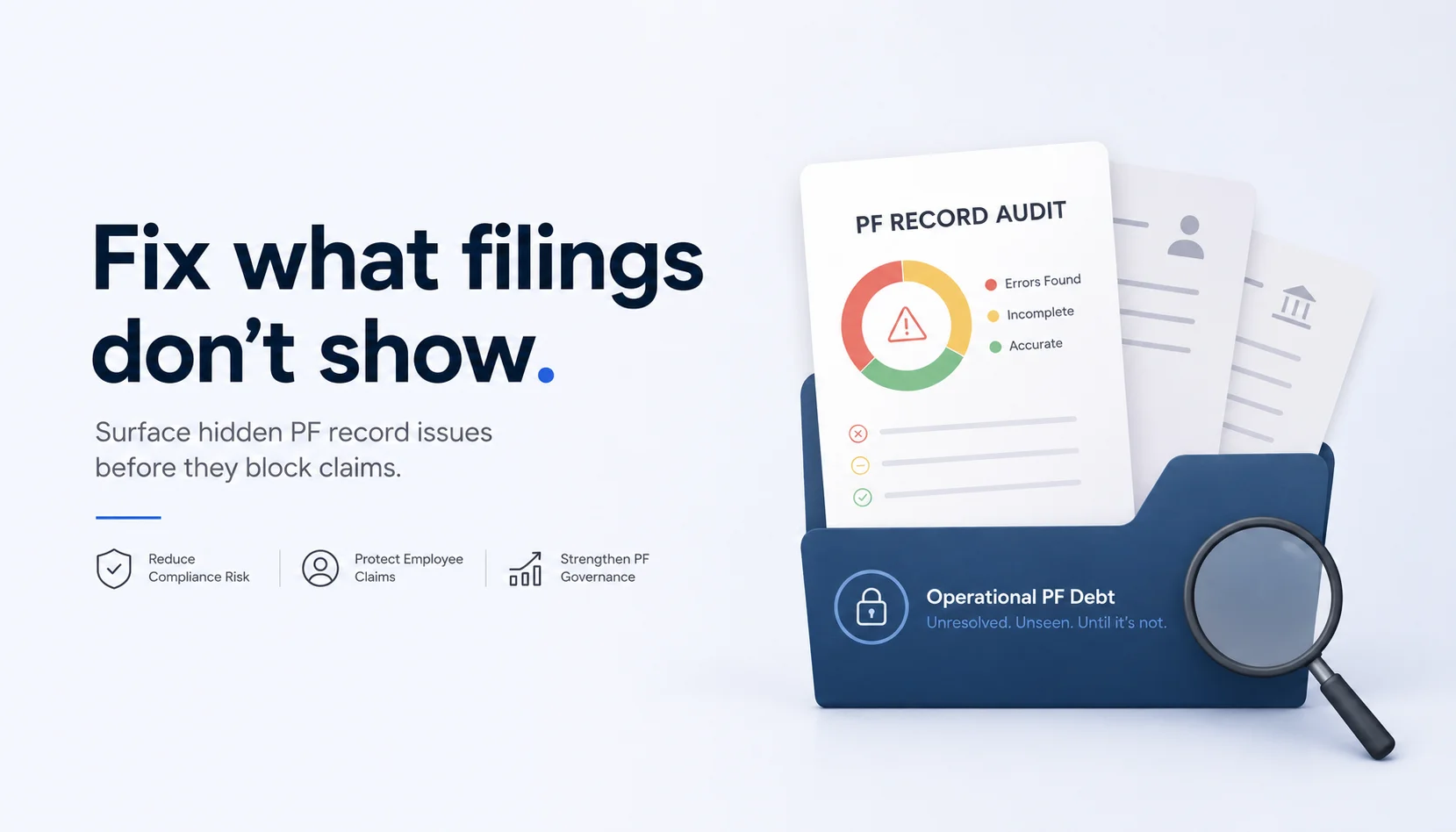
Monthly EPFO filings being current doesn't mean your PF records are correct. Filing and accuracy are measured differently — and the gap between them, left unattended, is what this guide calls Operational PF Debt.
Operational PF Debt is the accumulated set of unresolved employee-record errors, incomplete corrections, and reconciliation gaps that a business carries forward silently, regardless of whether its monthly compliance has stayed current.
It doesn't show up on a compliance calendar. It shows up when an employee tries to withdraw PF, apply for pension, or exit — and the record underneath the filing turns out to be wrong.
Switching consultants doesn't clear this debt. It only changes who's now responsible for finding and repaying it.
Book a Historical PF Audit → — surface hidden record risk before you start fixing individual cases.
Is It Actually the Previous Consultant's Fault?
Usually, no single party. Most historical issues trace back further than the last consultant change.
| Issue Found | Most Common Root Cause |
|---|---|
| Incorrect employee details | HR onboarding, employee-submitted data |
| Duplicate UAN | Form 11 declaration gaps at onboarding |
| Payroll–ECR mismatch | Payroll configuration, not filing |
| Missing Date of Exit | Exit-process oversight, not the consultant |
| Unresolved correction backlog | Consultant follow-through, or employer non-response |
| Portal/DSC access gaps | Governance handover, not any single filing |
The useful question isn't who caused it. It's who has to act now — and that's almost always the current employer, regardless of which consultant is engaged next.
The Kustodian Historical PF Recovery Framework
Correcting issues before scoping them is the single most common mistake employers make — it produces repeat work and leaves the largest risks untouched. Use this six-stage sequence instead.
DISCOVER → VERIFY → SCOPE → PRIORITISE → RECOVER → GOVERN
| Stage | What It Answers | Skip This and… |
|---|---|---|
| 1. Discover | What event exposed this? (exit, claim rejection, migration, notice, audit) | You investigate randomly instead of where the evidence points |
| 2. Verify | Does the issue actually exist, or is it an assumption? | You correct records that were never wrong |
| 3. Scope | One employee, or a cohort? One establishment, or several? | You fix a symptom and miss a systemic pattern |
| 4. Prioritise | Which issues carry compliance, financial, or claim-blocking risk? | You spend effort on low-risk admin fixes first |
| 5. Recover | Employer-led, employee documentation, or EPFO intervention? | You apply one generic process to issues that need different paths |
| 6. Govern | What prevents this debt from re-accumulating? | You repeat the same cycle in 18 months |
What Triggered Your Search? Map It to the Likely Cause
| What You're Seeing | Likely Area | Where to Go Next |
|---|---|---|
| Employee can't withdraw PF | Exit records, KYC | DOE Correction |
| Pension amount looks wrong | EPS service history, eligibility | EPS Errors Guide |
| Duplicate UAN surfaced | Form 11, onboarding | Duplicate UAN Guide |
| Payroll ≠ EPFO records | ECR, reconciliation | ECR Filing Mistakes |
| EPFO notice received | Filing history, Section 7A exposure | Section 7A Notice Guide |
| New consultant flags inconsistencies | Historical governance | DSC & Portal Handover Checklist |
[CITE: Reference the EPFO circular/paragraph governing member profile correction via Joint Declaration, e.g. para 26(6) or the relevant Head Office circular number, with date and link.]
Priority Matrix: What to Fix First
| Issue | Employee Impact | Compliance Risk | Priority |
|---|---|---|---|
| Pending EPFO notice | Medium | Very High | Immediate |
| Contribution mismatch | High | High | Immediate |
| Missing/incorrect Date of Exit | High | Medium | High |
| Duplicate UAN | High | Low | High |
| EPS service/eligibility gaps | High | Medium | High |
| Missing documentation / portal ownership | Low | High | High |
| Incorrect Date of Joining | Medium | Medium | Medium |
| Nomination/KYC gaps | Medium | Low | Planned |
[CITE: Statutory basis for Section 7A proceedings — cite the Section 7A provision of the EPF & MP Act, 1952, to substantiate "Very High compliance risk" for pending notices.]
Recovery Readiness Assessment
Score your organisation before starting any correction work.
| Question | Risk if "Yes" |
|---|---|
| Multiple employees have reported PF issues | High |
| Duplicate UANs discovered | High |
| Historical corrections remain unresolved | High |
| EPFO notices are pending | Critical |
| Portal access isn't employer-controlled | Critical |
| Payroll has never been reconciled with EPFO records | High |
| No PF audit in the last two years | Medium–High |
| Documentation depends on one consultant/person | High |
| No single repository for historical records (ECRs, correspondence, prior correction requests) | Medium |
Score interpretation:
| High/Critical Findings | Operational Health |
|---|---|
| 0–1 | Low Risk |
| 2–3 | Moderate Risk |
| 4–5 | High Risk |
| 6+ | Immediate audit recommended |
Not sure where you stand? Book a Free PF Audit →
Building the Governance Layer That Prevents Recurrence
Recovery without governance just resets the clock on the next debt cycle.
| Control | Purpose |
|---|---|
| Quarterly PF health review | Catch new issues before they compound |
| Payroll-to-EPFO reconciliation | Prevent contribution mismatches at the source |
| Employer-controlled portal/DSC access | Remove single-consultant dependency |
| Documented SOPs | Preserve continuity through personnel changes |
| Annual historical record audit | Surface dormant issues before they block a claim |
FAQ
Can mistakes made years ago still be corrected? Many can — feasibility depends on the issue, available documentation, and the applicable EPFO process.
Does changing my PF consultant fix historical records automatically? No. A transition changes who manages operations going forward; existing records stay unchanged until reviewed and corrected through the relevant process.
Should I audit every employee record? Not necessarily — start by identifying patterns (a joining cohort, one location, one payroll migration) rather than reviewing individually. Scope first, per Stage 3 above.
How often should employers audit historical PF records? No universal cadence, but reviews after payroll migrations, consultant changes, mergers, or recurring employee complaints catch issues before they compound into Operational PF Debt.
What's the most common employer mistake? Starting corrections before scoping the full pattern — fixing what's visible while leaving the underlying debt untouched.
Facing EPF issues? Talk to the experts at Kustodian.
Get a free consultation and personalized guidance for your EPF concerns.
The Full Picture Comes Before the Fix
A rejected claim or an EPFO notice is rarely the whole problem — usually it's the first visible sign of Operational PF Debt that's been accumulating quietly.
Kustodian's Historical PF Audit identifies hidden record issues across your workforce, prioritises them by employee and compliance risk, and builds a recovery roadmap mapped to the right EPFO process for each one.
PF Interest Loss Calculator
See how much interest you lose every month your claim sits unresolved.