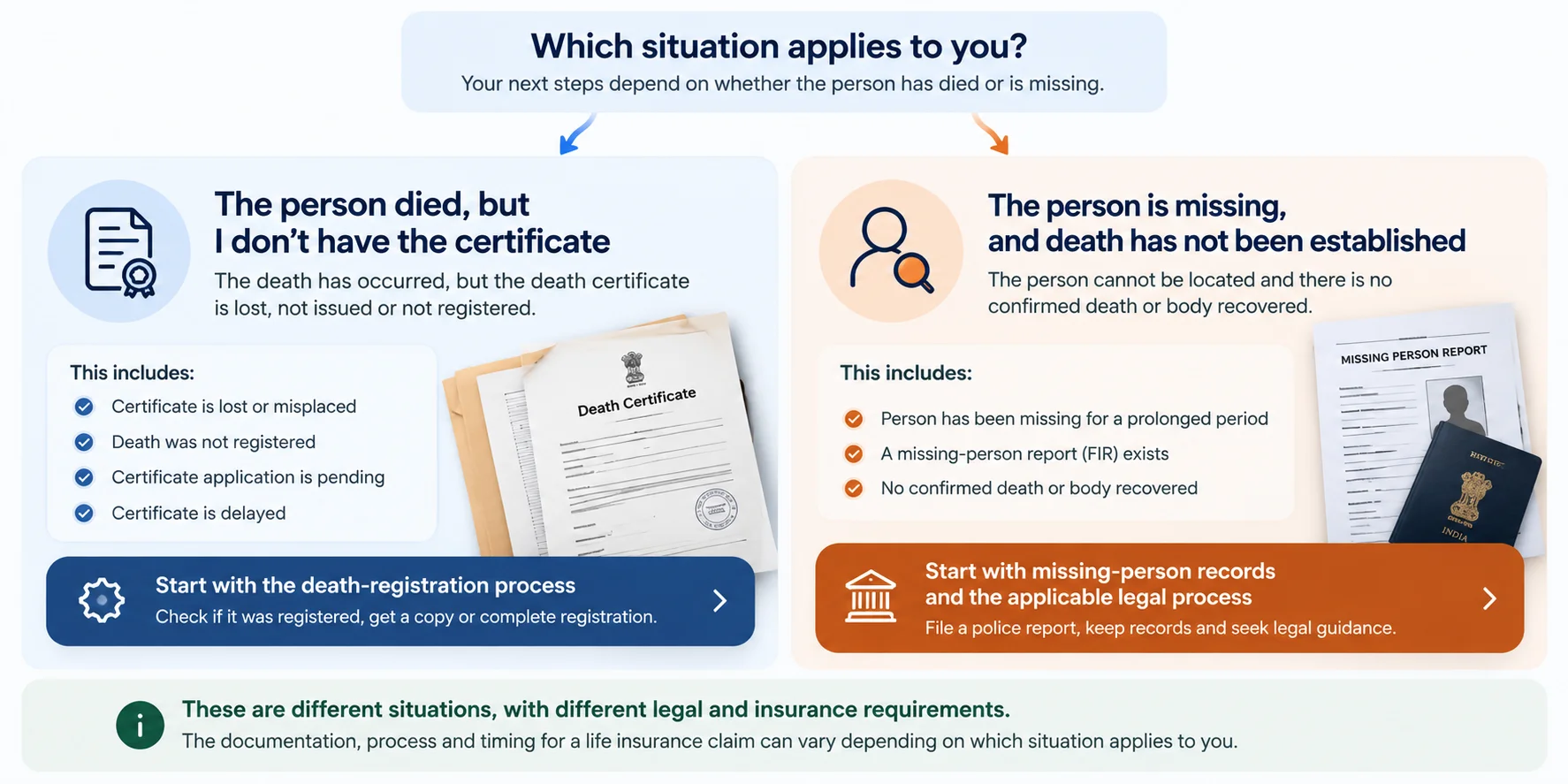
Insurers in India almost always need an official death certificate or a certified extract from the death register to settle a life insurance claim. If you don't have one, the fix depends on your situation:
- The certificate is lost: ask the Registrar for a copy.
- The death was never registered: apply for delayed registration. More than a year late needs a magistrate's order; more than two years late, a judicial magistrate's.
- The policyholder is missing: keep paying the premiums. Death is presumed only after seven years, and a lapsed policy may pay only its paid-up value.
In every case, tell the insurer in writing now, so the claim is on record while the certificate is sorted out.

If the death certificate is lost
If the death was registered, the record still exists. Apply to the Registrar of Births and Deaths for the area where the death occurred, giving the deceased's full name, date and place of death, and any registration number. Many states issue copies online through their own portals or India's Civil Registration System.
Ask for a certified extract from the death register. That is the document LIC lists among its standard death-claim requirements, and other insurers accept it too.
If the death was never registered
Death registration is compulsory under the Registration of Births and Deaths Act, 1969. If it wasn't done on time, you can still register it, but the later you apply, the higher the authority that must approve it. Under Section 13 of the Act, as amended in 2023 and 2026:
| When the death is reported | What's needed to register it |
|---|---|
| Within 21 days (most states) | Normal registration; hospitals usually report deaths that occur there |
| 21–30 days | Typically a small late fee |
| 30 days to 1 year | Written permission of the District Registrar, a fee and a self-attested document |
| 1–2 years | An order from the District Magistrate, Sub-Divisional Magistrate or an Executive Magistrate authorised by the DM |
| More than 2 years | An order from a Judicial Magistrate of the First Class (added by the Registration of Births and Deaths (Amendment) Act, 2026, in force from 1 October 2026) |
If the Registrar refuses, you can appeal under Section 25A of the Act within 30 days. The appeal must be decided within 90 days.
Documents for delayed registration
| Document | Who issues it | Why it matters |
|---|---|---|
| Medical Certificate of Cause of Death (MCCD) | Hospital or treating doctor | Records the cause of death; needed for registration and often asked for by insurers |
| Non-availability certificate | Registrar | Confirms no death record exists; many states require it before delayed registration |
| Cremation or burial record | Crematorium, burial ground or local body | Shows the death was recognised at the time |
| Hospital discharge or death summary | Hospital | Supports the date, place and cause of death |
| Police FIR, panchnama or post-mortem report | Police or hospital | Required for accidental or unnatural deaths |
| Identity proof of the deceased and applicant | — | Links the record to the right person |
| Magistrate's order | DM, SDM or Executive Magistrate (1–2 years late); Judicial Magistrate First Class (more than 2 years late) | Required if registration is more than 1 year late |
A hospital summary, cremation receipt or affidavit supports registration but does not replace the death certificate for the insurer.
Tell the insurer now, without waiting
Don't wait for the certificate before contacting the insurer. Send a written death intimation with the policy number, the date and place of death, and whatever proof you have, and say the certificate will follow. Ask the insurer to confirm in writing:
- that the claim is registered while the certificate is pending
- the full list of documents it needs for this claim
- whether it will accept any document in the meantime
Keep the acknowledgement. It puts the claim on record and protects against any later objection that the death was intimated late. For LIC policies, see the LIC death claim guide.
If the policyholder is missing
A missing person is different from a missing certificate: until death is established, there is no certificate to obtain.
Under Section 111 of the Bharatiya Sakshya Adhiniyam, 2023 (formerly Section 108 of the Indian Evidence Act), a person who has not been heard of for seven years by those who would naturally have heard from them is presumed dead.
But the presumption does not fix a date of death. In LIC v. Anuradha (2004), the Supreme Court held that the presumption only establishes that the person is dead, not when they died, and the claimant must prove any earlier date. Because the family had stopped paying premiums and the policy lapsed, LIC was entitled to refuse the full claim; the widow received only the policy's paid-up value.
The lesson: keep paying premiums until the claim is made.
| When | What to do |
|---|---|
| Immediately | File a missing-person report (FIR) with the police and keep a copy |
| Immediately | Tell the insurer in writing that the policyholder is missing and ask what it will need |
| Every premium due date | Keep paying premiums so the policy stays in force |
| Throughout the seven years | Keep a record of searches, police correspondence and attempts to contact the person |
| After seven years | File the claim with the FIR, the police non-traceable report and evidence of the search; obtain a civil court declaration of death if the insurer requires one |
If there is strong evidence of death before seven years (a disaster, an accident at sea, a body that couldn't be recovered), take legal advice: a court can sometimes be asked to declare death earlier on the evidence.
If the insurer still won't proceed
First check whether the insurer is asking for a document or has formally rejected the claim.
- Asking for a document: get the exact requirement in writing and work through the steps above.
- Formal rejection: get the written reasons and follow our guide to challenging a rejected life insurance claim.
- No response or an unresolved dispute: escalate using our guide to complaining against an insurance company.
If the question is who should receive the money rather than whether death is proven, see life insurance nominee vs legal heir.
Frequently asked questions
Can I claim life insurance without a death certificate?
You can intimate the claim, but insurers almost always need the death certificate or a certified extract from the death register before they settle it. If the death wasn't registered, apply for delayed registration.
How do I get a death certificate after one year?
Apply to the Registrar for delayed registration. Between one and two years after the death, registration needs an order from the District Magistrate, Sub-Divisional Magistrate or an authorised Executive Magistrate. Since 1 October 2026, registration more than two years late needs an order from a Judicial Magistrate of the First Class instead.
Can a hospital death summary replace a death certificate?
No. It supports registration, but insurers want the certificate issued by the Registrar.
What is a non-availability certificate?
A certificate from the Registrar confirming that no record of the death exists. Many states ask for it before allowing delayed registration.
Should I keep paying premiums if the policyholder is missing?
Yes. In LIC v. Anuradha, the Supreme Court held that a policy that lapsed during the seven-year wait paid only its paid-up value, not the sum assured.
Can a family claim insurance if the policyholder has been missing for seven years?
Yes, if the policy is still in force. Death is presumed after seven years without news, supported by a police missing-person report and evidence of search.
Need help with a missing death certificate?
Kustodian prepares the delayed-registration application, follows it up with the Registrar and keeps the insurer informed so the claim doesn't stall. We can't issue certificates or declare death; if your case needs a magistrate's order or a court declaration, we'll tell you upfront and what it involves.
Get help with your insurance claim →
A death certificate is needed for every asset, not only insurance. See managing finances after a death in India.
General information on Indian death registration and insurance claims, not legal advice on any individual case.