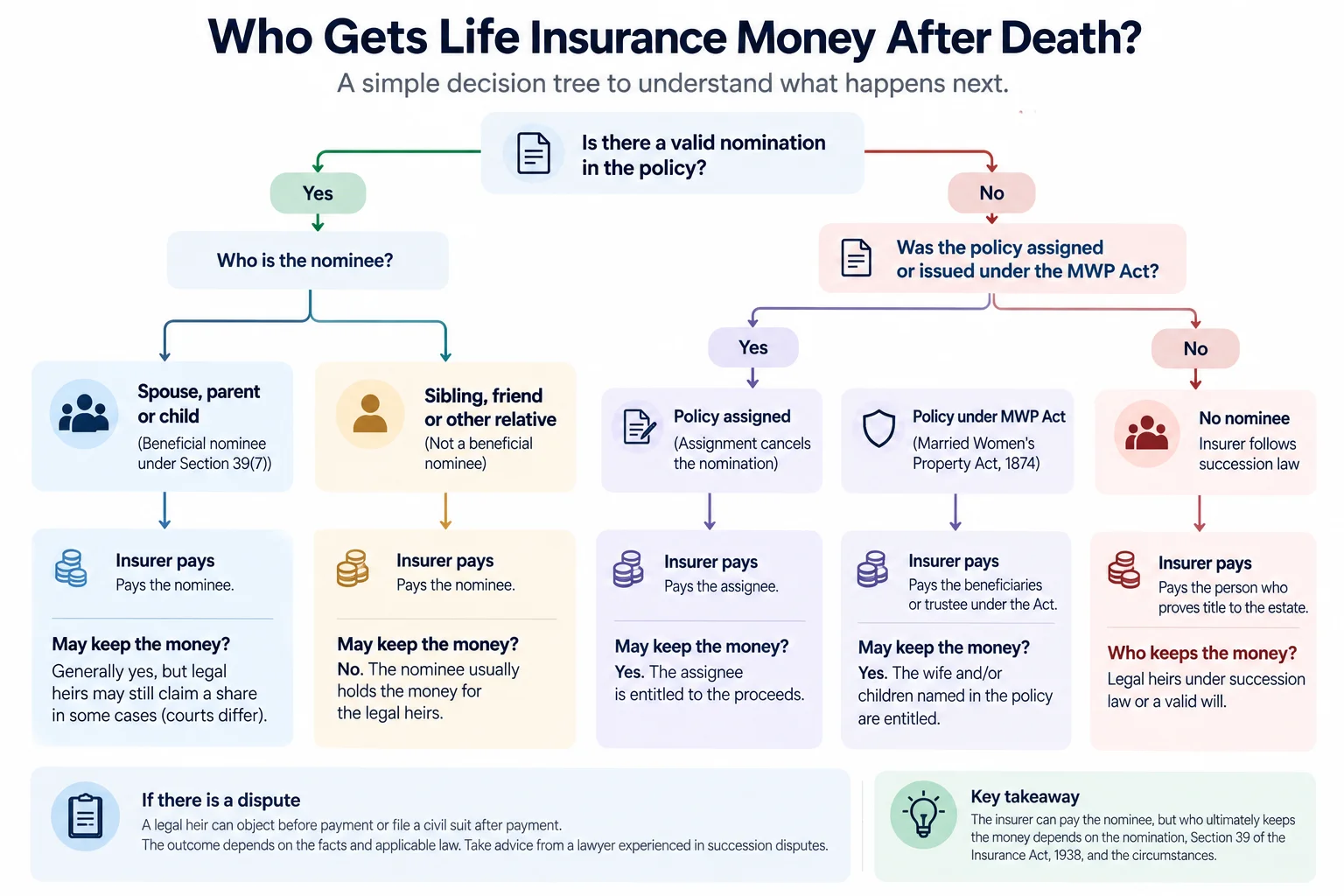
When a policyholder dies, the insurer pays the nominee. Whether the nominee can keep the money depends on who they are. Under Section 39(7) of the Insurance Act, 1938, a nominee who is the policyholder's spouse, parent or child is a beneficial nominee and can own the proceeds. Any other nominee, such as a sibling or friend, collects the money for the legal heirs. Even for beneficial nominees, High Courts disagree on whether legal heirs can still claim a share, and the Supreme Court has not yet ruled on the point.

Nominee vs legal heir: the difference
| Nominee | Legal heir | |
|---|---|---|
| Decided by | The policyholder, in the policy | Succession law or a valid will |
| Insurer pays them? | Yes, directly | Only if there is no valid nominee, assignment or MWP Act trust |
| Keeps the money? | Spouse, parent or child: yes, subject to the court split below. Anyone else: no | Yes, unless a beneficial nominee or assignee takes priority |
| Can be the same person? | Yes | Yes |
Who gets the money in each situation?
| Situation | Insurer pays | Who ultimately keeps it |
|---|---|---|
| Spouse, parent or child is the nominee | Nominee | Nominee as beneficial owner, but contested if other heirs object (see below) |
| Sibling, friend or other relative is the nominee | Nominee | Legal heirs; the nominee only collects on their behalf |
| No nominee | Person who proves title to the estate | Legal heirs under succession law or the will |
| Nominee died before the policyholder | Policyholder's heirs or legal representatives | Legal heirs |
| Beneficial nominee died after the policyholder, before payment | Nominee's heirs or legal representatives | Nominee's heirs |
| Policy absolutely assigned | Assignee | Assignee; assignment cancels the nomination |
| Policy issued under the Married Women's Property (MWP) Act | Beneficiaries or trustee named under the Act | Wife and/or children named in the policy |
Multiple nominees: The policyholder can split the proceeds by percentage. Each nominee's share is treated separately, so a policy can have a beneficiary nominee (a spouse) alongside a collecting nominee (a brother).
Minor nominee: The appointee named in the policy receives the money on the child's behalf until they turn 18.
Does a spouse, parent or child nominee keep the money? Courts disagree
Before 2015, the law was settled: in Sarbati Devi v. Usha Devi (1984), the Supreme Court held that a nominee is only an agent to receive the money, which then forms part of the estate. In 2015, Parliament amended Section 39 to create beneficial nominees. Courts have read the amendment differently since then.
| Position | Court | What it held |
|---|---|---|
| Beneficial nominee keeps the money | Bombay High Court; Andhra Pradesh High Court (Mallela Manimala v. Mallela Lakshmi Padmavathi, 2023); Madras High Court (A. Devika, 2025) | Amended Section 39(7) gives a spouse, parent or child nominee ownership, excluding other heirs |
| Legal heirs can still claim | Karnataka High Court (Neelavva v. Chandravva, 2025); Allahabad High Court (Kusum v. Anand Kumar, 2025); Kerala High Court, Division Bench (Prasanna Narendran, 2025) | Section 39 does not override succession law; the nominee keeps the money only if no heir claims it |
| Nomination does not confer ownership (other assets) | Supreme Court, Shakti Yezdani v. Jayanand Salgaonkar (2023) | Decided for shares under company and depository law, not insurance; heirs' courts rely on it, nominees' courts distinguish it |
| Final answer | Supreme Court | Not yet decided for amended Section 39 (as of November 2026) |
In practice: The insurer pays the nominee in every case. The split only matters if another legal heir challenges the nominee, and then the outcome can depend on which High Court has jurisdiction.
Can legal heirs challenge a life insurance nominee?
What heirs can do depends on when they act.
| Stage | What legal heirs can do | What to expect |
|---|---|---|
| Claim not yet paid | Send the insurer a written objection with proof of heirship | The insurer may hold payment or ask for a court order |
| Claim already paid to the nominee | File a civil suit against the nominee | The insurer is generally discharged once it pays a valid nominee in good faith |
| No nominee | Obtain a succession certificate, probate or letters of administration | The insurer pays whoever holds title |
Where heirs have the strongest case: the nominee is not a spouse, parent or child, or the policyholder could not legally have given away the proceeds.
Where nominees have the strongest case: a spouse, parent or child is the nominee, the policy is self-acquired, and the dispute is heard by a court that follows the Bombay, Andhra Pradesh or Madras High Court view.
For anything beyond a written objection, take advice from a lawyer who handles succession disputes.
How nomination works across other assets
Insurance is the exception, not the rule. For most assets, a nominee only receives the money and holds it for the legal heirs.
| Asset | Can the nominee keep it? | Guide |
|---|---|---|
| Life insurance | Spouse, parent or child: yes, subject to the court split. Others: no | This page |
| LIC policy claim | Same as life insurance | LIC death claim process |
| EPF and EDLI | Governed by EPF rules, not Section 39 | EDLI nominee vs legal heir · EPF death claim |
| Shares and demat | No; held for legal heirs (Shakti Yezdani) | Nominee vs successor |
| No nomination on EPF | Legal heirs claim | EPF death claim |
How to make sure the right person keeps the money
Because courts disagree, the nomination alone does not guarantee the outcome a policyholder intends.
- Nominate a spouse, parent or child if you want that person to own the money.
- Write a will that says the same thing, so a beneficial nominee and the will point the same way. Make a will with Kustodian.
- Consider an MWP Act policy for new term cover meant only for a wife and children. It keeps the money out of the estate and away from creditors.
- Update the nomination after marriage, divorce, a birth or a nominee's death.
Frequently asked questions
Can a nominee keep life insurance money?
A spouse, parent or child nominee can, as a beneficial nominee under Section 39(7), though some High Courts allow other legal heirs to claim. Any other nominee holds the money for the legal heirs.
Can a brother or sister be a life insurance nominee?
Yes. A sibling can receive the money, but because siblings are not in the Section 39(7) list, they hold it for the policyholder's legal heirs.
Who gets the money if the nominee dies before the policyholder?
The nomination fails and the proceeds go to the policyholder's heirs or legal representatives, unless another nominee is alive.
Can a wife claim if the mother is the nominee?
The mother is a beneficial nominee. Whether the wife can claim a share depends on the court: the Karnataka, Allahabad and Kerala High Courts have let heirs claim, while the Bombay, Andhra Pradesh and Madras High Courts have favoured the nominee.
Is a succession certificate needed if there is no nominee?
Usually some proof of title is needed. LIC, for example, asks for evidence of title to the estate when a policy has no nominee, assignment or MWP Act trust.
What happens if the insurer has already paid the nominee?
The dispute moves to the family. Legal heirs must pursue the nominee in civil court, not the insurer.
Need help with a nomination problem?
If a claim is stuck because the nominee has died, there is no nominee, or heirs disagree, Kustodian can work out what the insurer needs and handle the paperwork. Contested ownership disputes need a lawyer, and we'll tell you if yours is one.
Discuss your insurance claim with Kustodian →
Planning instead? Write a will so your nomination and your wishes match →
General information on Indian life insurance law, not legal advice on any individual claim.