Last updated: July 2026 · Reviewed by the Kustodian property documentation team
Kustodian has reviewed property document sets for clients navigating BBMP/GBA processes as part of our financial recovery and asset-verification work. This guide reflects the current e-Aasthi process, GBA transition status, and the document-mismatch patterns we see most often.
Apply for e-Khata in 30 Seconds
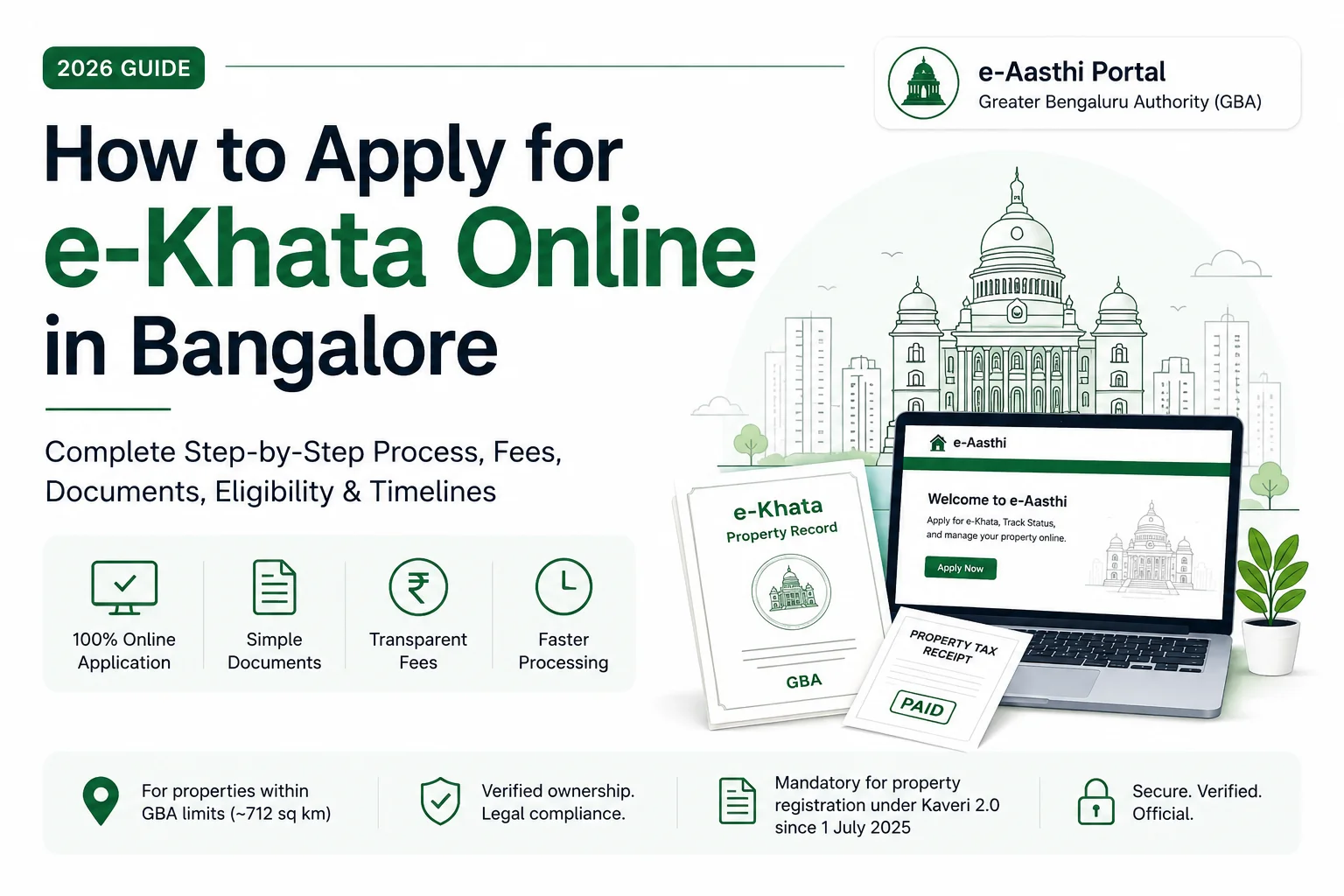
If your property falls within Greater Bengaluru Authority (GBA) limits — the body that replaced BBMP in September 2025 — you apply for an e-Khata through the official e-Aasthi portal. You'll need a registered Sale Deed, your Property ID (PID/ePID), latest property tax records, an Encumbrance Certificate (EC), and identity proof. The authority verifies ownership and municipal records before issuing the digital e-Khata.
Why this matters now: e-Khata has been mandatory for property registration under Kaveri 2.0 since 1 July 2025. If your e-Khata isn't verified, the sub-registrar's system blocks the sale deed registration outright — there's no manual override anymore. Loan disbursements and building plan approvals are affected in the same way.
This guide covers who needs to apply, the eligibility checklist, the exact step-by-step process, current fees and timelines, why applications actually get delayed, and the special cases (BDA, revenue sites, inheritance, joint ownership) that need extra documentation.
If your property falls within Greater Bengaluru Authority (GBA) limits, you can apply for an e-Khata through the official e-Aasthi portal using your Sale Deed, Property ID (PID/ePID), latest property tax receipt, Encumbrance Certificate (EC), and ID proof.
1. At a Glance
| Item | Details |
|---|---|
| Best for | New e-Khata, mutation/transfer, digitisation of paper Khata |
| Apply through | Official e-Aasthi portal |
| Governing authority | Greater Bengaluru Authority (GBA), formerly BBMP |
| Application fee | ₹110–125 for standard e-Khata applications |
| Mutation/transfer fee | 2% of stamp duty on the sale deed, minimum ₹500 |
| e-Khata processing charge | ~₹170 |
| Typical timeline | 7–15 working days (clean applications); up to 30 days for standard cases; 15–45 days in peripheral/border zones |
| Mandatory since | October 2024 for transactions; 1 July 2025 for sale-deed registration |
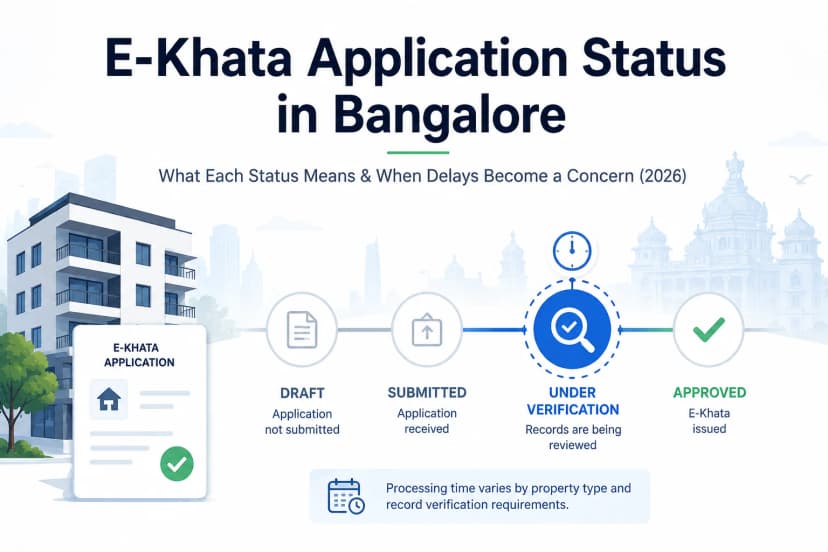
| Track status | Online, via the e-Aasthi status portal |
Fees and timelines are current as of July 2026 and subject to revision. Always confirm the live rate on the official portal before paying — no third party is authorised to charge above the official schedule.
2. Before You Apply
Most applications don't fail at the portal — they stall because the property's records don't agree with each other.
i. Do You Actually Need to Apply?
| Situation | Apply? | What to do |
|---|---|---|
| Just purchased a property | ✅ | Apply for mutation/e-Khata transfer |
| The property has no Khata at all | ✅ | Apply for a new e-Khata |
| You hold an old paper Khata | ✅ | Apply for digitisation via e-Aasthi |
| You already have a verified e-Khata | ❌ | No action unless ownership or property details have changed |
| Property is outside GBA limits (~712 sq km) | ❌ | Panchayat areas use e-Swathu (Form 9); BDA-allotted land not yet resold uses BDA's own Khata — see below |
ii. Is Your Property Even Eligible?
| Requirement | Usually required |
|---|---|
| Property within GBA limits | ✓ |
| Registered ownership document | ✓ |
| Property tax assessment up to date | ✓ |
| Valid PID/ePID (10-digit electronic ID with GPS boundaries) | ✓ |
| Applicant identity proof matching ownership records | ✓ |
A registered Sale Deed alone does not guarantee approval. The authority cross-checks ownership, municipal assessment, and tax records together — and this is exactly where most delays originate (more below).
iii. Property-Type-Specific Documents
| Property type | Additional documents typically needed |
|---|---|
| Apartment | Builder/project records; individual unit e-Khata is only possible after the Occupancy Certificate is issued |
| BDA-allotted property | Allotment letter and subsequent ownership records; migrates to GBA e-Aasthi only on first resale |
| Revenue site | Revenue-to-municipal conversion records, where applicable |
| Inherited property | Legal Heir Certificate or Succession Certificate, Death Certificate, Gift Deed if applicable |
| Joint ownership | Identity and ownership documents for all co-owners |
| B-Khata property | See A-Khata vs B-Khata — you may need conversion first |
Ready-to-Apply Checklist
- Property taxes paid and up to date
- PID/ePID confirmed
- Sale Deed registered
- Latest EC obtained (via Kaveri 2.0, which integrates directly with e-Aasthi)
- Owner name spelled identically across Sale Deed, Aadhaar, PAN, and tax receipt
The one check that matters most: In our document reviews, the single biggest cause of delay isn't a missing document — it's a name, PID, or address that doesn't match exactly across the Sale Deed, EC, tax record, and ID proof. A middle name dropped on one document ("Raghavendra" vs. "R. Raghavendra") is enough to trigger a rejection. Fix this before you submit, not after you get a clarification notice.
3. A-Khata vs B-Khata: Why It Matters Before You Apply
If you're not sure whether your property is A-Khata or B-Khata, check this before applying for e-Khata — it changes what you're eligible for.
| A-Khata | B-Khata | |
|---|---|---|
| Legal status | Fully compliant with municipal building/zoning rules | Property tax paid, but the property has some regularisation gap (unapproved layout, deviation, etc.) |
| Can you get e-Khata directly? | Yes | No — must convert to A-Khata first |
| Bank loan eligibility | Full eligibility | Usually rejected or heavily restricted |
| Building plan sanction | Allowed | Not allowed until converted |
| Resale value | Standard market value | Typically discounted |
2026 update — this is time-sensitive: Under the GBA's Bhu Guarantee 100-day special drive (launched 16 May 2026), the betterment charge for B-Khata → A-Khata conversion has been cut from the standard 5% of guidance value to 2%, with GBA targeting a 15-day processing window for eligible applications. This window closes in August 2026 — after that, the rate reverts to 5%. If your property is on the B register, converting now is meaningfully cheaper than waiting.
Around 7 lakh properties in Bengaluru currently sit in the B register — their owners pay tax but can't get a home loan or sanction a building plan against the property. If this describes your situation, resolve the B-to-A conversion before starting your e-Khata application; applying for e-Khata on an unconverted B-Khata property will not succeed.
4. How to Apply for e-Khata Online
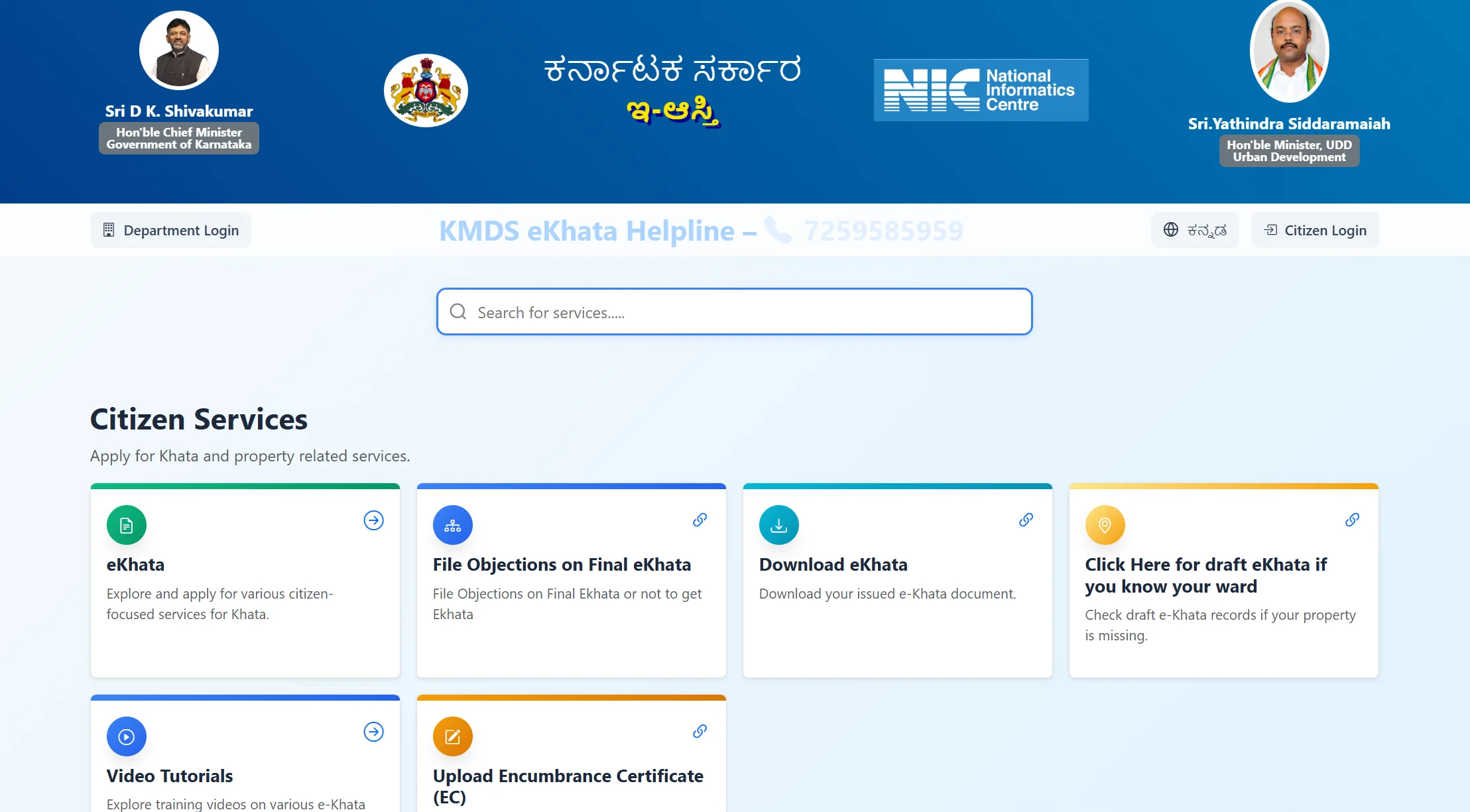
A clean application with documents ready takes about 20–30 minutes to submit. Verification afterward depends on your property's record quality.
Choose Application Type
        ↓
Locate Property (PID/ePID)
        ↓
Complete Applicant Details
        ↓
Upload Documents
        ↓
Review & Submit
        ↓
Verification (GBA / faceless system)
        ↓
Approval
        ↓
Download e-Khata
Step 1: Choose the Correct Application Type
| Your situation | Application type |
|---|---|
| Property has no Khata | New e-Khata |
| Ownership just changed (purchase, gift, inheritance) | Mutation / Khata transfer |
| You hold an existing paper Khata | Digitisation |
Picking the wrong type is one of the more common self-inflicted delays — it routes your file to the wrong verification queue.
Step 2: Locate Your Property
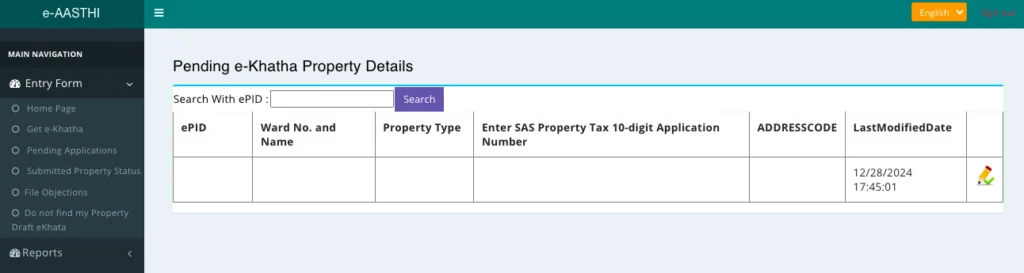
Search on the e-Aasthi portal using your ePID or existing municipal identifiers. If the property that comes up doesn't match your records — wrong area, wrong owner name, wrong survey number — stop and resolve that mismatch before continuing. Submitting on top of a mismatch just generates a rejection later.
Step 3: Complete the Application
Enter applicant details exactly as they appear on your ownership documents:
- Owner name (character-for-character match with Aadhaar and Sale Deed)
- Mobile number (used for all further correspondence — the system is largely faceless/contactless from here)
- Property address
- PID/ePID
Step 4: Upload Documents
- Registered Sale Deed
- Latest Encumbrance Certificate (pull this from Kaveri 2.0 — it's pre-integrated with e-Aasthi)
- Property tax payment records
- Identity proof
- Any property-type-specific documents from the table above
Upload clear, complete scans only. Duplicate or unrelated files slow down manual review rather than speeding it up.
Step 5: Review & Submit
Two minutes here saves weeks later. Before hitting submit, verify:
- The property record shown is correct
- Owner's name matches the Sale Deed and ID proof exactly
- PID/ePID is correct
- All uploads are complete and legible
- Your mobile number is active — this is now the primary channel for any clarification request
Save your application reference number after submission. You'll need it for status tracking and for responding to any Assistant Revenue Officer (ARO) query.
Submitting the right documents the first time gives your application the best chance of moving smoothly through verification. A final review today can help you avoid unnecessary follow-ups and repeat submissions.
5. Timelines & Status Tracking
| Processing time | Typical duration |
|---|---|
| Clean, straightforward applications | 7–15 working days |
| Standard applications (mid-2026 average) | Up to 30 working days |
| Peripheral/border zones (e.g. outer Sarjapur, outer Whitefield, outer Yelahanka) | 15–45 working days, due to file migration between the five new GBA city corporations |
| Applications with an ARO clarification query | 60+ days if the owner is slow to respond or documents are incomplete |
A note on the GBA transition: BBMP was formally dissolved in September 2025, and Bengaluru is now split into five city corporations (North, South, East, West, Central) under the GBA. The e-Aasthi portal and your existing records remain valid and unaffected — but properties near a corporation border can see extra delay while their file is routed to the correct corporation.
Track your application anytime using your reference number on the e-Aasthi status page.
6. Why Applications Get Delayed
| Problem | Most likely cause | Fix |
|---|---|---|
| Property not found | Incorrect PID/ePID | Re-verify the ePID against your latest tax receipt |
| Clarification (ARO query) raised | Document unclear or incomplete | Respond within the query window — don't let it sit |
| Name mismatch | Ownership and ID documents don't match exactly | Correct via affidavit/gazette or resubmit with consistent spelling before reapplying |
| Ownership mismatch | Municipal records not yet updated to reflect a prior sale/inheritance | Complete mutation first, then apply for e-Khata |
| B-Khata property | Property isn't eligible for e-Khata until converted | Apply for B-to-A conversion first (see above — do this before August 2026 to get the reduced rate) |
| Stuck in "verification" for weeks | Border-zone file migration or backlog | Track status weekly; escalate via ARO contact if past 30 working days with no update |
Name mismatch is the most frequent rejection reason we see — and it's also the easiest to prevent. Before you submit anything, lay your Sale Deed, EC, tax receipt, and Aadhaar side by side and check three fields: name, PID, and address. If all three match exactly across all four documents, you've eliminated the most common cause of delay.
7. Special Property Scenarios
| Property type | What's different |
|---|---|
| Apartment | Individual unit e-Khata only becomes possible after the Occupancy Certificate is issued — don't apply before then |
| BDA property | Stays on BDA's own Khata system until first resale, at which point it migrates into GBA/e-Aasthi |
| Revenue site | Eligibility depends on whether the site has completed revenue-to-municipal conversion |
| Inherited property | Requires Legal Heir/Succession Certificate and Death Certificate in addition to standard documents |
| Joint ownership | All co-owners' identity and ownership documents required |
| B-Khata property | Must convert to A-Khata before e-Khata is possible — see the dedicated section above |
8. Frequently Asked Questions
Can I complete the entire e-Khata application online?
Yes, through the e-Aasthi portal using mobile OTP login — no ward office visit is required for standard cases. Applications flagged for ARO clarification may need document resubmission, but the process stays online.
Is a registered Sale Deed enough on its own?
No. The GBA cross-verifies your Sale Deed against municipal tax assessment, the EC, and existing property records before approval. A registered deed with mismatched tax records will still trigger a query.
Can a B-Khata property get an e-Khata?
Not directly. It must first be converted to A-Khata. As of mid-2026, the betterment charge for this conversion is temporarily reduced to 2% of guidance value (from the standard 5%) under a special drive closing in August 2026.
Can inherited property get an e-Khata?
Yes, provided you can establish ownership through a Legal Heir Certificate, Succession Certificate, or equivalent, along with the Death Certificate of the previous owner.
What happens if property taxes are pending?
Clear pending dues before applying. Outstanding tax arrears are a documented cause of verification delay and can result in an ARO query that adds weeks to your timeline.
How long does e-Khata approval actually take in 2026?
7–15 working days for clean applications, up to 30 days for standard cases, and 15–45 days in peripheral zones near GBA corporation borders due to ongoing file migration. Applications with unresolved ARO queries can run past 60 days.
What should I check immediately after downloading my e-Khata?
Verify the owner's name, property address, PID/ePID, and measurements against your Sale Deed. The certificate carries a QR code you can scan to verify authenticity directly on the e-Aasthi portal. Report any mismatch immediately — using an incorrect e-Khata in a future transaction compounds the problem.
Does an e-Khata prove legal ownership?
No. It's a municipal record used for tax and administrative recognition. Your registered Sale Deed remains the actual proof of legal title.
My application was rejected — what now?
Read the rejection reason carefully; it's usually one of the mismatch categories above. Correct the specific issue and reapply. For inheritance, joint ownership, or B-Khata conversion cases, get the document set reviewed before resubmitting — repeated rejections extend your timeline further each time.
Related Guides
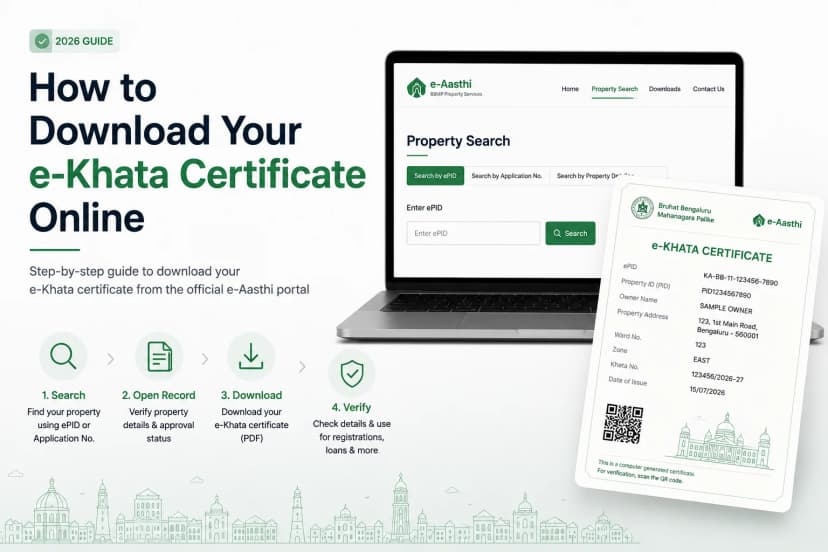
- How to Track Your e-Khata Application Status
- How to Search Your Property on E-Aasthi
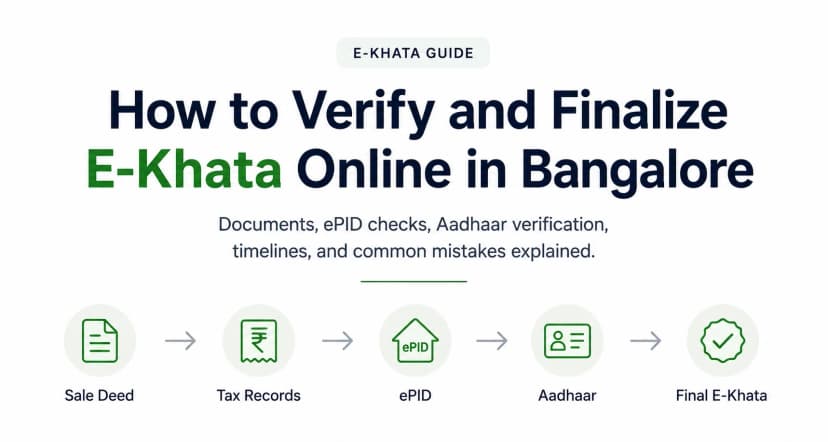
- How to Verify and Finalize E-Khata Online in Bangalore
- Why E-Khata Applications Get Rejected in Bangalore
Get Your Documents Reviewed Before You Apply
Name mismatches, PID errors, and B-Khata eligibility gaps are the reasons applications stall for weeks instead of days. Send us your Sale Deed, EC, and latest tax receipt — we'll flag inconsistencies before you submit, not after you get a rejection notice.
Sources: e-Aasthi Portal, Government of Karnataka; Kaveri 2.0 property registration integration; Greater Bengaluru Governance Act, 2024; GBA Bhu Guarantee scheme announcement, May 2026. Fees and timelines verified as of July 2026 — confirm current rates on the official portal before payment.