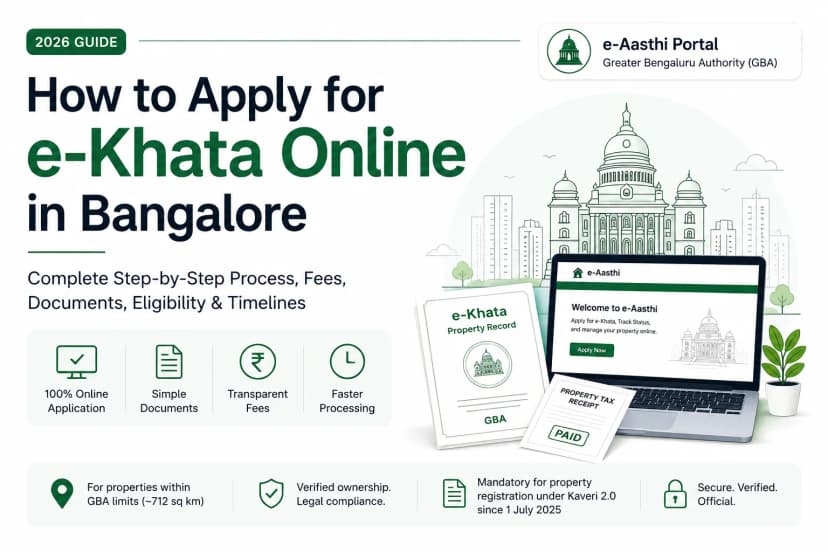
Submitted your E-Khata application and wondering whether the status you're seeing is normal? Most property owners are not actually looking for a status definition. They're trying to answer a more important question: Is my application progressing normally, or is something wrong?
An E-Khata application typically moves through Draft, Submitted, Under Verification, Correction Required (if needed), and Approved stages. While some applications are approved within a few weeks, others remain unchanged because of ownership mismatches, ePID issues, transfer record gaps, Aadhaar verification problems, or other record discrepancies. The status alone does not tell you whether you should be concerned. The combination of status + duration is what matters. Not sure whether your delay is normal or a sign of a record issue?
Kustodian helps Bangalore property owners identify ownership mismatches, ePID issues, and documentation gaps that can delay E-Khata approval.
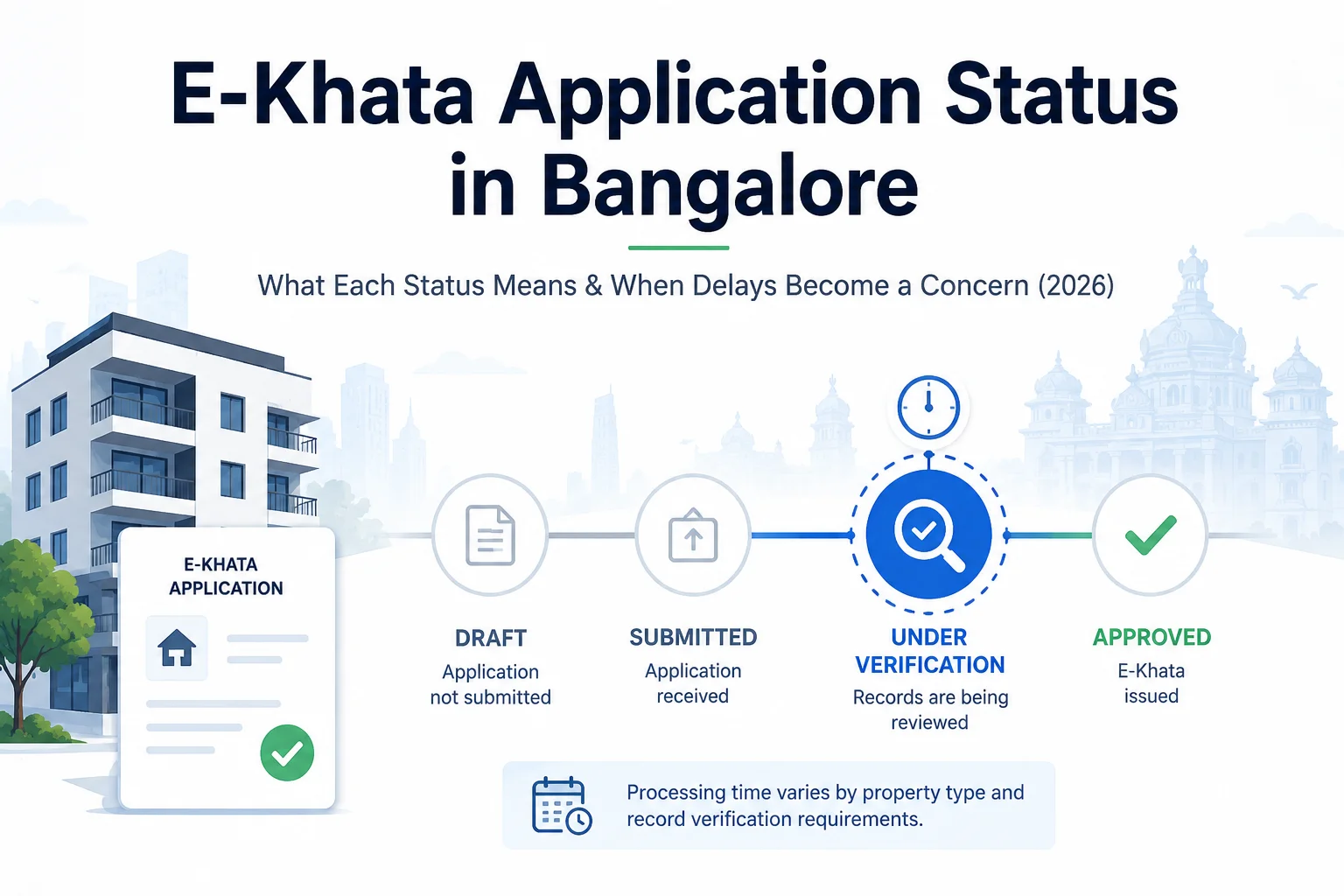
Quick Status Reference
| Status | Meaning | Action Needed? |
|---|---|---|
| Draft | Application not submitted | Yes |
| Submitted | Application received | No |
| Under Verification | Records being reviewed | No |
| Correction Required | Issue identified | Yes |
| Rejected | Application not approved | Yes |
| Approved | E-Khata issued | No |
Quick Answer
Most E-Khata applications remain in Submitted or Under Verification status while property and ownership records are reviewed. Delays become more concerning when a status remains unchanged significantly beyond the normal processing timeline for that property type.
You can check your application through the BBMP E-Aasthi portal and use the guidance below to understand what your status means, how long it usually lasts, and when further investigation may be worthwhile.
1. How to Check Your E-Khata Status
You can track your E-Khata application through the official BBMP E-Aasthi portal after submission.
The portal allows property owners to view submitted applications, monitor status changes, and respond to correction requests during the review process.
- Log in to the portal.
- Open your submitted applications.
- Select the relevant property or application.
- Review the current application status.
The status itself is only part of the picture. An application that has been under verification for two weeks may be progressing normally, while the same status after two months could indicate an underlying issue.
2. How Long Does E-Khata Approval Usually Take?
Processing times vary depending on the property's ownership history, record quality, and whether additional verification is required.
Typical Processing Timelines
| Property Type | Typical Processing Time |
|---|---|
| Apartment | 7–30 days |
| Independent House | 15–45 days |
| Inherited Property | 30–60 days |
| NRI-Owned Property | 45–90 days |
A longer timeline does not automatically mean there is a problem.
Inherited properties, recently transferred properties, and NRI-owned properties often require additional verification and therefore take longer than straightforward apartment applications.
When Does a Delay Become Concerning?
| Property Type | Consider Investigating After |
|---|---|
| Apartment | 30 days |
| Independent House | 45 days |
| Inherited Property | 60 days |
| NRI-Owned Property | 90 days |
These are not official BBMP deadlines. They are practical thresholds after which ownership issues, documentation gaps, ePID mapping problems, or record discrepancies become more likely.
The next section explains what each status means, what usually causes it, and whether you need to take any action.
Crossed the normal timeline for your property type?
Applications that stay unchanged for weeks or months often involve ownership, transfer, inheritance, or municipal record issues.
3. What Each E-Khata Status Means
Most E-Khata applications move through the same core stages. Understanding what each status means can help you decide whether you should wait, take action, or investigate further.
i. Draft Status
Meaning: Draft status means the application has been created but has not been submitted for review.
What Usually Causes It: This typically happens when the application was saved before completion, mandatory information is missing, or the submission process was not finished successfully
What You Should Do: Review the application, upload any missing documents, and complete the submission process.
Typical Duration: There is no time limit. The application remains in Draft status until it is submitted.
ii. Submitted Status
Meaning: Submitted status confirms that the application has been successfully received and is waiting to enter the verification workflow.
What Usually Causes It: This is the normal status immediately after submission. Applications may remain here while they are queued for review.
What You Should Do: No action is usually required. Avoid creating duplicate applications while waiting for the status to progress.
Typical Duration: Usually a few days before moving to Under Verification.
iii. Under Verification Status
Meaning: Under Verification means property records, ownership information, and supporting documents are being reviewed. This is often the longest stage of the E-Khata process.
What Usually Causes It: The application remains in this stage while authorities verify:
- Ownership records
- Property details
- Tax information
- Supporting documents
Longer verification periods are common for inherited properties, recently transferred properties, and NRI-owned properties.
What You Should Do: In most cases, simply wait. If the application remains under verification significantly beyond the normal timeline for your property type, it may be worth investigating whether a record discrepancy or documentation issue is slowing the process.
Typical Duration:
| Property Type | Typical Duration |
|---|---|
| Apartment | Up to 30 days |
| Independent House | Up to 45 days |
| Inherited Property | Up to 60 days |
| NRI-Owned Property | Up to 90 days |
iv. Correction Required Status
Meaning: Correction Required means an issue was identified during review, and additional information or corrections are needed before processing can continue. This does not mean the application has been rejected.
What Usually Causes It: Common triggers include:
- Ownership mismatches
- Name discrepancies
- Incorrect property details
- Missing documents
- Aadhaar verification issues
- Objections raised during review
What You Should Do: Review the requested correction carefully and respond as quickly as possible. Most applications continue normally once the issue has been resolved. Depends on how quickly the correction is submitted and reviewed.
v. Rejected Status
Meaning: Rejected status means the application could not be approved based on the information available during review.
What Usually Causes It: Applications may be rejected because of unresolved ownership issues, documentation problems, verification failures, or other record discrepancies.
What You Should Do: Identify the specific rejection reason before taking further action. Many rejected applications can be successfully resolved and resubmitted once the underlying issue is addressed. For a detailed breakdown, read our guide on common reasons E-Khata applications get rejected.
Typical Duration: Rejected is generally a final workflow status unless corrective action is taken.
vi. Approved Status
Meaning: Approved status means the application has successfully completed review and the E-Khata has been issued.
What Usually Causes It: Approval occurs when ownership information, property records, tax records, and verification requirements have been successfully validated.
What You Should Do: Download the E-Khata certificate and verify that all ownership and property details are correct. Store both digital and physical copies for future use.
Typical Duration: Approved is the final stage of the application process.
4. When Is Your E-Khata Application Actually Stuck?
A common mistake is assuming that a status that hasn't changed for several weeks automatically means something is wrong. In reality, many E-Khata applications remain under verification for extended periods while records are reviewed. The better question is not:
Why is my application still pending?
The better question is:
Has my application remained pending longer than it normally should for a property like mine?
i. Practical Investigation Thresholds
Use the investigation thresholds discussed earlier as a practical benchmark for deciding whether a delayed application is still progressing normally or may require closer review. These are not official BBMP deadlines. They are practical thresholds where the likelihood of an underlying issue becomes higher.
ii. Delays That Are Usually Normal
A recently purchased apartment with clean ownership records may remain under verification for several weeks before approval. This is generally normal and does not require intervention.
iii. Delays That May Indicate a Problem
An inherited property that remains under verification for more than two months is more likely to involve a documentation gap, ownership mismatch, succession issue, or record discrepancy that requires attention. The delay itself is often not the problem. The delay is a symptom of another issue that has not yet been resolved.
iv. Signs That Further Investigation May Be Worthwhile
Consider reviewing the application more closely if:
- The status has not changed significantly beyond the normal timeline for your property type.
- The property was inherited.
- The property was recently transferred.
- Multiple owners are involved.
- Municipal records contain outdated ownership information.
- Property details differ across supporting documents.
Not every delayed application has a problem. However, once an application remains unchanged far beyond the expected timeframe, identifying the underlying cause can prevent additional months of waiting.
v. Been Under Verification for Longer Than Expected?
Many delayed E-Khata applications are not waiting because of processing queues—they are waiting because of ownership mismatches, ePID issues, inheritance-related documentation gaps, or property record discrepancies. If your application has remained unchanged significantly beyond the normal timeline for your property type, identifying the underlying issue is often faster than continuing to wait.
Kustodian helps Bangalore property owners investigate delayed E-Khata applications, understand the root cause of verification delays, and resolve documentation and record issues that prevent approval.
vi. Been Under Verification for Longer Than Expected?
Many delayed E-Khata applications are not waiting because of processing queues—they are waiting because of ownership mismatches, ePID issues, inheritance-related documentation gaps, or property record discrepancies.
5. Most Common Reasons E-Khata Applications Stay Pending
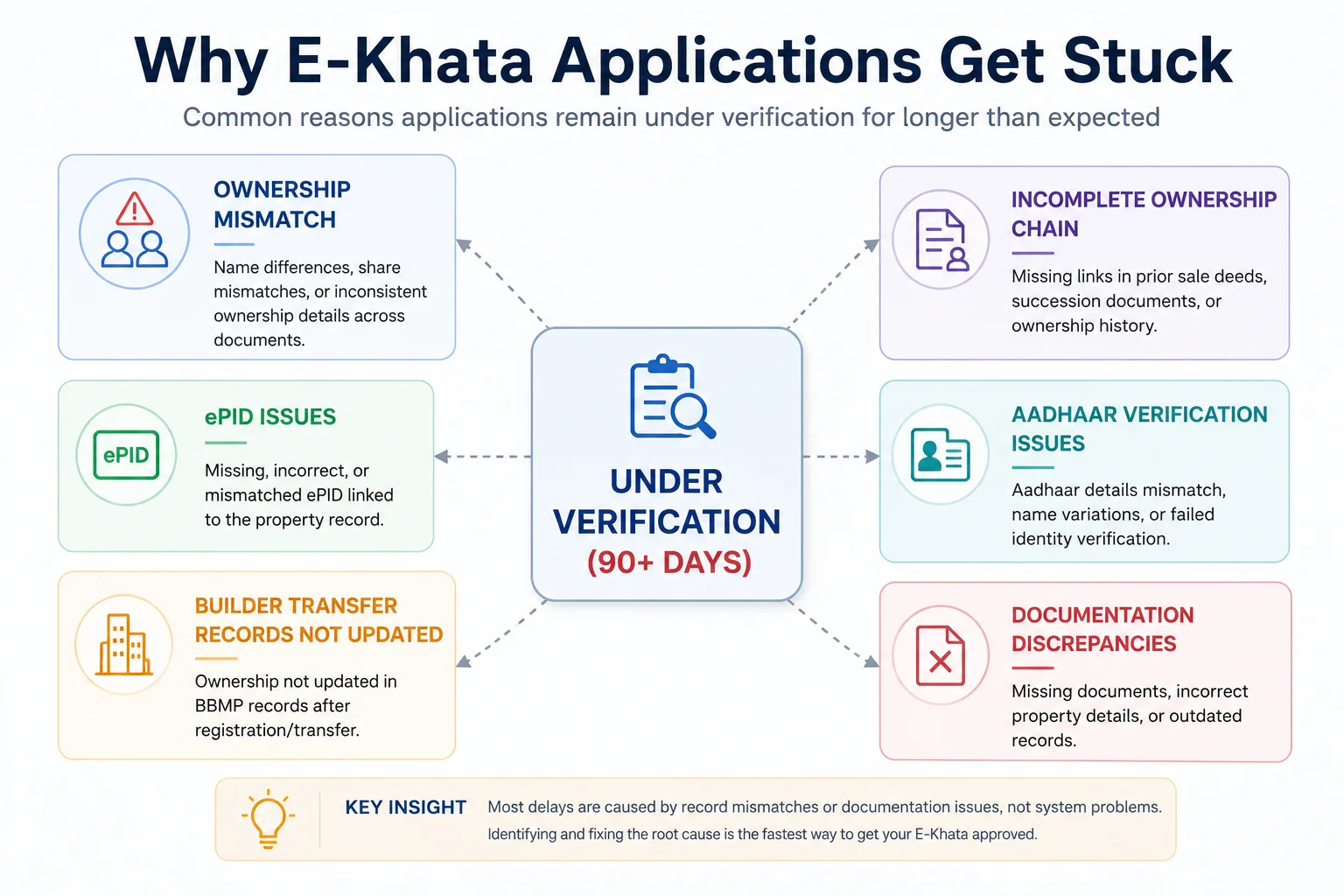
When an E-Khata application remains unchanged for an unusually long period, the delay is often linked to a small number of recurring issues. The status itself rarely tells you the exact cause. However, certain problems appear repeatedly across delayed applications.
i. Ownership Mismatch
Ownership details must align across sale deeds, tax records, municipal records, and supporting documents. Even small differences in names, initials, ownership shares, or historical records can trigger additional review.
ii. ePID Issues
An ePID (Electronic Property Identification Number) is the unique identifier assigned to a property in BBMP's digital records. If the ePID is missing, linked incorrectly, or associated with outdated property information, verification may take longer than expected.
If you cannot locate your property record, read our guide on how to search for your property on E-Aasthi.
iii. Builder Transfer Records Not Updated
Apartment owners sometimes face delays because builder records and municipal ownership records have not been fully updated after registration. The property may legally belong to the owner, while older records still require reconciliation.
iv. Incomplete Ownership Chain
Inherited properties and properties that have changed hands multiple times often require additional scrutiny. Missing succession records, incomplete transfers, or gaps in historical ownership information can slow verification.
v. Aadhaar Verification Issues
Differences between identity information provided during the application process and information available in supporting records can result in additional review.
Common Delay Indicators
| Status Showing | Most Likely Explanation |
|---|---|
| Draft | Application not submitted |
| Submitted | Waiting for review |
| Under Verification | Record checks underway |
| Correction Required | Information mismatch identified |
| Rejected | Verification could not be completed |
| Approved | Process completed |
Most delays are ultimately caused by a record mismatch rather than a system issue. Identifying the specific discrepancy is usually the fastest path toward resolution.
Found a possible issue in your case? Whether it's an ownership mismatch, missing transfer records, inheritance documentation, or ePID errors, identifying the exact issue early can save months of waiting.
6. What Should You Do Based on Your Status?
If you're unsure whether to wait or take action, use the framework below.
Status Action Guide
| Current Status | Recommended Action |
|---|---|
| Draft | Complete and submit the application |
| Submitted | Wait for the review to begin |
| Under Verification (within normal timeline) | Continue monitoring |
| Under Verification (beyond normal timeline) | Investigate possible record issues |
| Correction Required | Resolve the requested issue promptly |
| Rejected | Review the rejection reason before taking further action |
| Approved | Download and verify the E-Khata certificate |
When Waiting Is Usually The Right Decision
If your application is still within the normal timeline for your property type, patience is often the best approach. Many applicants become concerned too early, particularly when an application remains under verification for several weeks.
When Investigation Becomes More Useful
Investigation becomes worthwhile when:
- The application has exceeded the typical timeline for the property type.
- Ownership records may be outdated.
- The property was inherited.
- Multiple ownership transfers are involved.
- A correction request has already been raised.
At that stage, the focus should shift from waiting for the status to change to understanding what may be preventing the application from progressing.
7. What Happens After E-Khata Is Approved?
Approval is not the end of the process. Once your E-Khata application is approved, take a few minutes to verify that the information recorded in the certificate is accurate. Check:
- Owner name(s)
- Property details
- Property identification information
- Address details
- Other key ownership records
If any information appears incorrect, it is usually easier to address the issue soon after approval rather than months or years later. After verification:
- Download the E-Khata certificate.
- Save a digital copy.
- Keep a backup copy of your property records.
- Use the document for future property transactions, verification requirements, and ownership-related processes.
A correctly issued E-Khata can help simplify future property-related activities, while unnoticed errors can create complications later.
8. Are Processing Times Different Across Bangalore Properties?
While BBMP follows a common application workflow, processing times can vary based on the property's ownership history, record quality, and whether additional verification is required. Properties involving inheritance, recent transfers, multiple owners, or older municipal records generally require more scrutiny than straightforward apartment applications with updated records.
As a result, two applications submitted on the same day may be approved weeks apart despite following the same process.
9. Frequently Asked Questions
What Does E-Khata Pending Mean?
E-Khata Pending usually means the application is still moving through the review process and has not yet reached a final decision.
In many cases, pending applications are simply waiting for verification to be completed. The status becomes more concerning only when it remains unchanged significantly beyond the normal timeline for the property's ownership type.
Is Pending the Same as Under Verification?
Not always. Pending is a broad term that may refer to any application that has not yet reached a final outcome. Under Verification is a more specific status indicating that records and documents are actively being reviewed.
If your portal displays Under Verification, it generally means the application is progressing through the review process.
How Long Does E-Khata Approval Usually Take?
Processing times vary depending on the property and its ownership history.
As a general guideline:
- Apartments: 7–30 days
- Independent houses: 15–45 days
- Inherited properties: 30–60 days
- NRI-owned properties: 45–90 days
Applications involving ownership transfers, inheritance, or record discrepancies may take longer.
Why Is My E-Khata Status Not Changing?
A status may remain unchanged because verification is still in progress or because additional review is required. Common reasons include ownership mismatches, ePID issues, builder transfer record gaps, incomplete ownership histories, and documentation discrepancies.
The longer the application remains unchanged beyond the normal timeline, the more worthwhile the investigation becomes.
What Does Correction Required Mean?
Correction Required means the reviewing authority identified an issue that must be addressed before the application can continue.
This does not mean the application has been rejected. Most applications proceed normally once the requested correction has been submitted and reviewed.
What is an ePID?
An ePID (Electronic Property Identification Number) is the unique identifier assigned to a property within BBMP's digital property records.
It helps connect property information, tax records, and ownership details within the E-Aasthi ecosystem. Incorrect or missing ePID information can sometimes delay E-Khata processing.
Can a Rejected E-Khata Application Be Resubmitted?
In many cases, yes. Whether resubmission is possible depends on the reason for rejection and the steps required to resolve the underlying issue.
Before submitting a new application, identify the specific reason for rejection and address the problem that triggered it.
Why Is My E-Khata Application Pending for More Than 60 Days?
A delay beyond 60 days does not automatically mean approval will be denied. However, applications that remain unchanged far beyond the normal timeline are more likely to involve ownership issues, documentation gaps, inheritance-related complications, or record discrepancies that require further review.
Investigating the cause is often more productive than continuing to wait indefinitely.
Can NRIs Check E-Khata Status Online?
Yes. NRI property owners can generally track E-Khata applications through the same online portal used by resident property owners.
However, NRI-owned properties often require additional verification and may therefore take longer to process.
How Often Should I Check My E-Khata Status?
Checking once every few days is usually sufficient. Status updates do not typically occur daily, and excessive monitoring rarely changes the outcome. A more useful approach is to compare the application's age against the normal timeline for the property type.
What Should I Do If My Application Has Been Under Verification for Several Months?
Start by reviewing whether the property involves inheritance, multiple ownership transfers, or recently updated records. Applications that remain under verification for several months often involve record discrepancies that need to be identified and resolved before approval can proceed. The key question is not whether the application is delayed, but why it is delayed.
What Should I Do After E-Khata Is Approved?
Download the certificate, verify all property and ownership information, and save copies for future use. If any information appears incorrect, address it as early as possible to avoid complications in future property transactions.
10. Need Help Understanding a Delayed E-Khata Application?
A delayed application does not always indicate a problem. But when an application remains under verification for weeks or months beyond the normal timeline, the delay is often a symptom of an underlying issue that has not yet been identified.
Kustodian helps property owners understand why applications are delayed, identify ownership and record discrepancies, navigate documentation challenges, and move stalled cases toward resolution. If you're unsure whether your application is experiencing a normal delay or a genuine issue, getting clarity on the root cause is often the fastest way forward.
---
Reviewed by the Kustodian Property Assistance Team
Kustodian helps Bangalore property owners navigate E-Khata applications, ownership record issues, inheritance-related documentation challenges, and property record corrections across Karnataka.
Still Waiting for Your E-Khata Approval?
If your application has been stuck in Submitted, Under Verification, or Correction Required status beyond the normal timeline, the delay may be caused by an underlying record issue rather than processing time.
![Why E-Khata Applications Get Rejected in Bangalore (And How to Fix Them) [2026]](/_next/image?url=https%3A%2F%2Fwebsite-assets-wix.s3.ap-south-1.amazonaws.com%2Fimages%2Fposts%2F3031ceb9f0274289aad5c5f140be716f.webp&w=828&q=75)