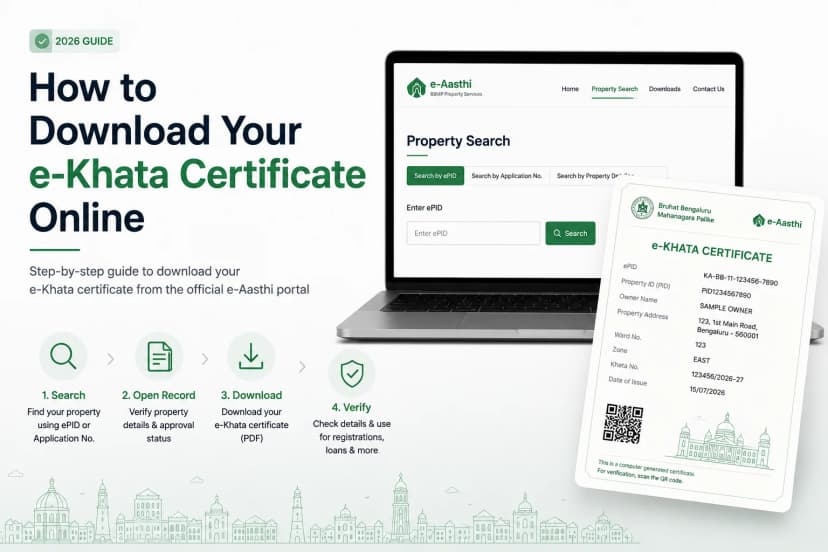
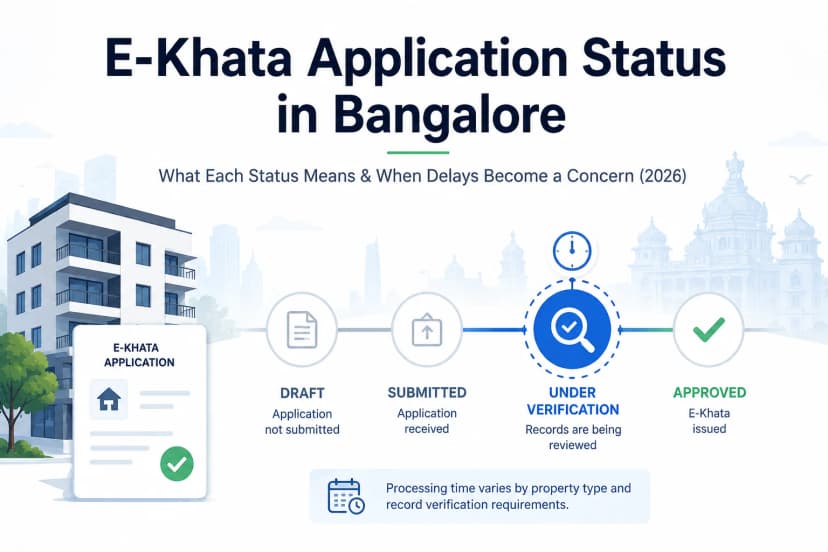
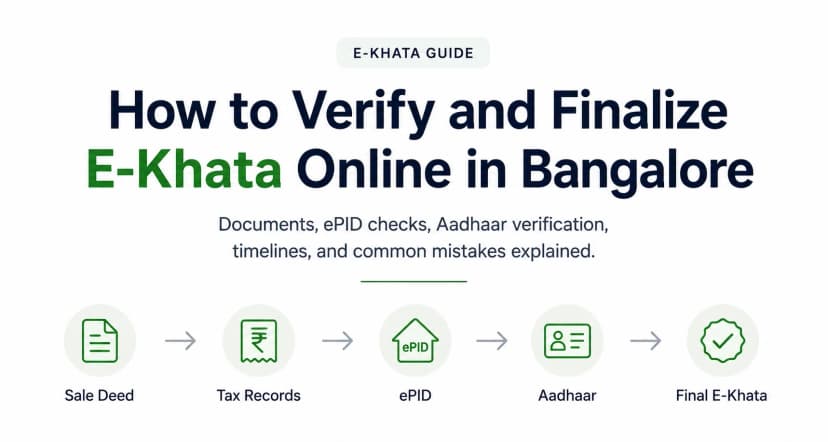
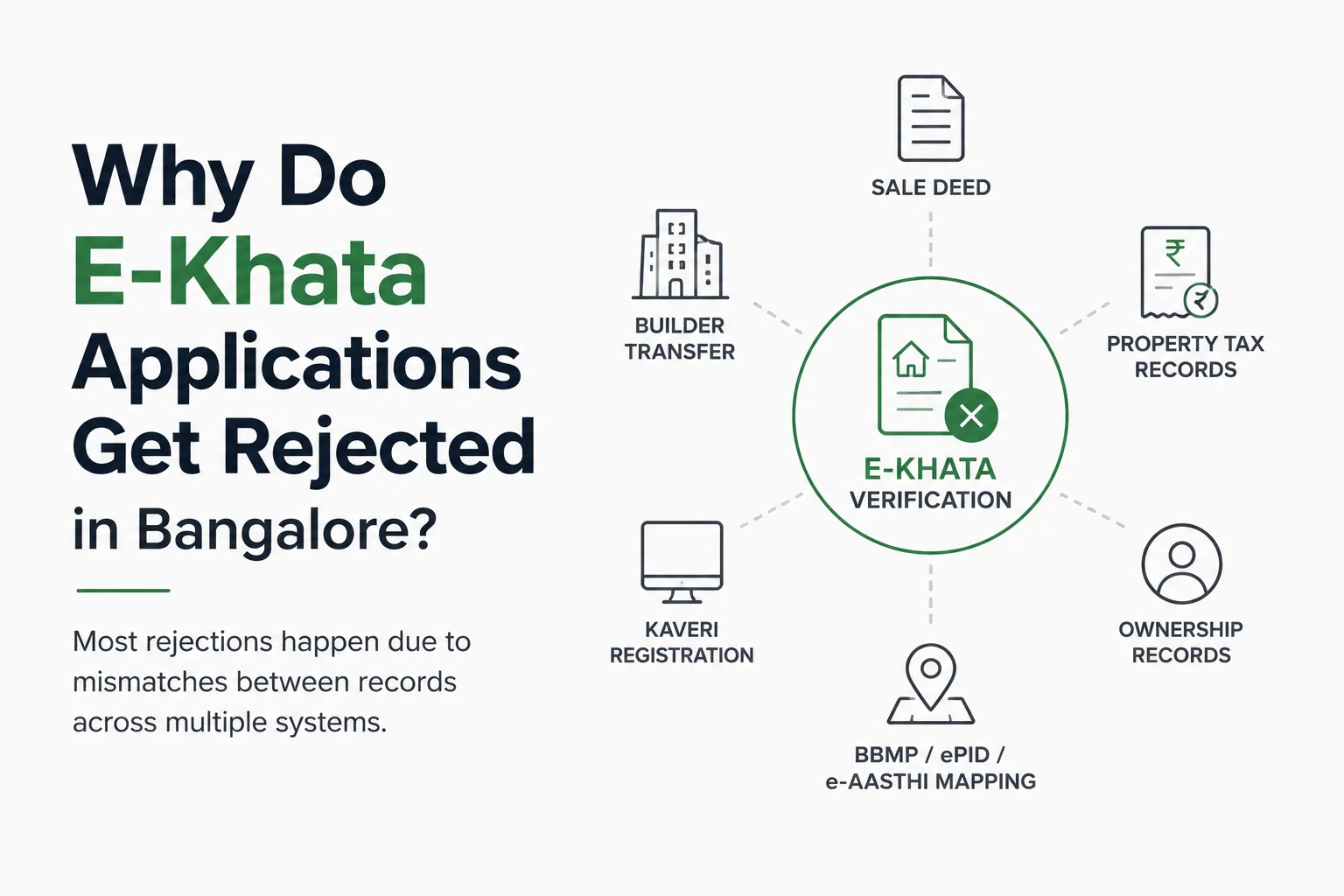
1. Why Do E-Khata Applications Get Rejected?
As Bangalore transitions over 25 lakh properties into the digital E-Khata system, many property owners are discovering issues only when they try to:
- sell a property,
- apply for a home loan,
- transfer ownership,
- register a sale,
- or obtain approvals.
Across the city, E-Khata applications are getting delayed or rejected due to:
- missing historical records,
- property dimension mismatches,
- incomplete builder transfers,
- tax inconsistencies,
- B-Khata complications,
- and old manual-entry errors surfacing during digitization.
In many cases, owners have been paying property tax for years without realizing their records may still contain gaps or mismatches.
This guide explains: The most common E-Khata rejection reasons in Bangalore, which issues are usually fixable, what to do after rejection, and when expert help may save significant time and effort.
Many rejections happen because of record mismatches, missing documents, builder-transfer issues, or legacy data errors that property owners are unaware of.
👉 Kustodian can help review your property records, identify potential issues, and guide you through the E-Khata process before delays occur.
What Problem Are You Facing?
| Situation | Go To |
|---|---|
| My E-Khata application got rejected | Common Rejection Reasons |
| My property is missing online | Missing Record Issues |
| My sale or home loan is delayed | Understand Risk Areas |
| My property has B-Khata issues | B-Khata Related Problems |
| I need urgent guidance | Book a 15-Minute Consultation |
Kustodian works on high-friction financial and documentation workflows across claims, inheritance, EPF, and property-linked processes in India.
This guide combines official municipal workflows, public notifications, and real-world issue patterns commonly faced by Bangalore property owners during E-Khata processing and correction.
Official Systems & References
This guide references workflows and public systems associated with:
Where applicable, workflows may also intersect with:
- ePID-linked municipal records,
- e-Aasthi property workflows,
- and digitized ownership-verification systems used across Karnataka municipal ecosystems.
2. WHY E-KHATA REJECTIONS ARE INCREASING IN BANGALORE
As Bangalore’s E-Khata and e-Aasthi-linked municipal workflows become increasingly digitized, E-Khata rejections are increasing across Bangalore largely because the city is undergoing one of India’s biggest municipal property-record digitization exercises.
Over 25 lakh property records are being migrated from older manual systems into digitally verified databases linked to:
- ePID numbers,
- Aadhaar verification,
- GPS property mapping,
- tax records,
- registration data,
- and municipal approval systems.
This transition is designed to improve transparency and reduce fraud, but it is also exposing inconsistencies that remained unnoticed for years in older manual records.
For many property owners, these issues surface only during:
- resale transactions,
- home loan processing,
- Khata transfer,
- inheritance transfer,
- or building approvals.
Why Older Records Are Creating Problems
For decades, Bangalore’s property records were maintained manually across multiple municipal offices and revenue systems.
As these records are now being digitized and cross-verified, common problems are surfacing, such as: mismatched property dimensions, incomplete ownership updates, builder transfers that were never formally completed, inconsistent tax records, or missing historical entries.
In many cases, owners assumed that paying property taxes meant the property records were fully clean and updated. But tax payment alone does not always guarantee that:
- ownership data,
- khata transfer records,
- registration details,
- and digital mappings all match correctly inside the new E-Khata system.
The BBMP to GBA Transition Is Also Changing Workflows
The transition from the Bruhat Bengaluru Mahanagara Palike (BBMP) framework toward the Greater Bengaluru Authority (GBA) structure has further accelerated:
- centralized digitization,
- automated verification,
- and integration between municipal systems.
This has improved long-term transparency, but it has also increased the number of applications being flagged for manual review, correction requests, or additional verification.
As a result, many Bangalore property owners are now facing situations where:
- records are visible in one system but missing in another,
- apartment details do not match municipal records,
- Or E-Khata applications remain stuck despite years of tax payment history.
One Important Reality Most Owners Discover Too Late
Many E-Khata issues remain invisible until a time-sensitive event happens.
Common triggers include:
- A buyer requesting clean documentation,
- A bank conducting loan verification,
- A builder transfer is finally being initiated,
- Or a registration office requiring updated digital records.
This is why many owners first discover record mismatches only when a property sale is already underway, a loan is in process, or a registration deadline is approaching. And at that stage, even relatively small documentation inconsistencies can delay transactions significantly.
The good news is that many E-Khata issues are procedural rather than legal and can often be corrected once the underlying mismatch is identified properly.
3. TOP E-KHATA REJECTION REASONS IN BANGALORE
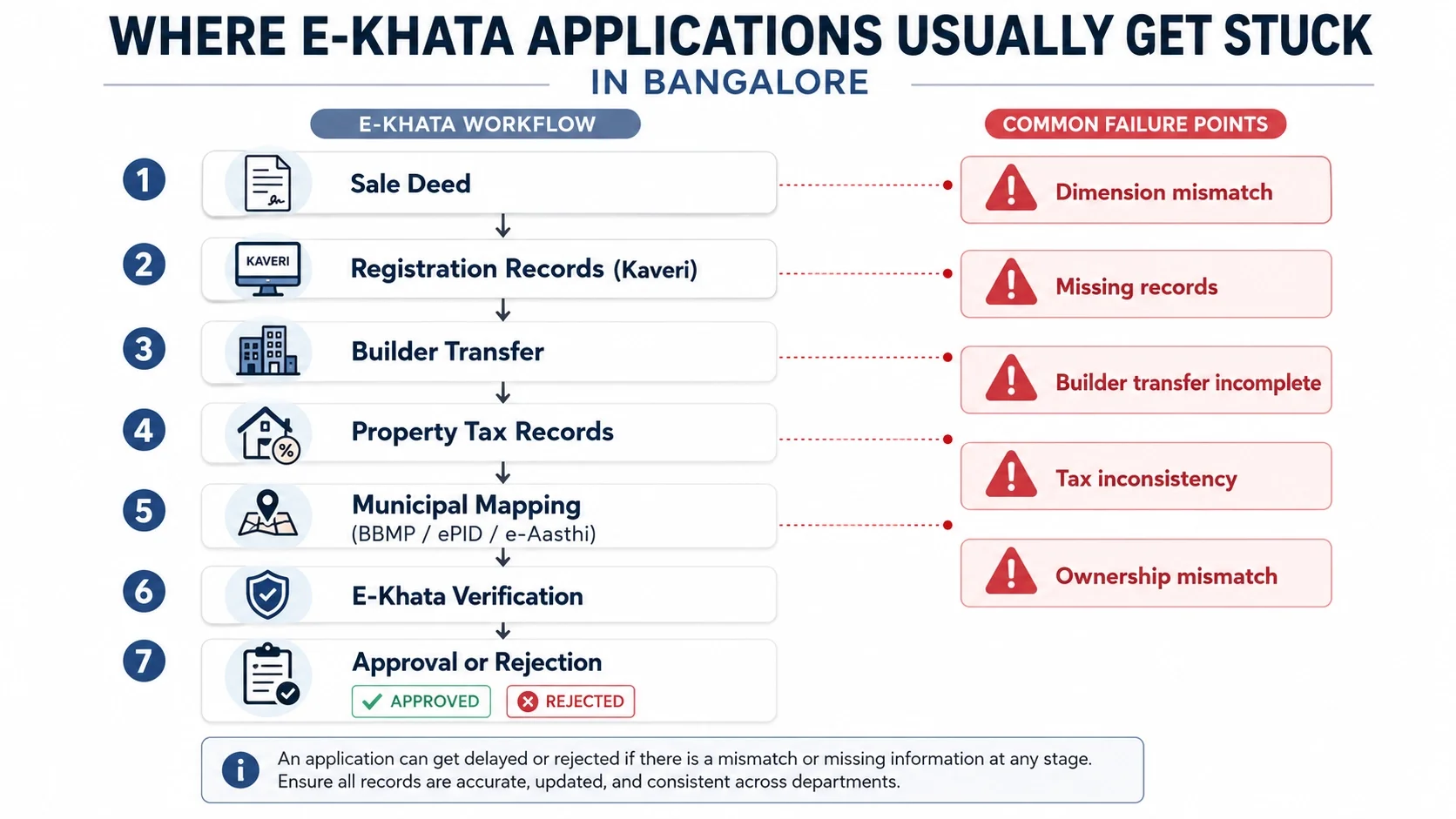
While every property case is different, a relatively small number of issues account for most E-Khata rejections and delays across Bangalore. Some problems are simple verification mismatches. Others involve older municipal records, incomplete builder transfers, or inconsistencies between multiple government systems. Below are the most common rejection patterns property owners are currently facing.
Common E-Khata Rejection Issues in Bangalore
| Issue | Usually Fixable? | Complexity | Commonly Affects |
|---|---|---|---|
| Dimension mismatch | Often yes | Medium | Apartments |
| Missing BBMP records | Usually yes | High | Older layouts |
| Builder transfer incomplete | Often yes | Medium-High | Apartment owners |
| EC mismatch | Usually yes | Medium | Resale/inheritance |
| Tax mismatch | Often yes | Medium | Older properties |
| B-Khata complications | Depends | High | Revenue/layout issues |
| Digitization errors | Usually yes | Medium | Legacy properties |
| Inheritance mismatch | Usually yes | High | Family properties |
| Aadhaar/OTP issue | Yes | Low | All users |
| GPS mapping issue | Usually yes | Medium | Older layouts |
i. Property Dimension Mismatch
What is the issue?
The property dimensions recorded in one system do not match the dimensions available in:
- sale deeds,
- tax records,
- sanctioned plans,
- apartment documentation,
- or municipal databases.
This is currently one of the most common E-Khata rejection reasons in Bangalore.
Why does it happen?
In many older records, dimensions were entered manually over several years across different systems. Common mismatch situations include:
- built-up area vs super built-up area confusion,
- parking area incorrectly mapped,
- partial updates during earlier Khata transfers,
- layout revisions,
- apartment modifications,
- or manual data-entry errors during digitization.
Apartment owners are particularly vulnerable because parking areas, common areas, and flat dimensions were often recorded inconsistently in older records.
Common impact
Dimension mismatches can lead to E-Khata rejection, correction notices, delayed resale transactions, home loan verification problems, or additional municipal verification requests. In some cases, banks may ask for clarification before processing loans.
Is it usually fixable?
Yes, in many cases. But resolution depends on: how large the mismatch is, which systems contain conflicting data, and whether supporting documents align clearly. Simple inconsistencies are often easier to correct than structural layout conflicts.
When expert help matters?
Expert help may save time if:
- A sale or loan is already in progress,
- Multiple records conflict,
- Apartment documentation is inconsistent,
- Or repeated corrections are being requested.
Operational insight: Many apartment owners discover dimension mismatches only during resale or home loan processing because older municipal records, tax entries, and builder documentation were never fully synchronized.
In many cases, dimension-related issues are discovered late but are still correctable once the conflicting records are identified clearly.
ii. Missing Historical BBMP Records
What is the issue?
Some property owners discover that their property:
- is missing from the E-Khata portal,
- has incomplete digital records,
- or cannot be properly mapped during verification.
This is especially common in: older layouts, merged BBMP zones, legacy properties, and manually maintained records.
Why does it happen?
Many historical records existed only in physical registers for years before digitization began.
During migration into digital systems, some entries remained incomplete, some records were duplicated, and some properties were not mapped correctly to newer ePID structures. In certain cases, tax records exist, but ownership or Khata history is incomplete digitally.
Common impact
Missing records can create: E-Khata rejection, inability to proceed with transfer, delays during registration, difficulty during loan verification, or repeated requests for historical documentation.
Is it usually fixable?
Usually yes, but resolution timelines vary significantly. Older properties often require: manual verification, historical document review, or correction requests across multiple systems.
When expert help matters?
Support may become useful when: the property is not appearing digitally at all, records conflict across systems, old documents are incomplete, or transactions are already time-sensitive.
Older records may increase verification time, but many properties can still be corrected or mapped properly with supporting historical documentation.
iii. Builder Never Completed Khata Transfer
What is the issue?
Many apartment owners discover that:
- The builder never formally completed the Khata transfer,
- or ownership records were never fully updated after purchase.
This is extremely common in apartment projects across Bangalore.
Why it happens
In some projects, builders delayed transfer formalities, approvals remained incomplete, or municipal updates were never fully processed after handover.
Owners often assume that registration and tax payment automatically complete all municipal ownership updates. But that is not always true.
Common impact
This can lead to rejection during E-Khata application, ownership mismatch flags, resale delays, or additional verification requirements. In some cases, apartment owners discover the issue only years later during resale.
Is it usually fixable?
Yes, but documentation quality matters heavily. The process may involve: builder records, earlier Khata documents, tax history, and registration verification.
When expert help matters?
Help may save significant time when: builders are unresponsive, apartment records are inconsistent, multiple owners are affected, or the issue surfaces during a live transaction.
Operational insight: One of the most common patterns in Bangalore apartments is owners paying property tax for years while the underlying municipal transfer workflow was never fully completed by the builder.
What Apartment Owners Often Discover Late
Registration and tax payment do not always mean the builder fully completed municipal transfer workflows.
iv. EC / Registration Data Mismatch
E-Khata applications may get flagged when ownership details across:
- sale deeds,
- Encumbrance Certificates (EC),
- registration records,
- and municipal databases do not fully match.
In Bangalore, this commonly happens when: older ownership transfers were never updated properly, inherited properties changed hands informally, spelling variations exist across records, or multiple ownership updates occurred over time.
Even relatively small inconsistencies can trigger manual verification during E-Khata processing. These issues become more serious when: resale is already underway, bank verification has started, or ownership history spans multiple transactions or generations. In many cases, the issue is fixable once the conflicting record is identified clearly.
Facing an E-Khata Rejection or Verification Issue?
Whether it's a dimension mismatch, missing BBMP records, a builder transfer issue, or an ownership discrepancy, identifying the root cause early can save weeks of delays.
👉 Kustodian helps property owners review records, understand rejection reasons, and navigate the next steps toward E-Khata approval.
v. Property Tax Data Mismatch
Some E-Khata applications get delayed because tax-related records do not fully align with:
- ownership data,
- property dimensions,
- or municipal mapping systems.
This is especially common in older properties, apartment projects, and layouts where records evolved manually over many years.
What Many Owners Assume
“If I’ve paid property tax regularly, my property records must already be fully correct.”
Reality: tax compliance does not always guarantee:
- synchronized ownership records,
- complete Khata transfer,
- or clean digital mapping across municipal systems.
In some cases, tax-related inconsistencies surface only when: a home loan is processed, a property sale begins, or digital verification workflows cross-check multiple systems simultaneously. The good news is that many tax-related mismatches are procedural and can often be corrected once the actual conflict is identified.
vi. B-Khata Related Complications
Properties linked to B-Khata classifications often face additional scrutiny during E-Khata processing because the underlying records may involve:
- Unapproved layouts,
- Incomplete municipal approvals,
- Revenue Land History,
- Or partially regularized developments.
As Bangalore’s property systems become more tightly digitized and cross-verified, these inconsistencies are getting flagged more systematically. This does not automatically mean a property cannot proceed further. However, complexity increases significantly when:
- Financing is involved,
- Ownership history is unclear,
- Or regularization pathways remain incomplete.
Many owners discover B-Khata-related complications only during resale, loan processing, or E-Khata correction workflows.
What Many Owners Assume
“If a property has existed for years, B-Khata status will not matter anymore.”
In practice, banks, buyers, and municipal verification systems may still treat B-Khata-linked properties differently depending on the documentation and approval history.
vii. Manual Record Digitization Errors
Many Bangalore properties existed in: physical registers, ward-office records, local tax systems, and manually maintained municipal databases for decades before digitization accelerated. As these older records are migrated into newer digital systems, inconsistencies sometimes appear because:
- Names were entered differently,
- Ownership updates remained incomplete,
- Records evolved independently across departments,
- Or historical entries were partially missing.
This is why some owners discover that physical records, tax records, and digital E-Khata entries all show slightly different information. These cases are often fixable, but they may require: historical document validation, manual review, or cross-verification across municipal systems.
viii. Multiple Ownership or Inheritance Issues
Inherited and jointly owned properties often face additional E-Khata verification complexity because ownership records may not have been fully updated across all systems over time.
Common issues include:
- incomplete succession linkage,
- inconsistent naming across generations,
- partial ownership updates,
- or missing historical ownership records.
These problems often remain invisible until resale, partition, inheritance transfer, or loan verification begins. Cases involving multiple heirs or older family-owned properties usually require more careful documentation review.
ix. Aadhaar or Mobile Verification Failure
Some E-Khata applications face delays because Aadhaar-linked verification or OTP authentication does not complete successfully.
This is commonly caused by:
- outdated mobile linkage,
- spelling mismatch,
- incomplete KYC synchronization,
- or verification inconsistencies across systems.
These are generally among the simpler E-Khata issues to resolve unless ownership records, tax records, or municipal entries also contain mismatches.
x. GPS or Property Mapping Error
As Bangalore properties become increasingly linked to:
- Geo-tagging,
- ePID systems,
- And digital municipal mapping, older layouts, and manually maintained properties sometimes face mapping inconsistencies.
This is more common in legacy layouts, subdivided plots, or areas where historical records evolved outside standardized digital workflows.
In many cases, owners discover the issue only when E-Khata verification begins, a loan is processed, or municipal systems attempt to cross-map property coordinates digitally. These issues are often procedural but may require manual verification or mapping correction workflows
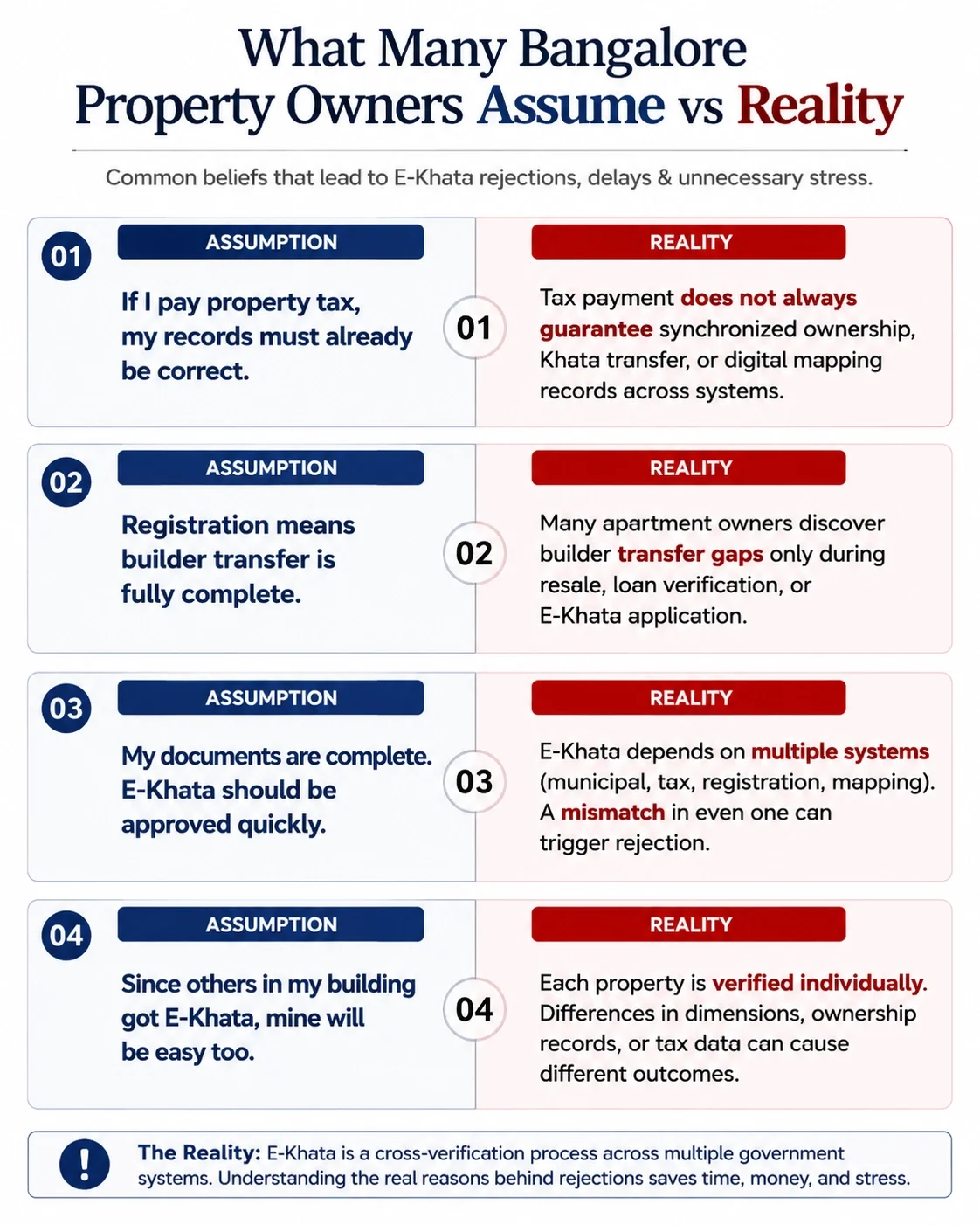
3. Not Sure Which Record Is Actually Causing the Rejection?
Many owners spend weeks correcting the wrong issue because:
- builder records,
- tax records,
- ownership records,
- and municipal databases often do not fully match.
A short workflow review can often identify: the likely mismatch, missing records, and the fastest correction path. Many owners assume their issue is highly complex when the actual problem is often a mismatch between just one or two municipal records.
4. REAL-WORLD PATTERNS WE’VE SEEN IN BANGALORE
While every property case is different, certain issue patterns appear repeatedly across Bangalore’s E-Khata workflows. These patterns often surface only during:
- resale,
- loan verification,
- inheritance transfer,
- or document correction.
Pattern 1 — Property Tax Paid for Years, But Transfer Was Never Fully Completed
A common apartment issue involves owners regularly paying property tax, while the underlying municipal ownership transfer workflow was never fully completed by the builder or previous owner.
The issue becomes visible only during resale, loan processing, or E-Khata correction.
Pattern 2 — Dimension Mismatch Appears During Loan Verification
Many owners first discover flat-dimension inconsistencies only after banks begin technical verification for a home loan.
In several apartment projects, parking area, built-up area, and tax-record dimensions were historically recorded differently across systems.
Pattern 3 — Property Exists in Tax Records but Not in Digital Mapping
Some owners discover that:
- Tax records exist,
- But the property is missing or incomplete inside the digital E-Khata workflow.
This is more common in: older layouts, legacy BBMP zones, and manually maintained historical records.
Pattern 4 — Family-Owned Properties Have Incomplete Ownership Updates
Inherited properties often contain:
- partially updated ownership chains,
- missing succession linkage,
- or inconsistent naming across older records.
These issues may remain invisible for years until a transaction begins.
Pattern 5 — Owners Assume Tax Payment Automatically Means Records Are Clean
One of the most common misconceptions is:
“If I have paid property tax regularly, my records must already be correct.”
In practice, tax payment alone does not always guarantee:
- ownership consistency,
- clean digital mapping,
- updated Khata transfer,
- or synchronized municipal records.
5. WHICH E-Khata ISSUES CAN YOU HANDLE YOURSELF?
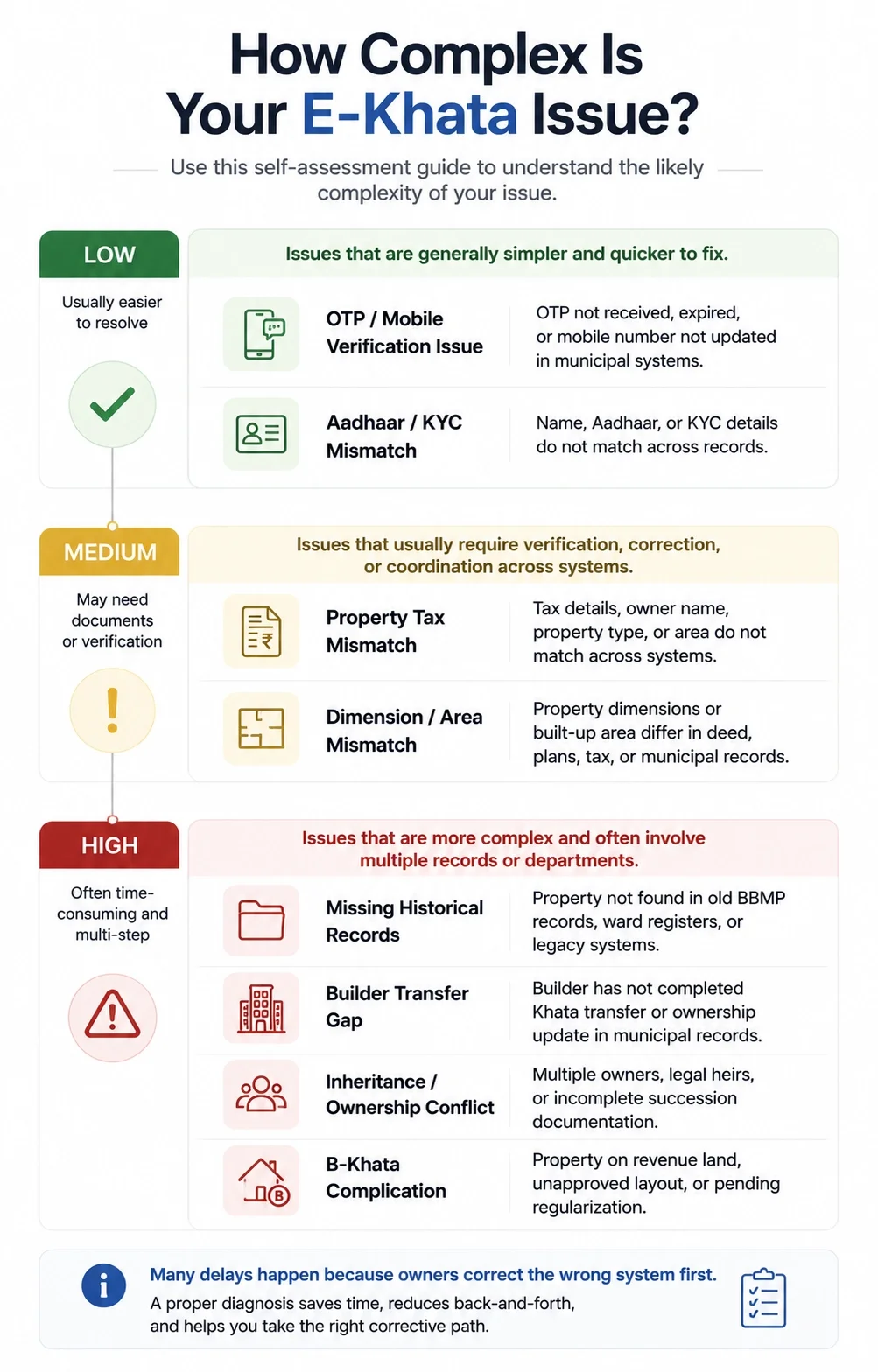
Not every E-Khata rejection requires professional assistance. Some issues are relatively straightforward. Others involve multiple municipal systems, historical records, or ownership complications that can significantly increase resolution time. Understanding the difference can save both time and unnecessary stress.
Usually Simpler Issues
These are often easier to resolve directly through standard correction workflows:
- Aadhaar or OTP verification issues
- Minor spelling corrections
- Mobile-number mismatch
- Simple document upload problems
- Minor KYC inconsistencies
- Basic portal submission errors
In many such cases, owners can resolve issues themselves if: records are otherwise consistent, no transaction urgency exists, and supporting documents align properly.
More Complex Issues
Some situations become significantly more complicated because they involve: older manual records, conflicting ownership history, multiple systems, or incomplete municipal workflows.
These often include:
- Missing historical records,
- Repeated rejections,
- B-Khata complications,
- Builder transfer failures,
- Inheritance-linked ownership issues,
- Dimension conflicts,
- Or digitization inconsistencies.
Repeated
Professional support may become useful when:
- A sale timeline is already active,
- Home loan approval is delayed.
- records conflict across systems,
- municipal corrections keep repeating,
- The ownership history is unclear.
In many cases, the biggest delay is not the correction itself. It is identifying:
- which system actually contains the problem,
- which documents conflict,
- and which correction pathway applies to the property.
Not Sure Whether Your E-Khata Issue Is Simple or Complex?
If your application has been rejected multiple times, records do not match across systems, or a property sale or loan approval is on hold, identifying the actual source of the problem is often the hardest part.
👉 Kustodian can help review your records, identify the root cause, and guide you toward the correct resolution path.
6. WHAT TO DO AFTER AN E-KHATA REJECTION
For many property owners, the most stressful part of the process is not the rejection itself. It is:
- Not knowing what caused it,
- Which department is involved?
- Or what should happen next.
In practice, many E-Khata issues are fixable once the underlying mismatch or missing record is identified correctly.
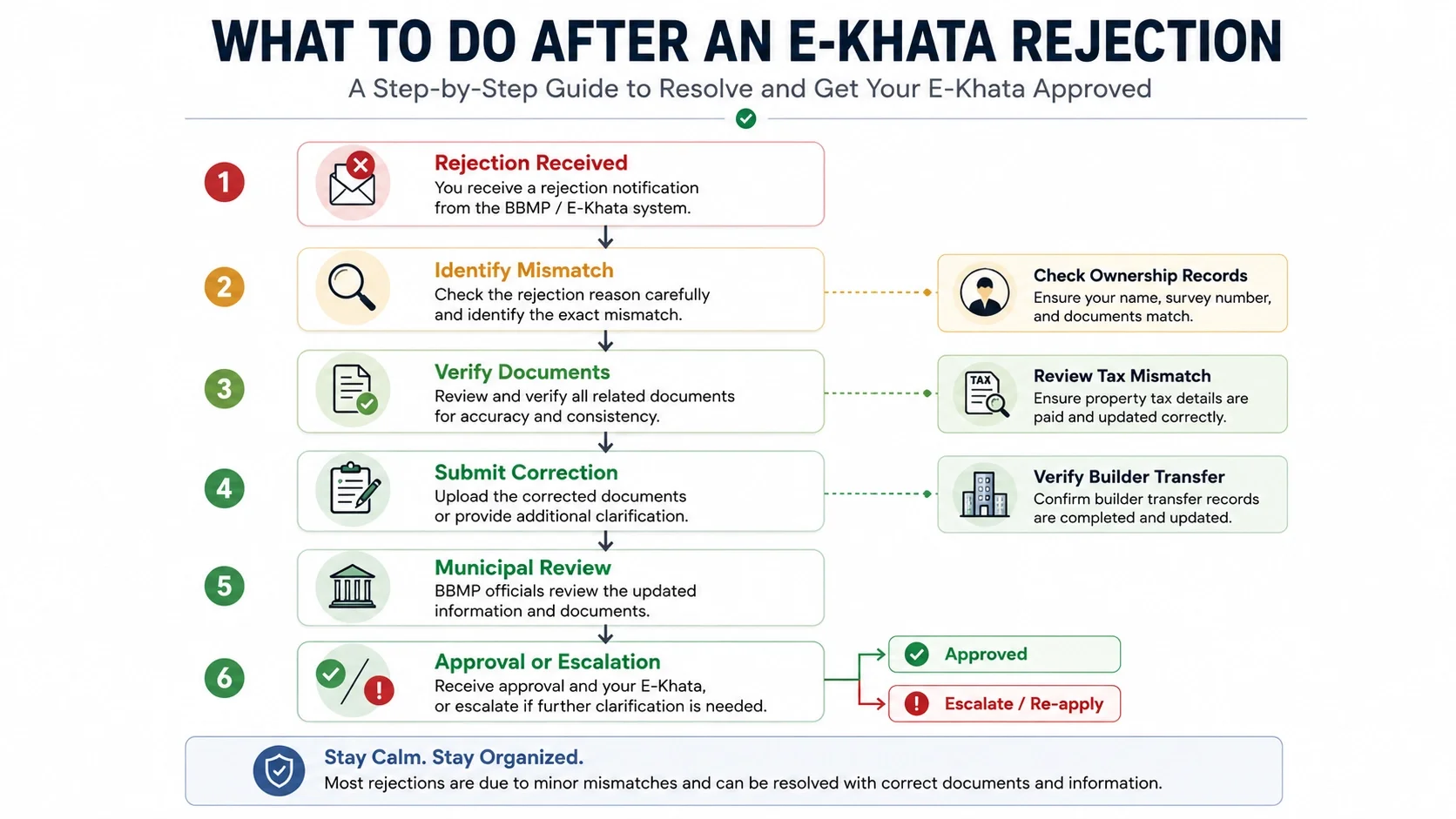
A Practical Next-Step Flow
Step 1 — Understand the Actual Rejection Reason
Start by identifying: which document, record, or verification stage triggered the rejection or delay.
In many cases, the visible issue is only a symptom of a deeper mismatch between:
- tax records,
- ownership records,
- builder documentation,
- EC data,
- or municipal mapping systems.
Step 2 — Verify Supporting Documents
Carefully compare: sale deed, EC, property tax records, Khata details, builder documentation, and ownership information.
Look specifically for:
- spelling differences,
- dimension inconsistencies,
- incomplete ownership updates,
- or missing historical records.
Step 3 — Submit Correction or Clarification
Depending on the issue, this may involve:
- updating records,
- uploading corrected documents,
- responding to verification requests,
- or initiating municipal correction workflows.
Simple issues are often resolved at this stage.
Step 4 — Escalate If the Issue Persists
More complex cases sometimes require:
- manual verification,
- historical record validation,
- clarification across departments,
- or escalation within municipal workflows.
This is especially common in older layouts, apartment projects, inherited properties, or manually maintained historical records.
Step 5 — Seek Structured Help If Time-Sensitive
If the issue is delaying:
- a property sale,
- home loan,
- registration,
- or transfer process,
Early workflow review may help identify: the actual mismatch, missing documentation, and the fastest correction path.
Important: Many owners lose time repeatedly correcting the wrong issue because the visible rejection reason is not always the root cause of the workflow failure.
7. FREQUENTLY ASKED QUESTIONS ABOUT E-KHATA REJECTIONS
Is E-Khata Connected to e-Aasthi?
In many municipal workflows, E-Khata processing increasingly overlaps with digitized property-record systems and e-Aasthi-linked verification workflows used across Karnataka municipal ecosystems.
Can a rejected E-Khata application usually be corrected?
Yes, many E-Khata rejections are correctable once the underlying mismatch or missing record is identified properly. The complexity depends on whether the issue involves simple verification errors or older ownership and municipal record conflicts.
Is E-Khata mandatory for property resale in Bangalore?
Increasingly, buyers, banks, and registration-related workflows expect updated E-Khata-linked digital verification, especially in the Bangalore municipal limits.
Is E-Khata proof of property ownership?
No. E-Khata is a municipal property record linked to taxation and verification workflows. Legal ownership is generally established through registered title documents such as sale deeds and supporting ownership records.
Can banks reject home loans because of E-Khata issues?
Yes. Banks may delay or reject loan processing if:
- ownership records conflict,
- dimensions mismatch,
- Khata records are incomplete,
- or municipal verification remains unresolved.
What happens if my property is missing from the E-Khata portal?
This usually indicates:
- incomplete digitization,
- mapping issues,
- or missing historical municipal records.
Older layouts and manually maintained properties are more likely to face such issues.
Are apartment owners more likely to face E-Khata rejection?
In many cases, yes.
Apartment-related rejections commonly involve:
- builder transfer gaps,
- parking-area mismatches,
- inconsistent dimensions,
- or incomplete municipal updates.
Can B-Khata properties face additional E-Khata complications?
Yes. B-Khata properties often involve:
- additional scrutiny,
- layout verification,
- financing limitations,
- or regularization-related complications.
The complexity varies significantly by property history and municipal status.
How long does E-Khata correction usually take?
Timelines vary widely depending on:
- issue complexity,
- record quality,
- municipal verification requirements,
- and whether historical corrections are involved.
Simple verification corrections may resolve relatively quickly, while older record conflicts can take significantly longer.
Why do issues surface only during resale or loan processing?
Many record inconsistencies remain invisible until:
- banks begin technical verification,
- buyers request updated documentation,
- or municipal systems cross-check records during transactions.
This is why owners often discover problems years after purchase.
Can inheritance-related properties face E-Khata rejection?
Yes. Inherited properties frequently involve:
- incomplete ownership updates,
- missing succession linkage,
- or inconsistent historical records across systems.
Does paying property tax guarantee records are clean?
Not always.
Property tax compliance does not automatically guarantee:
- ownership consistency,
- completed Khata transfer,
- clean digital mapping,
- or synchronized municipal records.
What documents are commonly required during correction?
Commonly referenced documents include:
- sale deed,
- Encumbrance Certificate (EC),
- property tax receipts,
- earlier Khata documents,
- Aadhaar-linked verification,
- and supporting ownership records.
Can older Bangalore properties face more issues?
Yes. Older layouts and manually maintained records are more likely to contain:
- incomplete digitization,
- inconsistent ownership history,
- or historical record gaps.
Are repeated E-Khata rejections common?
They can happen when:
- the underlying mismatch is not identified correctly,
- multiple systems contain conflicting data,
- or correction workflows address symptoms instead of root causes.
Can incorrect property dimensions create legal or financial issues later?
Potentially yes.
Dimension inconsistencies can affect:
- resale verification,
- loan processing,
- municipal approvals,
- and future documentation workflows.
8. IS YOUR E-KHATA ISSUE DELAYING A SALE, LOAN, OR REGISTRATION?
For many Bangalore property owners, the biggest challenge is not just the rejection itself.
It is:
- understanding which record is actually wrong,
- identifying where systems conflict,
- and avoiding weeks or months of repeated correction cycles.
In many cases, issues involving:
- property dimensions,
- builder transfer gaps,
- tax mismatches,
- missing records,
- or ownership inconsistencies can often be identified early once the full workflow is reviewed properly.
How Kustodian Helps
Kustodian works on high-friction documentation and financial workflows across:
- property-linked processes,
- inheritance,
- claims,
- EPF,
- and record-verification systems in India.
For E-Khata-related cases, we help property owners:
- identify likely rejection triggers,
- understand documentation gaps,
- review workflow inconsistencies,
- and navigate correction pathways more efficiently.
When a Review May Help
Support may become useful when:
- a property sale timeline is active,
- a bank loan is delayed,
- repeated rejections continue,
- records conflict across systems,
- or older/manual records are involved.
In many situations, the biggest delay is simply:
- not knowing which system contains the actual issue,
- or correcting the wrong problem repeatedly.
Book a 15-Minute Consultation
A short consultation can often help identify:
- likely mismatch points,
- missing documentation,
- municipal workflow blockers,
- and possible next steps.
Important:
Every property case is different. Resolution timelines and correction requirements vary depending on documentation quality, ownership history, municipal records, and workflow complexity.