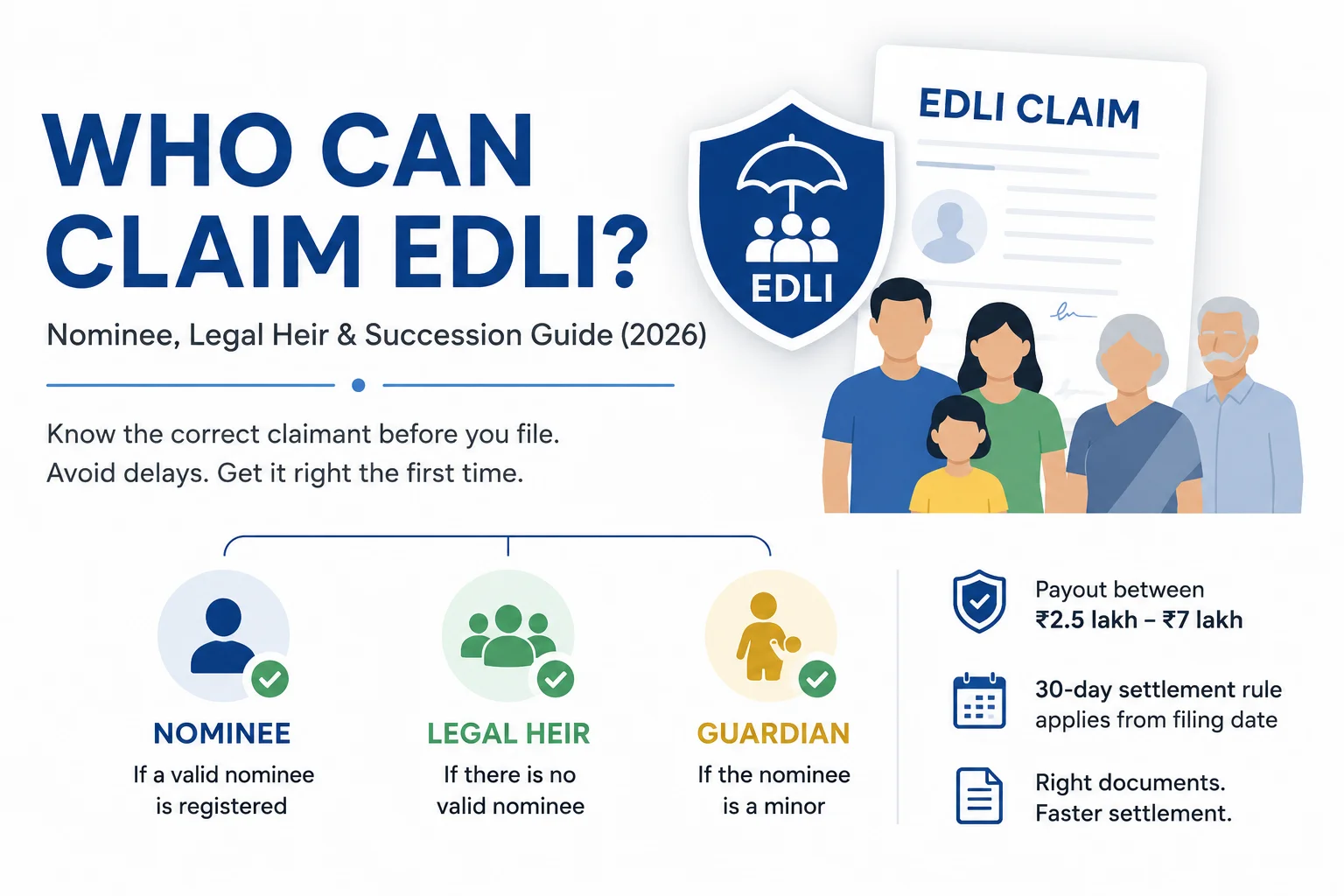
EDLI pays out between ₹2.5 lakh and ₹7 lakh on an EPF member's death, but the claim can't move until you know who is entitled to file it. Get the claimant wrong, and you don't just lose time: EPFO restarts document verification from zero. Since July 2025, even members with under a year of service are covered, with a ₹50,000 minimum benefit regardless of PF balance, so the claimant question now applies to almost every case, not just long-tenured employees.
Quick Answer
| Your Situation | Who Can Claim |
|---|---|
| Valid nominee exists | Named nominee |
| No nominee | Eligible legal heir(s), per applicable personal law |
| Minor nominee | Guardian, on behalf of the minor |
| Nominee died before the employee | Eligible legal heir(s) |
If a nominee exists, the claim path is settled — skip to EDLI Documents Required. If not, the next section determines who qualifies.
Not sure who can claim the EDLI benefit?
Whether you're a nominee, legal heir, or guardian, Kustodian can help you understand your eligibility and the documents you'll need.
How Legal Heirs Are Determined (This Is Where Most Claims Get Stuck)
"Legal heir" isn't one fixed rule in India - it's set by the deceased member's personal law. This is the step most claimants skip, and it's the one that determines which certificate EPFO will actually accept.
| Personal Law Applies To | Governing Act | Who's Typically in the First Priority Circle |
|---|---|---|
| Hindus, Buddhists, Jains, Sikhs | Hindu Succession Act, 1956 | Spouse, children, and mother, as Class I heirs under the Act's Schedule |
| Muslims | Muslim Personal Law (Shariat), varies by Sunni/Shia school | Spouse, children, and parents, with shares fixed by religious inheritance rules rather than a single "class" |
| Christians, Parsis | Indian Succession Act, 1925 | Spouse and children, per the shares specified in the Act |
Exact shares differ by family composition and, for Muslim succession, by school of law - this table tells you which framework applies, not the final split. That's what determines whether EPFO will ask for a legal heir certificate (simpler, issued by local revenue authorities) or push you toward a succession certificate (court-issued, needed when heirship or the estate itself is disputed).
Kustodian Tip: Confirm which personal law applies before requesting any certificate. Applying for the wrong one is the single most common cause of EDLI claim delays after the nomination question itself.
Nominee vs. Legal Heir: The Procedural Difference
| Nominee | Legal Heir | |
|---|---|---|
| How determined | Named by the employee in the EPF records | Determined by personal law after death |
| Claim form | Form 5 IF — filed directly | Form 5 IF, plus heir-verification documents |
| Typical certificate needed | None beyond ID/nomination proof | Legal heir certificate, or succession certificate if heirship is disputed |
| Settlement clock | 30 days from filing | 30 days from filing, but the clock doesn't start until heir documents are verified |
The nominee path skips heir verification entirely - it's the fastest route by design. Everything below applies only when no valid nominee exists.
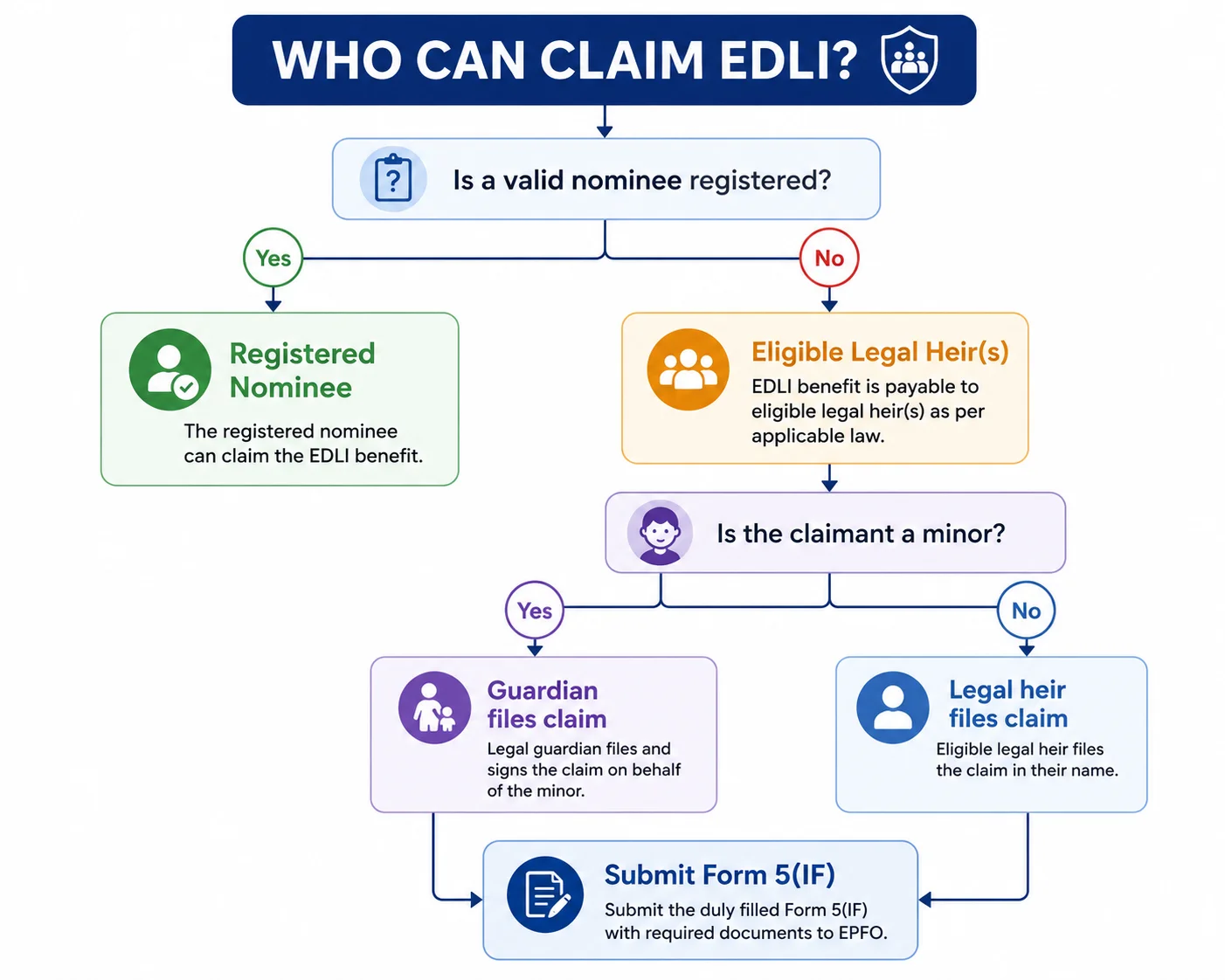
No Nominee: What Actually Happens
The claim moves to legal heirs, but three things change:
- The form is the same. Legal heirs file the same Form 5 IF a nominee would - the difference is what's attached to it.
- A guardian steps in for minors. If the identified heir is a minor, their guardian files and signs on their behalf; multiple minors under one guardian can be covered by a single form.
- The statutory deadline still runs. EPFO must settle the claim within 30 days of filing; if it doesn't, the Regional PF Commissioner is liable to pay 12% annual interest from the deadline until actual disbursal. That deadline is your leverage if a claim stalls - most claimants don't know it exists.
If the deceased hadn't completed a year of continuous service, the 50,000 minimum floor introduced in July 2025 still applies to legal heirs — the claim doesn't fail just because tenure was short.
Common Nomination Mistakes
| Mistake | Consequence |
|---|---|
| No nomination ever recorded | Full legal heir verification required, adding weeks |
| Nomination not updated after marriage or a new child | EPFO may reject the outdated nominee, forcing a heir-based refile |
| Nominee details don't match current EPF/Aadhaar records | Claim held for re-verification |
| Family assumes an "obvious" nominee without checking EPF records | Claim filed by the wrong person, then has to be corrected and refiled |
Most of these are fixable before death, not after — a five-minute nomination check on the EPFO member portal prevents nearly all of them.
Unsure if the EDLI nomination is correct?
A missing or outdated nomination can significantly delay the claim process. Kustodian can help you verify nominee details, understand who is eligible to claim, and prepare the right documents before filing.
Before You File: Pre-Claim Checklist
- Confirmed whether a valid nominee is on record
- Identified which personal law governs heir determination (if no nominee)
- Confirmed whether a legal heir certificate or succession certificate is required
- Have Form 5 IF and the employer's certification of date of death ready
- Know the 30-day settlement deadline applies from the filing date
Need Help Identifying the Correct Claimant?
Most delays trace back to one of two errors: the wrong nominee record, or a heir certificate that doesn't match the personal law that actually governs the estate. Kustodian reviews the family and nomination situation before you file — not after EPFO sends it back.
What we check:
- Whether the on-file nomination is valid and current
- Which personal law applies, and which certificate does it require
- Whether the 12-month continuous service and gap-tolerance rules affect the payout tier
- Document readiness before submission, not after rejection
Frequently Asked Questions
What's the actual EDLI payout range?
Between ₹2.5 lakh and ₹7 lakh, calculated as 35 times the average monthly salary over the last 12 months, plus a bonus component. Since July 2025, members who die before completing a year of service are still guaranteed a ₹50,000 minimum, regardless of PF balance.
Legal heir certificate or succession certificate - which one do I need?
A legal heir certificate, issued by a local revenue/municipal authority, is usually sufficient when heirship is undisputed, and the personal law's priority order is clear. A succession certificate - issued by a civil court — is required when heirship is contested, when multiple heirs disagree, or when the estate involves other assets beyond EPF. Which one EPFO accepts depends on the case, not a fixed list.
Can a minor nominee or heir actually receive the money?
Yes — a legal guardian files Form 5 IF and receives the funds on the minor's behalf until the minor can act independently.
Does the 30-day settlement rule actually get enforced?
It's a statutory obligation on the Regional PF Commissioner, with a 12% annual interest penalty for late disbursal. In practice, claims stall most often at the document-verification stage before the clock is even considered "started," which is why getting the claimant and certificate right up front matters more than the deadline itself.
What if the nominee died before the employee?
The claim moves to legal heirs under the applicable personal law, following the same process as if no nomination existed.
Need help identifying the correct EDLI claimant?
Whether you're a nominee, legal heir, or guardian, Kustodian can help you understand eligibility, verify the required documents, and guide you through the claim process. Avoid unnecessary delays by getting expert assistance before you file.
Key Takeaway
The claimant question has two layers, not one: first, whether a valid nomination exists; second — if it doesn't — which personal law determines the heir order, because that decides which certificate EPFO will accept. Skipping the second layer is what turns a 30-day claim into a multi-month one.
PF Interest Loss Calculator
See how much interest you lose every month your claim sits unresolved.