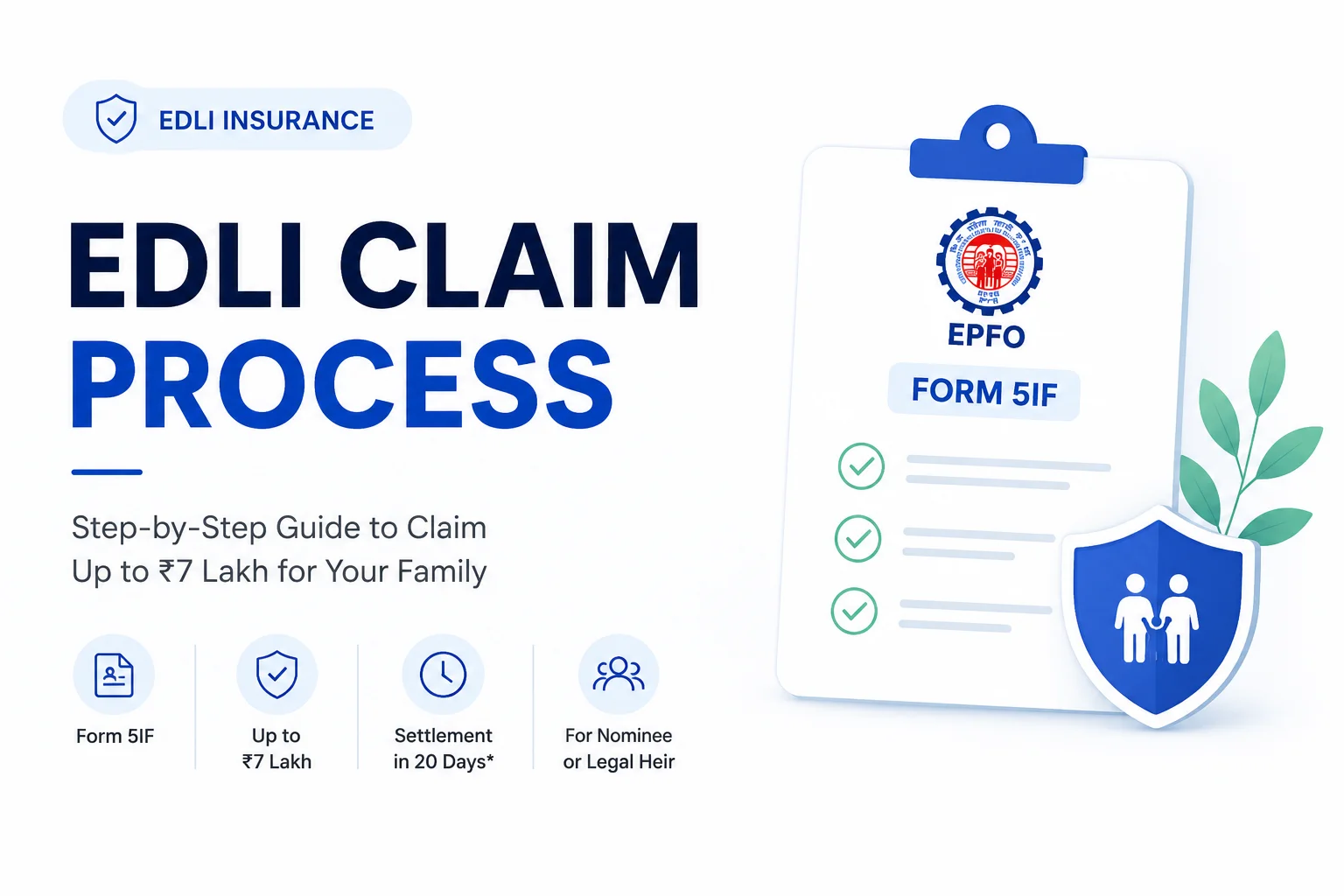
If an EPF member dies while covered under the Employees' Deposit Linked Insurance (EDLI) scheme, the family can claim a lump-sum benefit of up to ₹7 lakh. The claim is filed on Form 5IF, usually through the employer, and processed after eligibility, document, and claimant verification.
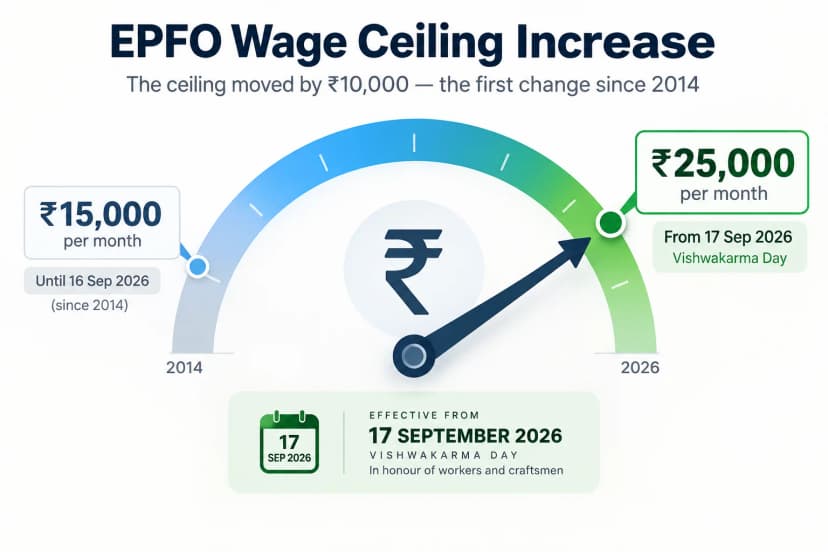
The scheme itself changed name and legal basis on 29 June 2026 — the government replaced the EDLI Scheme, 1976 with the EDLI Scheme, 2026 (G.S.R. 526(E)), notified alongside new EPF and EPS schemes under the Code on Social Security, 2020. The ₹7 lakh ceiling, the 0.5% employer-only contribution, and the ₹15,000 wage cap used in the payout formula are unchanged — but the claim-processing timeline has moved, and it matters for anyone filing now. Details below.
Quick Answer
| Question | Answer |
|---|---|
| Who can claim EDLI? | The registered nominee. If none exist, the eligible legal heir(s). A guardian files for a minor nominee. |
| Which form is required? | Form 5IF. |
| Where is it submitted? | Usually, through the employer, who verifies and forwards it to EPFO. Direct submission to EPFO is permitted in specific situations (employer closed, unresponsive, etc.). |
| Can it be filed online? | Partially full e-nomination cases can be filed through the UAN portal; most others still need physical documents and employer attestation. |
| How long does it take? | Under the EDLI Scheme, 2026, claims complete in all respects are targeted for settlement within 20 days. Incomplete claims take longer. |
| Maximum benefit? | ₹7 lakh, with a minimum guaranteed benefit down to ₹50,000 depending on service length (see Step 1). |
Need help filing an EDLI claim?
From checking eligibility to preparing Form 5IF and the required documents, Kustodian can guide you through every step of the process.
What Changed With the EDLI Scheme, 2026
On 29 June 2026, the Ministry of Labour and Employment notified the EDLI Scheme, 2026, replacing the EDLI Scheme, 1976, alongside new EPF and EPS schemes under the Code on Social Security, 2020. For a claimant, three things are worth knowing:
- The benefit structure is unchanged. Maximum payout stays at ₹7 lakh, employer contribution stays at 0.5% of wages with no employee contribution, and the ₹15,000 wage ceiling used in the calculation is unchanged.
- Processing has a tighter clock. The government's own commentary accompanying the 2026 reforms sets a 20-day settlement target for pension and EDLI claims that are complete and need no further verification — down from the earlier norm. Claims with missing documents or discrepancies fall outside this clock.
- Digitisation is a stated priority, not yet a universal reality. The new scheme pushes toward Aadhaar-authenticated, UAN-portal-based claims. In practice, most EDLI claims outside clean e-nomination cases still involve physical attestation — this hasn't disappeared with the rename.
Nothing about who can claim or what documents are needed has changed. The rest of this guide reflects the process as it stands under the 2026 scheme.
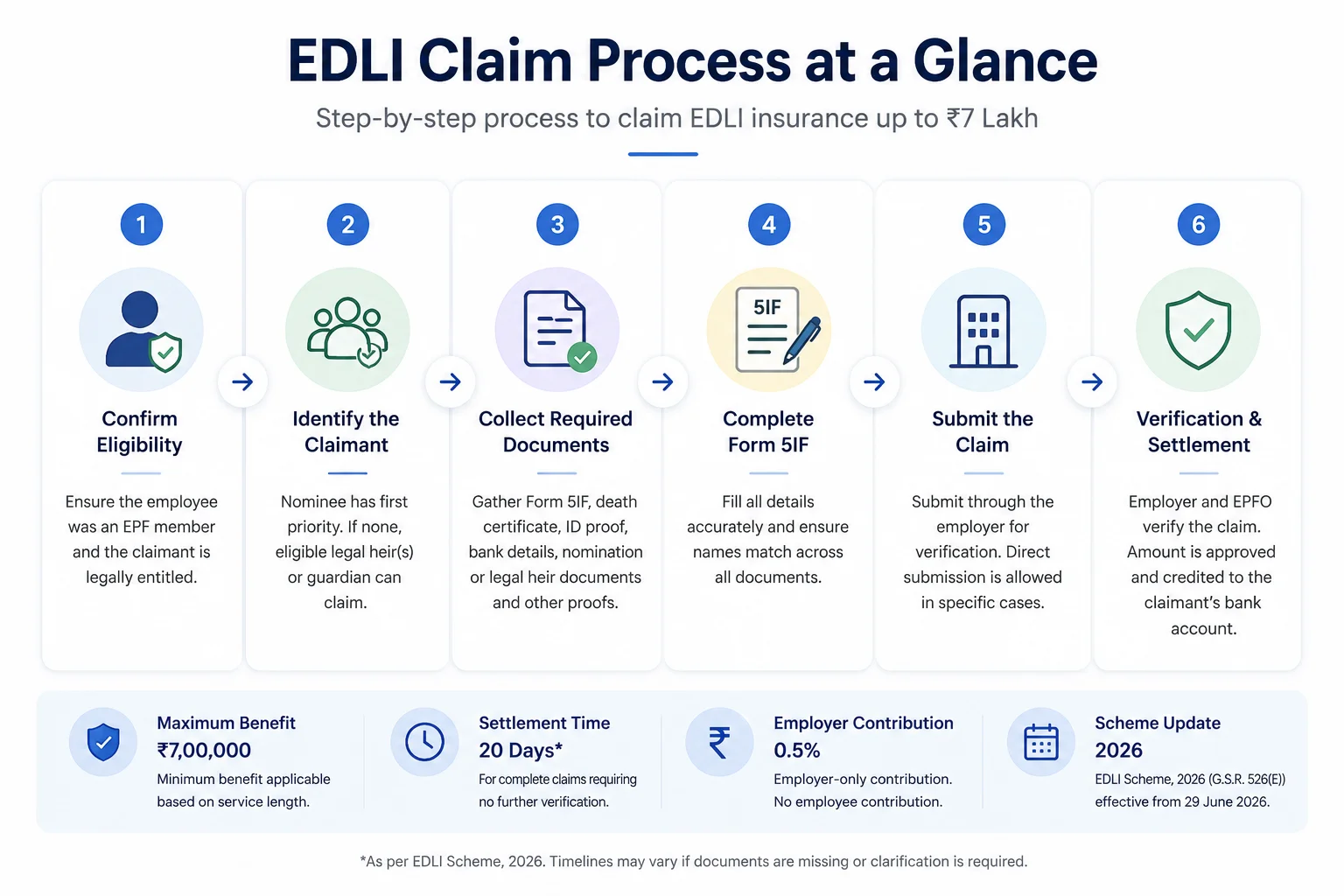
EDLI Claim Process at a Glance
Employee passes away
        │
        ▼
Step 1 — Confirm eligibility
        │
        ▼
Step 2 — Identify the eligible claimant
        │
        ▼
Step 3 — Collect required documents
        │
        ▼
Step 4 — Complete Form 5IF
        │
        ▼
Step 5 — Submit the claim
        │
        ▼
Step 6 — Employer + EPFO verification
        │
        ▼
Benefit approved and credited
Most delays happen before EPFO starts processing — incomplete documents, an unclear claimant, missing employer verification, or a bank-detail mismatch. Getting Steps 1–4 right is what actually determines your timeline.
How the EDLI Benefit Is Calculated
The payout has two components, added together and capped:
| Component | Formula | Cap |
|---|---|---|
| Wage component | 35 × average monthly Basic + DA over the last 12 months | ₹5,25,000 (since wages above ₹15,000/month are capped at ₹15,000 for this calculation) |
| PF component | 50% of the average monthly PF balance over the last 12 months | ₹1,75,000 |
| Total payable | Wage component + PF component | Minimum ₹2,50,000 (or ₹50,000 for short service — see Step 1), maximum ₹7,00,000 |
Want the number without doing the math? Use the EDLI Calculator.
Before You Begin
Have these ready before you start:
- Employee's UAN or PF account number
- Death certificate
- Employee's most recent salary slips or employment proof
- Claimant's identity proof
- Claimant's bank account details
- Nomination record or legal heir documents, if applicable
Step 1 — Confirm EDLI Eligibility
Before collecting documents, confirm the claim actually qualifies. Use Kustodian's 3-Point Eligibility Check:
| Check | Why it matters |
|---|---|
| 1. Was the employee an EPF member? | EDLI coverage is automatic for every EPF member — there's no separate enrolment or opt-in. |
| 2. Did the employee die while in service? | EDLI covers death during active service. Coverage after resignation depends on how recently service ended (see Special Situations). |
| 3. Is the claimant legally entitled? | Only the registered nominee, or in their absence the eligible legal heir(s), can claim. |
Service length affects the minimum guaranteed benefit, not eligibility itself:
| Service length at time of death | What the legal heirs are entitled to |
|---|---|
| 12+ months continuous service (portable across employers if the gap between jobs was under 12 months) | Full formula applies; minimum guaranteed benefit is ₹2,50,000 |
| 6–12 months continuous service, on the rolls of an EPF-covered employer at death | Eligible for the EDLI benefit under the formula |
| Under 12 months of continuous service | Minimum ₹50,000 is payable to the legal heirs regardless of PF balance |
This guide assumes eligibility is confirmed. For edge cases — international workers, exempted trusts, resignation shortly before death — see the EDLI Eligibility Guide.
Step 2 — Identify the Eligible Claimant
EPFO recognises claimants in a strict order. Don't skip ahead in this list, even if it seems obvious who "should" claim.
| Priority | Who can claim | Extra requirement |
|---|---|---|
| 1 | Registered nominee (e-nomination on the UAN portal, or physical Form 2 on file) | None, if the nomination is valid and unambiguous |
| 2 | Eligible legal heir(s), if no nominee is registered | Legal heir certificate or succession documents establishing entitlement |
| 3 | Guardian, if the nominee or heir is a minor | Guardianship proof; benefit is typically held for the minor until majority per EPFO's minor-payment rules |
If more than one legal heir has an equal claim, EPFO may require a joint declaration or supporting legal documents before releasing payment — resolving this among family members before filing avoids the single most common cause of multi-month delays in no-nominee cases.
Related: EDLI Nomination & Legal Heir Guide
Need help confirming EDLI eligibility?
If you're unsure whether the claimant is eligible or which documents are required, Kustodian can help you review your case before you file.
Our experts guide nominees and legal heirs through the EDLI claim process to help avoid unnecessary delays.
Step 3 — Collect the Required Documents
Documents are split into what's needed in every case and what depends on your specific situation.
Every claim needs:
| Document | Notes |
|---|---|
| Form 5IF | Covered in Step 4 |
| Death certificate | Issued by the municipal/local authority |
| Claimant's identity proof | Aadhaar, PAN, or voter ID |
| Claimant's bank proof | Cancelled cheque or passbook copy showing account number and IFSC |
| Employee's UAN / PF account details | From payslips or the UAN card |
Add, depending on the situation:
| Situation | Additional documents |
|---|---|
| No registered nominee | Legal heir certificate or succession certificate |
| Minor nominee or heir | Guardianship certificate, minor's birth certificate |
| Employer closed or untraceable | Proof of closure (if available) and an alternate attestation (see Step 4) |
| Filing PF and pension together | Form 20 (EPF) and Form 10D or 10C (EPS) |
Full checklist by scenario: EDLI Documents Required
Step 4 — Complete Form 5IF
Form 5IF has three parts:
- Claimant and deceased member details — UAN, name, date of death, and relationship of claimant to the deceased. Names must match exactly across Form 5IF, Aadhaar, and the bank passbook; a spelling mismatch is one of the most common rejection triggers.
- Claim and bank details — the account into which the benefit should be credited, plus a cancelled cheque attached as proof.
- Employer's certificate — the employer confirms employment and EDLI coverage, then signs and stamps the form.
If the employer is closed, untraceable, or unavailable to attest, EPFO accepts attestation from an alternate authority, commonly: a Gazetted Officer, a Magistrate, the Manager of a nationalised or scheduled bank, the head of the local Panchayat/Municipal body, or a Member of Parliament or the State Legislature. Confirm the accepted list with your regional EPFO office before submission, since practice can vary by region.
Field-by-field walkthrough with a filled sample: Form 5IF: Complete Guide
Step 5 — Submit the Claim
| Situation | Where to submit | Who verifies |
|---|---|---|
| The employer is operating | Through the employer | Employer, then EPFO |
| Employer closed or unresponsive | Directly to the concerned EPFO office, where permitted | EPFO, after alternate-authority attestation |
| Exempted PF trust | Per the trust's process | Trust and/or EPFO depending on the case |
Before you submit:
- Eligibility confirmed (Step 1)
- Correct claimant identified (Step 2)
- All documents attached (Step 3)
- Form 5IF complete, names consistent across all documents
- Bank details verified
- Copies retained for your records
Step 6 — What Happens After Submission
Claim received
      │
      ▼
Employer verification (where applicable)
      │
      ▼
Document + eligibility verification by EPFO
      │
      ▼
Clarification requested, if needed
      │
      ▼
Claim approved → Benefit credited
Under the EDLI Scheme, 2026, a complete claim requiring no further clarification is targeted for settlement within 20 days. If EPFO misses this without sufficient cause, penal interest can accrue on the claim amount. Claims with missing documents, name mismatches, or nominee disputes fall outside this clock until resolved.
Worked Example: How a Claim Actually Pays Out
Ramesh, an EPF member, dies while in active service after more than a year of continuous employment. His wife Meena, is the registered nominee.
| Input | Value |
|---|---|
| Average monthly Basic + DA (last 12 months) | ₹22,000 (above the ₹15,000 wage ceiling) |
| Average monthly PF balance (last 12 months) | ₹3,10,000 |
Calculation:
- Wage component: 35 × ₹15,000 (capped) = ₹5,25,000
- PF component: 50% × ₹3,10,000 = ₹1,55,000, which is within the ₹1,75,000 cap → ₹1,55,000
- Total: ₹5,25,000 + ₹1,55,000 = ₹6,80,000
Since ₹6,80,000 falls between the ₹2,50,000 floor and ₹7,00,000 ceiling, Meena is entitled to the full ₹6,80,000, provided Form 5IF, the death certificate, her ID, and bank proof are submitted and verified without discrepancy.
How Long Does an EDLI Claim Take?
There's no single number that applies to every claim — but under the EDLI Scheme, 2026, the stated target for a claim that's complete and requires no further verification is 20 days. What actually determines whether you hit that target:
| Stage | What affects the timeline |
|---|---|
| Document collection | Entirely within the claimant's control — the fastest-moving stage when prepared in advance |
| Employer verification | Varies by employer's responsiveness; the most common bottleneck |
| EPFO verification | Faster when documents and claimant details are internally consistent |
| Payment credit | Follows approval; delayed only by bank-detail errors |
What usually causes delays:
- Missing or incomplete documents
- Incorrect bank account details
- Name mismatches across records
- Employer verification delays
- Unresolved nominee or legal heir disputes
- Additional clarification requested by EPFO
Can the EDLI Claim Be Filed Online?
Partially, and this hasn't fundamentally changed under the 2026 scheme's digitisation push.
| Activity | Online? |
|---|---|
| Check eligibility | Yes |
| Download Form 5IF | Yes |
| File via the UAN portal (clean e-nomination cases) | Yes, in growing use |
| Employer attestation | Mostly offline |
| No-nominee / legal-heir cases | Mostly offline |
| Track progress | Limited, via EPFO office or EPFiGMS |
If you're unsure whether your case qualifies for the online route, confirm with your regional EPFO office before assuming — filing offline when eligible for online (or vice versa) just adds a round trip.
How to Track Your EDLI Claim Status
| Stage | Who to contact | What to ask |
|---|---|---|
| Submitted to the employer | Employer / HR | Has this been verified and forwarded to EPFO? |
| Submitted to EPFO | Concerned EPFO office | Has it been received? Is anything pending from my side? |
| Delayed | EPFO / EPFiGMS | What stage is it at, and what's causing the delay? |
Keep the UAN, claimant name, submission date, and any acknowledgement number on hand when you follow up.
Kustodian's Delay Prevention Checklist
Run through this before submission — in our experience, delays are almost always caused by one of these, not by complex legal issues:
- Correct claimant identified per the priority order in Step 2
- Every mandatory and situation-specific document is attached
- Names match exactly across Form 5IF, ID proof, and bank passbook
- Bank account number and IFSC double-checked
- Form 5IF signed by claimant and attested by employer (or alternate authority)
- Copies of everything submitted are retained
If the claim has already stalled: confirm the employer actually forwarded it, check whether EPFO has requested clarification, verify bank and claimant details, and if needed, raise a grievance through EPFiGMS.
Need help tracking your EDLI claim?
If you're unsure where your claim is stuck or what to do next, Kustodian can help you understand the status, identify pending requirements, and guide you through the follow-up process.
Special Situations
No nominee registered: The eligible legal heir(s) can claim, with additional documents establishing legal entitlement. See EDLI Nomination & Legal Heir Guide.
The employer has closed: EPFO may permit direct submission with alternate-authority attestation (Step 4). Confirm the process with the concerned EPFO office before filing.
Employer refuses to submit: Contact the concerned EPFO office directly; employers are expected to assist with eligible claims and refusal doesn't block the claimant's entitlement.
Employee died shortly after resignation or job change: Coverage depends on continuity of service — see the service-length table in Step 1. Don't assume ineligibility just because the employee had recently left.
The employee had under 12 months of service: Legal heirs are still entitled to a minimum ₹50,000, regardless of the PF balance, provided the employee was on the rolls of an EPF-covered employer at death.
Multiple legal heirs: EPFO may require a joint declaration or additional legal documents. Resolving entitlement among heirs before filing avoids the slowest category of delay.
Minor nominee: A lawful guardian files on the minor's behalf; the benefit is typically held for the minor per EPFO's minor-payment rules.
Exempted PF trust: Confirm the trust's specific claim process first; statutory eligibility is unchanged, but the administrative route may differ.
International Worker: May be covered, subject to applicable provisions and any relevant international social security agreement.
Need Help With an EDLI Claim?
Kustodian has helped 9,000+ Indian families recover EPF, insurance, and other unclaimed financial assets — including EDLI claims that stalled on exactly the issues covered in this guide.
| Situation | How we help |
|---|---|
| Unsure if the employee was eligible | Review available records against current EDLI requirements |
| No nominee registered | Identify the documents typically needed to establish legal heir status |
| Employer unresponsive | Explain the available next steps under the applicable process |
| Documents are missing or inconsistent | Review the full claim package and flag gaps before submission |
| Claim delayed | Identify which stage it's stuck at and the right next action |
| Claim rejected | Review the rejection reason and discuss corrective options |
Get an EDLI Claim Review before you submit — we check for the same issues that cause most rejections: wrong claimant, missing documents, name mismatches, bank errors, and incomplete employer attestation.
Frequently Asked Questions
1. What is the EDLI Scheme, 2026, and does it change how I claim?
It's the replacement for the EDLI Scheme, 1976, notified on 29 June 2026 (G.S.R. 526(E)) under the Code on Social Security, 2020. The benefit amount, contribution rate, and wage cap are unchanged; the main practical shift is a 20-day settlement target for complete claims and a continued push toward digital filing.
2. Can EDLI be claimed online?
Partially. Form 5IF and guidance are available online, and clean e-nomination cases can increasingly be filed through the UAN portal, but most claims — especially no-nominee or legal-heir cases — still require physical documents and employer attestation.
3. Can I claim EDLI without a nominee?
Yes. The eligible legal heir(s) can claim by submitting documents that establish legal entitlement. See the EDLI Nomination & Legal Heir Guide.
4. Can I submit the EDLI claim directly to EPFO?
Yes, where the employer has closed or refuses to process the claim. The concerned EPFO office can confirm the applicable procedure for your case.
5. How long does an EDLI claim take in 2026?
Under the EDLI Scheme, 2026, a complete claim needing no further verification is targeted for settlement within 20 days. Incomplete documentation or unresolved claimant disputes take longer and fall outside that target.
6. Can EDLI be claimed if the employee had resigned before death?
It depends on whether coverage continued at the relevant time — see the service-length table in Step 1. Resignation alone doesn't determine eligibility.
7. What happens if the employer refuses to submit the claim?
Contact the concerned EPFO office. In eligible situations, EPFO permits direct submission after alternate-authority attestation.
8. Can multiple legal heirs claim EDLI together?
Yes, though EPFO may require a joint declaration or additional documents before processing. Resolving entitlement before filing avoids the most common heir-dispute delays.
9. Can EDLI, EPF, and EPS benefits be claimed together?
Yes — they're separate benefits with separate eligibility conditions, but can be claimed together using Form 5IF (EDLI), Form 20 (EPF), and Form 10D or 10C (EPS).
Need help with an EDLI claim?
Whether you're filing as a nominee, legal heir, or guardian, Kustodian can help you understand your eligibility, prepare the required documents, and navigate the claim process from start to finish. Avoid common mistakes and unnecessary delays with expert guidance.
PF Interest Loss Calculator
See how much interest you lose every month your claim sits unresolved.