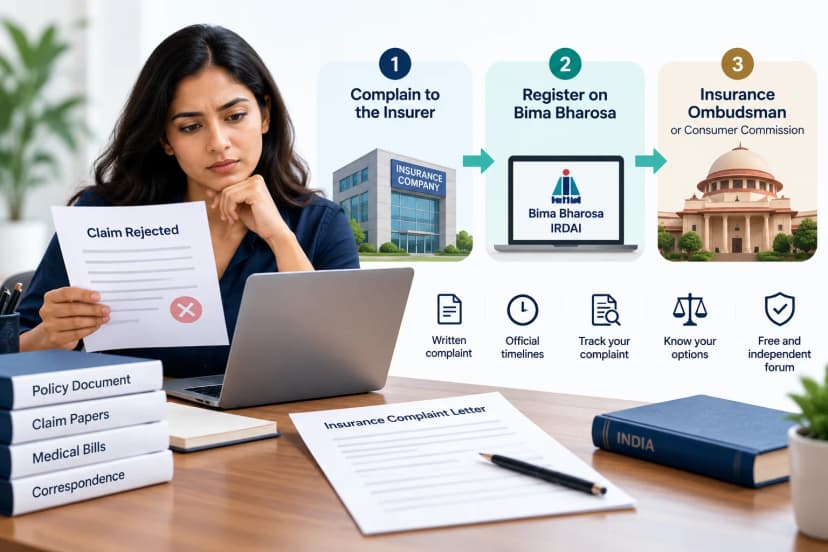
If your life insurance claim has been rejected, get the rejection letter, find the exact reason, and check one date first: was the policy (or its last revival) more than three years old when the policyholder died? If it was, Section 45 of the Insurance Act, 1938 bars the insurer from questioning the policy on any ground, including non-disclosure. If it wasn't, the insurer must prove that the fact it says was hidden was material. Challenge the reason with evidence, in writing, before the deadlines below run out.
| Deadline | Time limit |
|---|---|
| Insurer must reply to your written grievance | 14 days |
| Insurance Ombudsman (free, compensation sought up to ₹50 lakh) | Within 1 year of the rejection |
| Consumer commission | Within 2 years of the cause of action |

Why was your life insurance claim rejected?
| Reason given | What usually decides it | Your strongest evidence |
|---|---|---|
| Non-disclosure or misstatement | How old the policy was (Section 45), whether the fact was material, and whether the insurer can prove it | Policy and revival dates; proposal form; who filled it in |
| Fraud | The insurer must prove deliberate deception; after three years it can't be raised at all | Medical records showing the insured didn't know; disclosures made to the agent |
| Policy lapsed or premium unpaid | Whether death fell within the grace period, usually 30 days (15 for monthly premiums) | Premium receipts, bank debits, the premium due date |
| Suicide exclusion | Usually applies only if death was within 12 months of the policy start or revival; even then the nominee normally gets at least 80% of the premiums paid | Policy wording and revival date |
| Other exclusion (hazardous activity, intoxication, etc.) | Whether the clause actually matches the cause of death | Post-mortem report, FIR, the exact clause |
| Missing or mismatched documents | This is a requirement to fix, not a valid final rejection | Corrected documents; an affidavit for name or date variations |
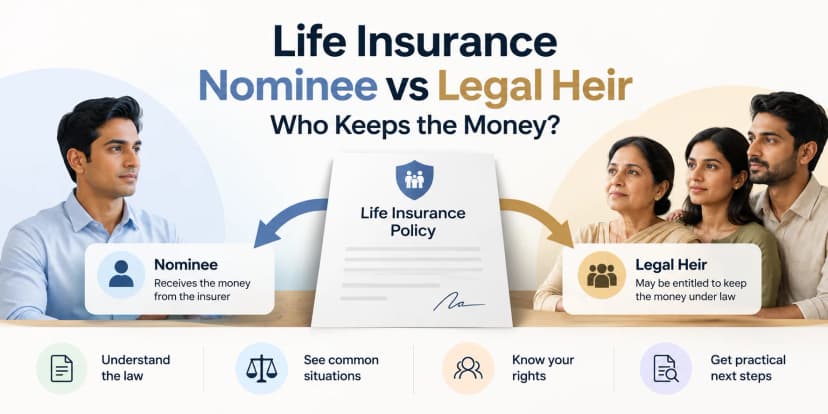
| Nominee or entitlement dispute | Not a rejection of the claim, but a question of who receives it | Nomination, assignment, succession papers. See nominee vs legal heir |
For a lapsed policy, LIC's own rules say a death claim is payable where death occurs within the days of grace; the outstanding premium is deducted.
Can a life insurance claim be rejected after 3 years?
No, not for non-disclosure, misstatement or fraud. Section 45 of the Insurance Act, as amended in 2015, sets the rules. The three years run from the date the policy was issued, the risk started, the policy was revived or a rider was added, whichever is latest.
| Death within 3 years | Death after 3 years | |
|---|---|---|
| Rejection for non-disclosure or misstatement | Allowed if the fact was material; grounds and evidence must be given in writing | Not allowed: Section 45(1) bars it on any ground |
| Rejection for fraud | Allowed, unless the claimant shows the statement was honestly believed true with no intent to suppress, or the insurer already knew the facts | Not allowed |
| Premium refund if rejected | Within 90 days if rejected for misstatement; none if rejected for fraud | Not applicable |
| Who must prove what | The insurer proves materiality; if fraud is alleged and the policyholder has died, the beneficiaries must disprove it | — |
| Still possible | Proof of age can be called for at any time | Proof of age; a lapsed policy remains lapsed |
If the policy was more than three years old and the claim was rejected for non-disclosure, cite Section 45(1) in your challenge. That is often decisive.
What courts look at in non-disclosure rejections
Within the three-year window, non-disclosure is the most common rejection reason. The Supreme Court has decided almost identical cases both ways, and the difference is evidence.
- In Reliance Life Insurance v. Rekhaben Nareshbhai Rathod (2019), the Court upheld a rejection because the insured had concealed other existing policies, and the suppression was admitted.
- In Mahakali Sujatha v. Future Generali India Life Insurance (2024), the Court reinstated the claim. Undisclosed other policies can be material, but the insurer had no documentary proof that they existed when the policy was bought.
- The Allahabad High Court, Division Bench (Santosh Kumar v. LIC, 2025) set aside an LIC rejection where the insured had told the LIC agent about an earlier LIC policy, so the details were already in LIC's own records.
| Question | Insurer usually wins when… | Claimant usually wins when… |
|---|---|---|
| Was the fact material? | It would have changed the decision to insure, such as large undisclosed cover or a known serious illness | It had no bearing on the risk |
| Can the insurer prove it? | There is documentary proof or an admission | There is no clear evidence |
| Who filled in the form? | The insured knowingly signed false answers | The agent was told the facts or filled in the form, or the insurer already knew |
| How old was the policy? | Death within 3 years | Death after 3 years: Section 45(1) applies |
How to challenge a rejected life insurance claim
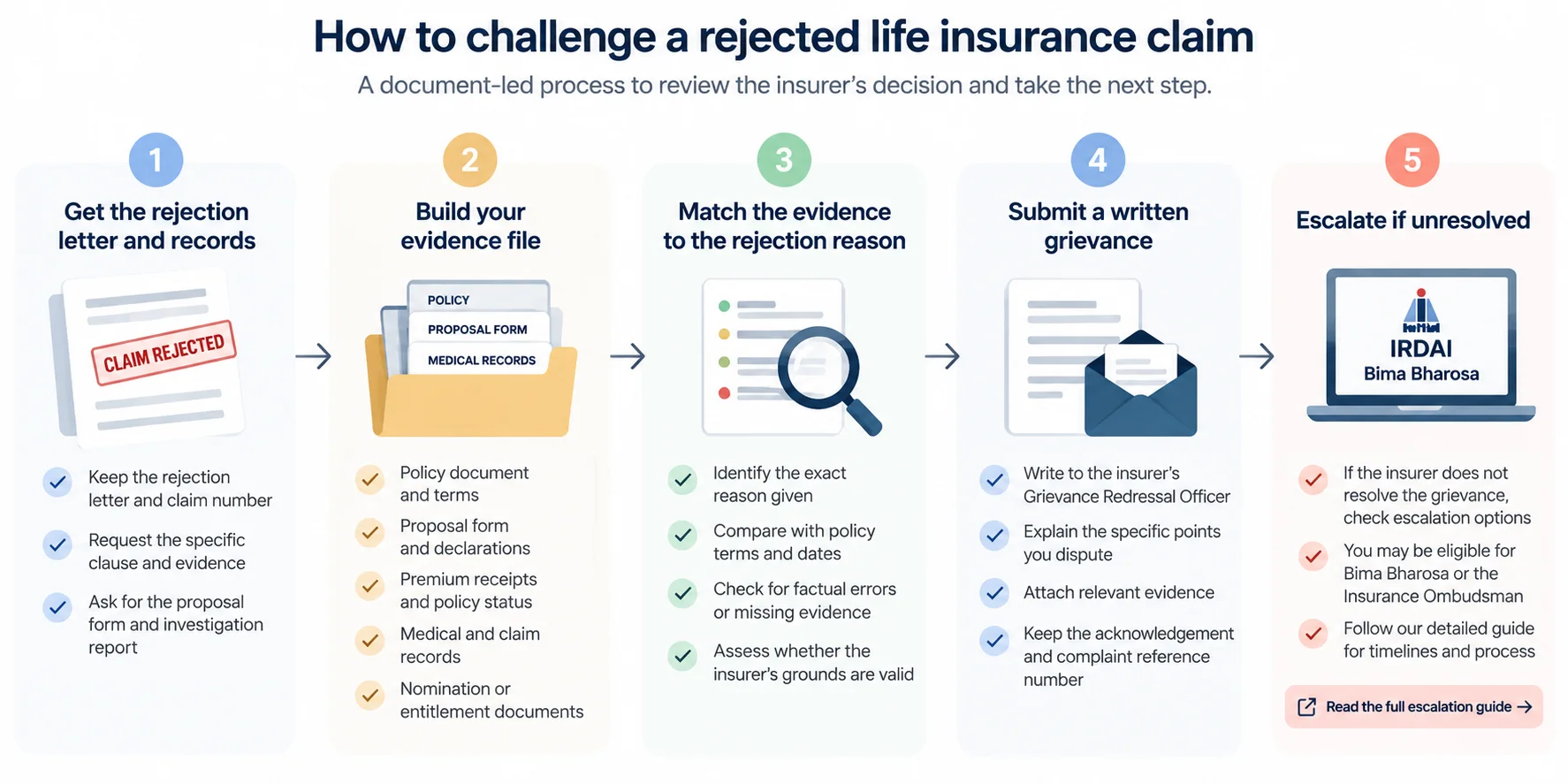
Step 1: Get the reasons and the records
Keep the rejection letter, claim number and date you received it. In writing, ask the insurer for the specific clause relied on, the evidence behind the decision, a copy of the proposal form and any investigation report. Insurers rarely send these unasked, and most challenges turn on them.
Step 2: Build your evidence file
- Rejection letter and policy document
- Proposal form and declarations
- Policy, revival and rider dates
- Premium receipts or bank debits
- Claim form and intimation acknowledgement
- Medical records, post-mortem report or FIR, where relevant
- Details of who filled in the proposal form, including the agent's name
- All correspondence with the insurer
Organise them by date. Each point in your challenge should point to one document.
Step 3: Match your evidence to the reason
Use the tables above. A challenge is strongest when it shows one of these:
- The policy or revival was more than three years old
- The "hidden" fact was disclosed, known to the insurer or immaterial
- The insurer has no documentary proof of what it alleges
- Death fell within the grace period
- The exclusion clause doesn't match the cause of death
Step 4: File a written grievance and escalate if needed
Send the letter below to the insurer's Grievance Redressal Officer (find yours on IRDAI's GRO list) and keep the acknowledgement. If the insurer doesn't resolve it within 14 days, or rejects it again, follow our guide to complaining against an insurance company for Bima Bharosa, the Insurance Ombudsman and consumer courts. For LIC claims, also use LIC's Claims Dispute Redressal Committees (formerly Claims Review Committees), explained in the LIC death claim guide.
Life insurance claim rejection letter format
Subject: Request for review of rejected claim [Claim Number] under Policy [Policy Number]
To
The Grievance Redressal Officer
[Insurance Company Name]
Dear Sir/Madam,
I am the [nominee / legal heir] of [Policyholder's Name], who died on [Date of Death]. Your letter dated [Date] rejected claim [Claim Number] under policy [Policy Number] on the ground of [reason stated by the insurer].
I request a review for the following reasons:
[Insert the paragraph below that matches your case.]
Please also send me a copy of the proposal form, the investigation report and the evidence relied on to reject the claim, and give me your reasoned decision in writing.
Please acknowledge this grievance and provide a reference number.
Regards,
[Full Name] · [Mobile] · [Email] · [Date]
Attachments: [Rejection letter, policy, proposal form if available, supporting records]
If the policy was more than three years old
The policy was issued/revived on [date], more than three years before the death on [date]. Under Section 45(1) of the Insurance Act, 1938, a life insurance policy cannot be called in question on any ground after three years. Please withdraw the rejection and settle the claim.
If the claim was rejected for non-disclosure within three years
Please identify the specific fact you say was not disclosed and the documentary evidence for it. [The insured disclosed this to your agent, [Name], on [date] / The fact had no bearing on the risk because…]. Under Section 45, the burden of proving a material misstatement is on the insurer.
If the claim was rejected because the policy had lapsed
The death occurred on [date], within the grace period after the premium due on [date]. The claim is payable after deducting the outstanding premium.
Frequently asked questions
Can an insurer reject a life insurance claim after 3 years?
Not for non-disclosure, misstatement or fraud. Section 45(1) of the Insurance Act bars questioning a policy on any ground three years after it was issued, revived or a rider was added. The insurer can still check proof of age.
Will I get the premiums back if the claim is rejected?
If the claim was rejected for misstatement or non-disclosure (not fraud), the insurer must refund the premiums within 90 days of the rejection.
Can I challenge a claim rejected for non-disclosure of other policies?
Yes. The Supreme Court reinstated such a claim in Mahakali Sujatha (2024) because the insurer couldn't prove the other policies existed. Ask for the proposal form and the insurer's evidence.
What if the agent filled in the proposal form?
Record who filled it in and what the insured told them. Courts have set aside rejections where the facts had been disclosed to the agent and were already known to the insurer.
Can a nominee challenge a rejected claim?
Yes. The nominee, a legal heir or an assignee can file a grievance and approach the Insurance Ombudsman.
How long do I have to challenge a rejection?
Approach the Insurance Ombudsman within one year of the rejection, or a consumer commission within two years. Send your written grievance to the insurer first.
Need help challenging a rejected claim?
If your claim was rejected for non-disclosure on a policy more than three years old, the insurer won't share the proposal form, or you're unsure whether you have a case, Kustodian drafts the challenge, gathers the records and tracks the deadlines. If your case needs a lawyer instead, we'll tell you upfront.
Get help with your rejected claim →
General information on Indian life insurance law, not legal advice on any individual claim.