To complain against an insurance company in India, first send a written complaint to the insurer's Grievance Redressal Officer (GRO). The insurer must resolve it within 14 days. If it rejects the complaint, gives a reply you don't accept, or doesn't reply within 30 days, you can go to the Insurance Ombudsman (free, for compensation up to ₹50 lakh) or to a consumer commission (any amount). IRDAI's Bima Bharosa portal tracks your complaint, but IRDAI does not decide individual claims.
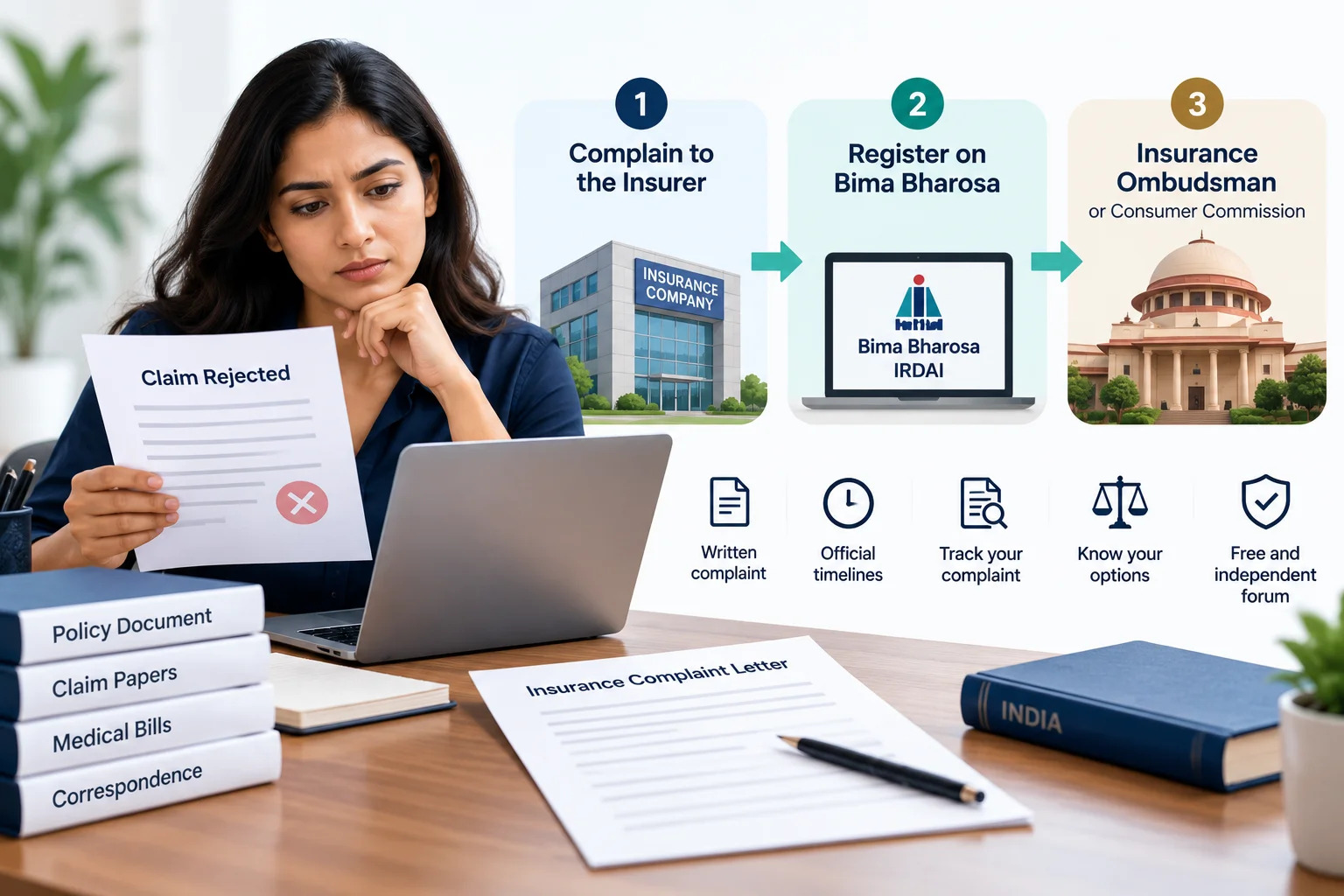
Insurance complaint timeline
| When | What you can do |
|---|---|
| Day 0 | Send a written complaint to the insurer's GRO and keep the acknowledgement |
| Any time after Day 0 | Register the complaint on Bima Bharosa so IRDAI can track it |
| Day 14 | Insurer's deadline to resolve the complaint, with reasons |
| On rejection, or Day 30 with no reply | The Insurance Ombudsman is open to you once the insurer rejects the complaint or replies in a way you don't accept, or after 30 days with no reply |
| Within 1 year of the insurer's decision | Last date to file with the Ombudsman |
| Within 2 years | Last date to file with a consumer commission |
IRDAI does not decide your claim. Bima Bharosa forwards your complaint to the insurer and monitors it. For an independent decision on a rejected or delayed claim, go to the Insurance Ombudsman or a consumer commission.
Step 1: Complain in writing to the insurer
Find the insurer's Grievance Redressal Officer on its website or on IRDAI's list of GROs. Send the complaint by email or through the insurer's grievance portal so there is a dated record.
Include:
- Policy number, claim number and claim date
- What went wrong: delay, rejection or partial payment
- The exact remedy you want
- Copies of the rejection letter, claim documents and earlier correspondence
Under IRDAI's 2024 Master Circular on Protection of Policyholders' Interests, the insurer must acknowledge your complaint immediately and resolve it within 14 days, giving reasons based on the policy terms.
Insurance complaint letter format
Subject: Grievance regarding claim [Claim Number] under Policy [Policy Number]
To
The Grievance Redressal Officer
[Insurance Company Name]
Dear Sir/Madam,
I am raising a formal grievance regarding claim number [Claim Number] under policy number [Policy Number].
- Policyholder: [Full Name]
- Claimant and relationship: [Name, relationship, e.g. nominee]
- Type of insurance: [Life / Health / Motor / Other]
- Claim intimated on: [Date]
- Earlier complaint reference, if any: [Reference Number]
- Nature of grievance: [Delay / Rejection / Partial settlement]
What happened: [Two to four sentences with dates and the insurer's response.]
Resolution requested: [Use one of the versions below.]
Please acknowledge this complaint and give me a reference number.
Regards,
[Full Name] · [Registered Mobile] · [Email] · [Date]
Attachments: [List documents]
Resolution wording: delayed claim
The claim was intimated on [date]. Under IRDAI's 2024 Master Circular, a death claim must be settled within 15 days of intimation, or 45 days if investigation is warranted. Please settle the claim with interest for the delay, or tell me in writing exactly what is outstanding.
Resolution wording: rejected claim
Please give me the specific policy clause and evidence relied on to reject the claim, a copy of the proposal form, and any investigation report, and review the decision.
For life policies that had run for more than three years, add: "Under Section 45 of the Insurance Act, 1938, a policy cannot be called in question on any ground after three years."
Resolution wording: partial settlement
Please give me a written breakdown of the amount paid and each deduction, with the policy clause supporting it, and pay the balance due.
Step 2: Register on Bima Bharosa
Bima Bharosa is IRDAI's grievance portal. Register the complaint, choose the insurer and complaint type, enter the policy or claim number, upload your documents and keep the token number. Bima Bharosa sends the complaint to the insurer and lets you track it.
Other IRDAI channels: toll-free 155255 or 1800 4254 732, and [email protected]. See IRDAI's grievance redressal mechanism.
Beware of fraud: IRDAI, Bima Bharosa and the Insurance Ombudsman never ask for payment to resolve a complaint or release a claim. Don't pay anyone who promises to, and don't scan QR codes or open links claiming a fee is due.
Step 3: Take the dispute to the Insurance Ombudsman
The Insurance Ombudsman is a free, independent forum for disputes with insurers, set up under the Insurance Ombudsman Rules, 2017.
| Condition | Rule |
|---|---|
| Who can file | Policyholder, claimant, legal heir, nominee or assignee |
| First step | You must have complained to the insurer in writing |
| When | The insurer rejected your complaint, gave a reply you don't accept, or didn't reply within 30 days |
| Deadline | Within 1 year of the rejection, repudiation or partial settlement |
| Maximum compensation sought | ₹50 lakh, including expenses |
| Fee | None |
| Other cases | The same dispute must not be before a court, consumer commission or arbitrator |
| After the award | The insurer must comply within 30 days, or pay you ₹5,000 a day for the delay |
What the Ombudsman can hear:
- Delay in settling a claim beyond IRDAI's deadlines
- Full or partial rejection of a claim
- Disputes over premium paid or payable
- Misrepresentation of policy terms
- Policy-servicing complaints against the insurer or its agents
- A policy issued differently from the proposal, or not issued after premium was paid
How to file: Register online with the Council for Insurance Ombudsmen, or send a signed complaint by email or post to the Ombudsman office covering your area. Attach the full policy copy, the insurer's rejection or settlement letter, your complaint to the insurer and all later correspondence. For health claims rejected over a pre-existing disease or waiting period, also attach your policies from the previous 48 months. Full rules: CIO complaint procedure.
Insurance Ombudsman or consumer court: which should you choose?
| Insurance Ombudsman | Consumer commission | |
|---|---|---|
| Cost | Free | Nominal fee, set by the consideration paid |
| Claim limit | ₹50 lakh of compensation sought | No upper limit. The tier depends on the premium paid (the consideration), not the claim: District up to ₹50 lakh, State ₹50 lakh–₹2 crore, National above ₹2 crore. Most insurance disputes go to the District Commission. |
| Lawyer needed | No | Not mandatory; common for large claims |
| Speed | Usually faster | Slower; appeals are possible |
| Time limit | 1 year from the insurer's decision | 2 years from the cause of action |
| Compensation | Limited to the claim and expenses | Can include compensation for harassment and costs |
| Best for | Delays, smaller rejections, policy-wording disputes | Large claims, term life policies, cases seeking compensation |
You can't run both for the same dispute at the same time. Consumer complaints can be filed online on e-Daakhil.
Documents for an insurance complaint
| Document | Why it matters |
|---|---|
| Policy document (all pages) | Shows the terms in dispute |
| Claim form and intimation acknowledgement | Proves when the claim was made, which sets deadlines |
| Rejection, settlement or deduction letter | Records the insurer's decision and reasons |
| Your complaint to the insurer and its acknowledgement | Required before the Ombudsman will hear you |
| All emails and letters with the insurer or TPA | Proves the history of the dispute |
| Medical records and bills | For health and early death claims |
| Death certificate and proof of entitlement | For death claims made by a nominee or heir |
| One-page timeline of dates | Makes your case quick to understand |
Specific situations
- LIC death claim delayed or rejected: LIC also has its own Claims Dispute Redressal Committees (formerly Claims Review Committees). See the LIC death claim process.
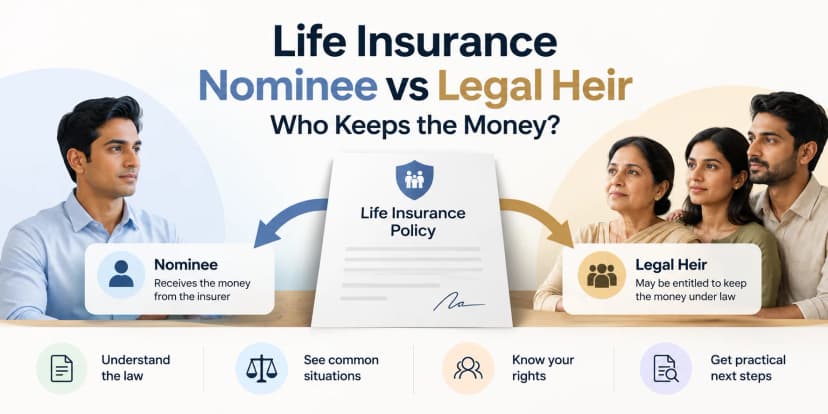
- Dispute over who should receive the money: This is an entitlement question, often for a civil court rather than the Ombudsman. See life insurance nominee vs legal heir.
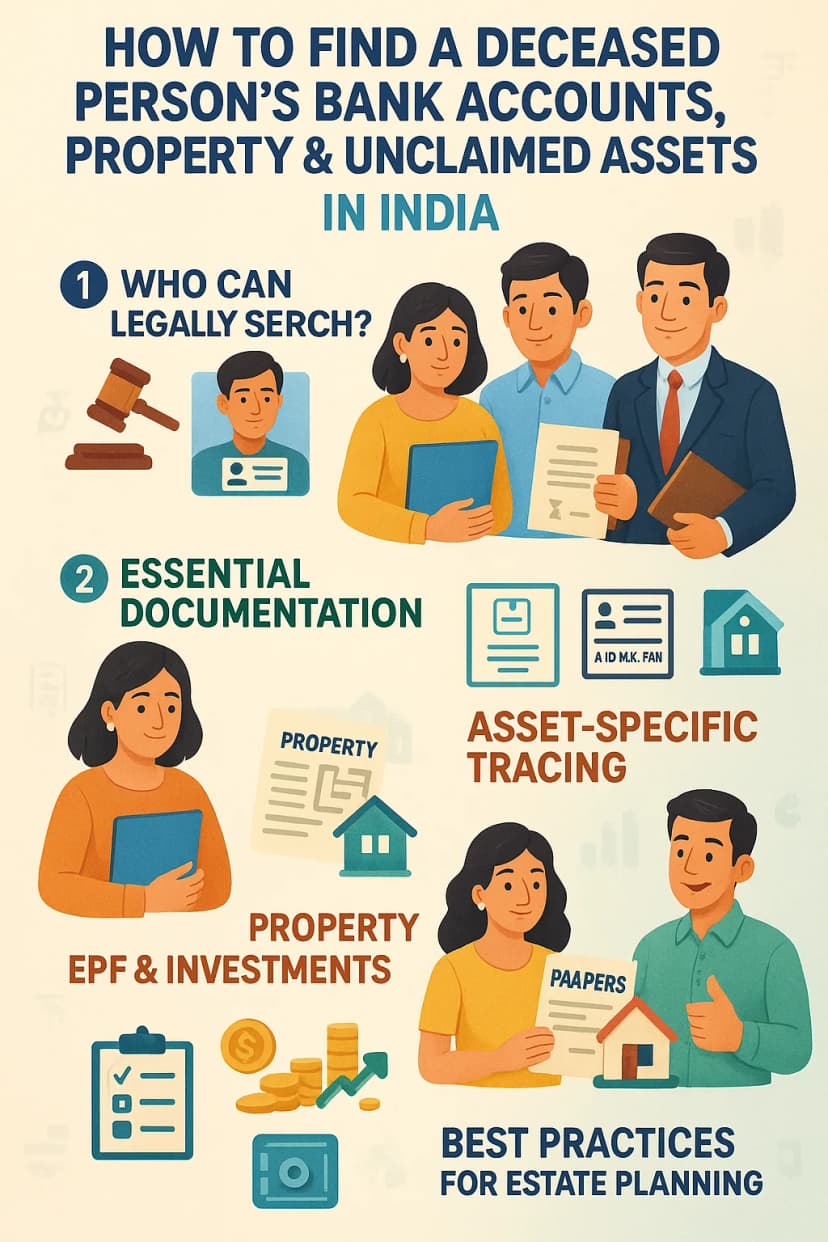
- You don't know what policies the deceased held: Start with finding a deceased person's unclaimed assets.
Frequently asked questions
How do I complain against an insurance company in India?
Send a written complaint to the insurer's Grievance Redressal Officer. If it isn't resolved within 14 days, register on Bima Bharosa. Once the insurer rejects it, or after 30 days with no reply, you can take the dispute to the Insurance Ombudsman or a consumer commission.
How long does an insurance company have to respond to a complaint?
14 days under IRDAI's 2024 Master Circular. The insurer must acknowledge the complaint immediately.
Is the Insurance Ombudsman free?
Yes. The Ombudsman charges no fee, and you don't need a lawyer.
What is the Insurance Ombudsman's claim limit?
The compensation you seek must not exceed ₹50 lakh, including expenses. Larger disputes go to a consumer commission.
Can I go to the Insurance Ombudsman directly?
No. You must first complain to the insurer in writing, then wait for its reply or for 30 days to pass.
Can I go to consumer court and the Ombudsman together?
No. The Ombudsman will not hear a dispute already before a court, consumer commission or arbitrator.
Does IRDAI settle insurance claims?
No. IRDAI regulates insurers and tracks complaints through Bima Bharosa, but it does not decide individual claims.
Need help with an insurance complaint?
Missed the 14-day deadline, received a rejection you don't understand, or unsure whether to go to the Ombudsman or a consumer court? Kustodian drafts the complaint, files the escalation and follows up with the insurer. If your case needs a lawyer instead, we'll tell you upfront. No route guarantees approval.
Get help with your insurance complaint →
General information, not legal advice on any individual dispute.