Last reviewed: 20 November 2026
A PF contribution mismatch is a difference between the contribution an employee should have received for a wage month and what the employer filed, paid or got recorded with EPFO. It often goes unnoticed because the monthly challan can match payroll exactly while individual employee records are wrong.
A missed employee, a wrong wage base, an incorrect EPF/EPS split or a contribution posted to the wrong member ID can all sit inside a correct total. These errors usually surface months later, through a failed claim, an employee complaint or an EPFO inquiry, when they are harder and costlier to fix.
If you filed September 2026 contributions, check them first. The mid-month wage-ceiling change is the most common source of new mismatches this quarter. See the September 2026 section below.
Talk to Kustodian's PF Compliance Team →
How do you test for a PF contribution mismatch?
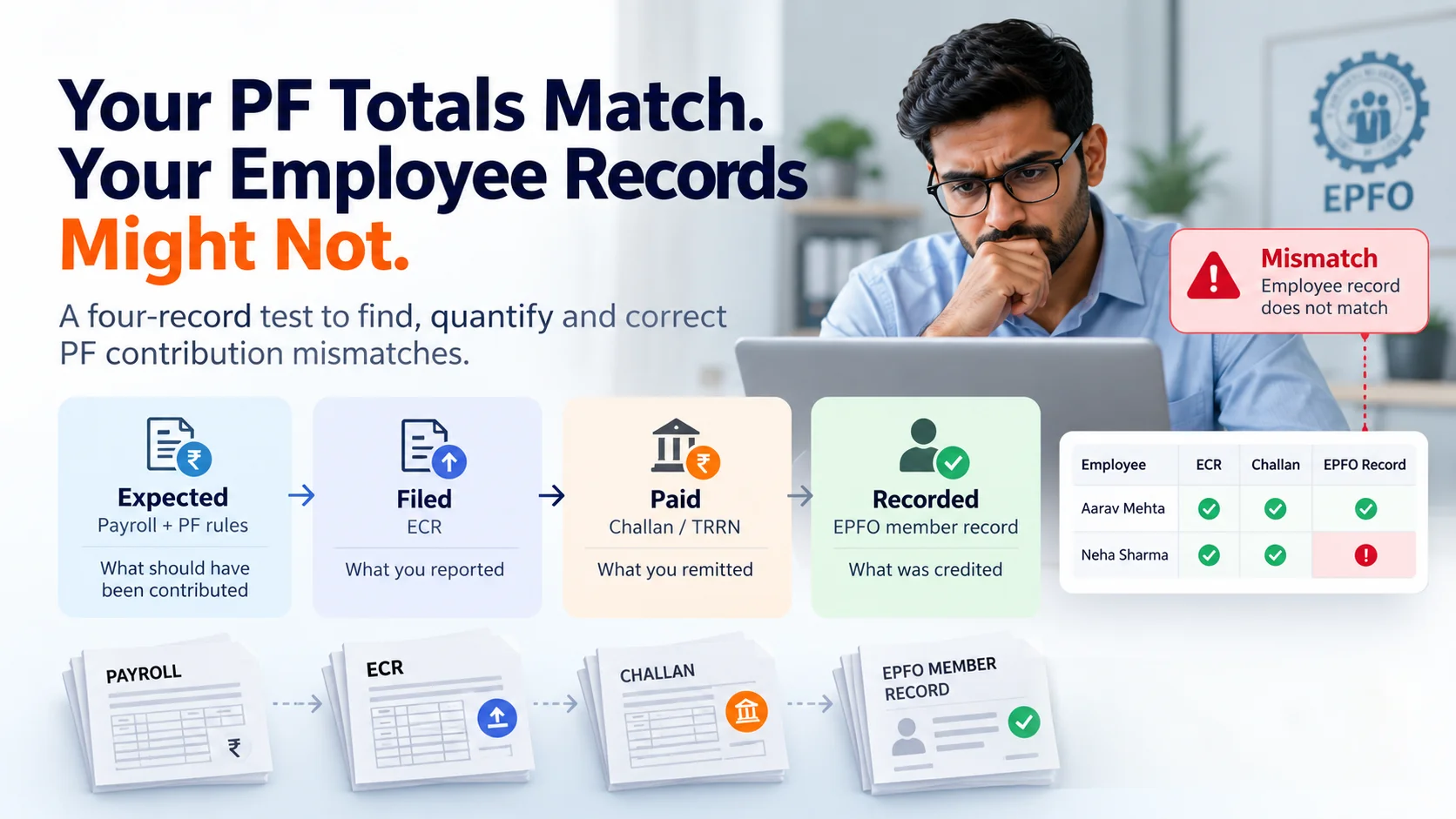
Compare four records for each employee and wage month. The first record that disagrees with the one before it is where the investigation starts.
| Record | Source | What it tells you |
|---|---|---|
| Expected | Payroll + applicable PF rules for that wage month | What should have been contributed |
| Filed | ECR | What you reported |
| Paid | Challan / TRRN | What you remitted |
| Recorded | EPFO member record | What was credited |
We call this the Four-Record Test: Expected → Filed → Paid → Recorded.
A mismatch is not always an ECR problem. The ECR can faithfully report payroll that was wrong to begin with. Payroll can be right while the ECR is wrong. Both can be right while the payment or member record is not. Checking one document tells you little; tracing the chain tells you where it broke.
Why don't matching totals prove the records are right?
Establishment-level totals net out employee-level errors. If one employee is under-contributed by ₹5,000 and another over-contributed by ₹5,000, the challan shows zero variance and both member records are wrong.
The same happens within a single employee's contribution. The employer share can be correct in total and still be split wrongly between EPS and EPF.
For any reconciliation, the useful unit is employee × wage month × contribution component (employee EPF, employer EPF, EPS). Anything coarser can hide the error.
Worked example: correct total, wrong EPS/EPF split
Take an employee with a PF wage of ₹25,000 in the October 2026 wage month, at the standard 12% rate.
- Employer contribution: 12% × ₹25,000 = ₹3,000
- EPS at 8.33% of the ₹25,000 ceiling: about ₹2,083
- EPF (balance): about ₹917
Now suppose payroll updated the PF wage to the new ceiling but kept the EPS cap at the old ₹1,250:
| Employer contribution | Correct | Filed |
|---|---|---|
| EPS | ₹2,083 | ₹1,250 |
| EPF | ₹917 | ₹1,750 |
| Total | ₹3,000 | ₹3,000 |
The establishment total reconciles to the rupee. But ₹833 a month has been credited to the employee's EPF account instead of their pension account. Over a year that is roughly ₹10,000 per affected employee in the wrong scheme, and it affects their pension record, not just their balance.
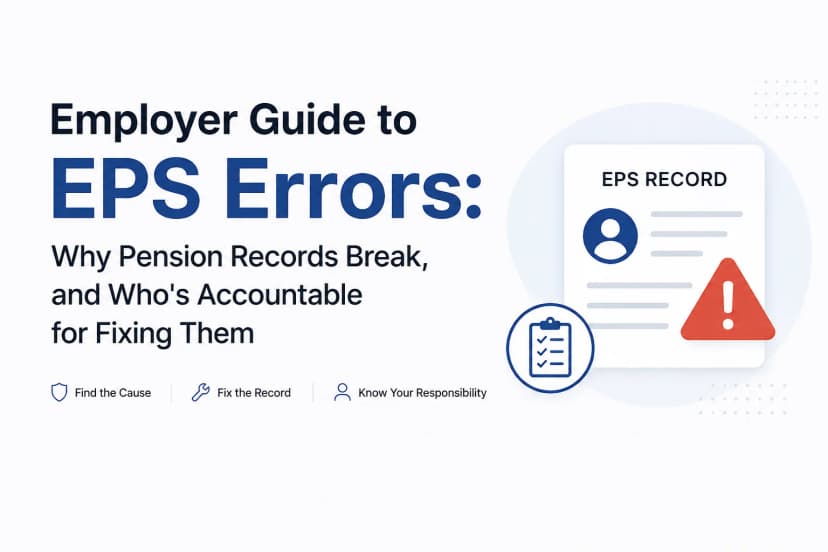
An establishment-level check reports no variance. An employee × month × component check reports an allocation mismatch. For pension-side remediation, see Employer EPS Errors.
September 2026: the split month most employers should check now
The statutory PF wage ceiling rose from ₹15,000 to ₹25,000 a month with effect from 17 September 2026 (Notification S.O. 5109(E), 17 September 2026). Because the change landed mid-month, the September 2026 wage month has two contribution periods:
- 1–16 September: contribution calculated subject to the ₹15,000 ceiling
- 17–30 September: contribution calculated subject to the ₹25,000 ceiling
EPFO's FAQ on the revised wage ceiling requires both periods to be reported in a single September 2026 ECR, not two returns.
Example (existing member, PF wage ₹20,000, 30-day month):
- 1–16 Sept: ₹15,000 × 16/30 = ₹8,000
- 17–30 Sept: ₹20,000 × 14/30 = ₹9,333.33
- September EPF wage: ₹17,333.33
Where September mismatches come from:
| Payroll treatment | Result |
|---|---|
| ₹25,000 ceiling applied for the full month | Over-contribution for 1–16 Sept |
| ₹15,000 ceiling applied for the full month | Under-contribution for 17–30 Sept |
| Newly covered employees (₹15,000–₹25,000 band) omitted, or included from 1 Sept | Missing contribution, or contribution for a period they weren't covered |
| EPF-only members in the ₹15,000–₹25,000 band not moved into EPS from 17 Sept | EPS allocation mismatch |
| EPS cap left at ₹1,250 | Allocation mismatch, as in the worked example above |
Why timing matters: under the revamped ECR, an upward revision is possible after payment, but a downward revision is restricted once payment processing has started for that wage month. If September was over-calculated, correct it before remitting. Afterwards, recovering the excess becomes a separate reconciliation with EPFO.
Get a September 2026 split-month check →
Where does the mismatch start?
Match what you're seeing to the comparison that will locate it.
| What you see | Compare first | Likely origin |
|---|---|---|
| Expected contribution ≠ payroll | PF rules ↔ payroll | Expected: payroll configuration (ceiling, wage base, EPS cap, coverage) |
| Employee in payroll but missing from ECR | Employee master ↔ ECR | Filed: omission |
| Payroll ≠ ECR values | Payroll ↔ ECR | Filed: return data |
| ECR ≠ amount remitted | ECR ↔ challan / TRRN | Paid: remittance |
| Paid but not credited as expected | Payment ↔ member record | Recorded: member ID / UAN mapping |
| Salary revision not reflected | Revision letter ↔ payroll ↔ ECR | Expected: revision or arrears process |
| Same variance across many employees | Employee × month analysis | Systemic process issue |
Checks for the Expected record:
- Was every eligible employee included? This includes those newly covered from 17 September 2026.
- Was the right PF wage used? PF is calculated on the applicable PF wage, not on gross salary or CTC.
- Was the right ceiling used for that specific wage month?
- Does the EPS/EPF split follow the rules for that month and that employee?
- Did salary revisions flow into the correct months?
Never apply today's rules to old wage months. A contribution capped at ₹15,000 in August 2026 is correct. The same cap in October 2026 is not.
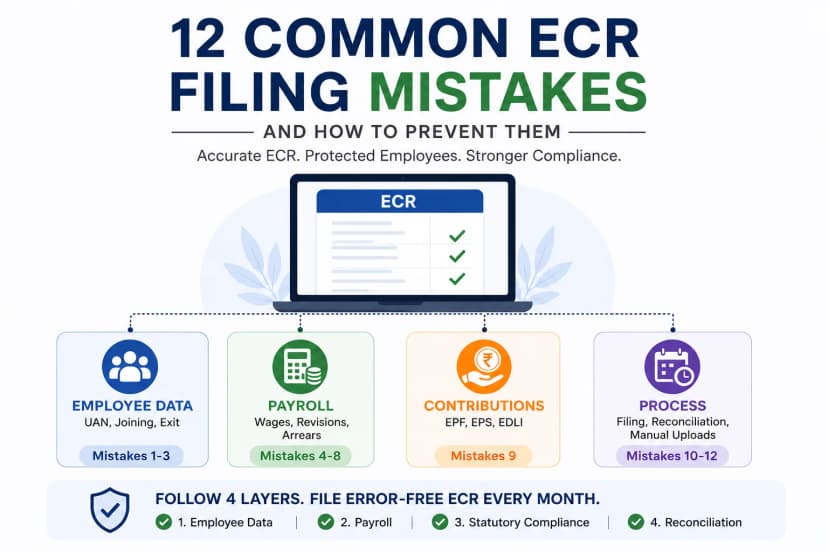
For ECR-level error patterns, see ECR Filing Mistakes. For member-ID problems, see Duplicate UAN for Employers.
How should employers reconcile PF contributions?
Work forward from what should have happened, never backward from the ECR.
- Calculate Expected from the employee master, payroll and the PF rules applicable to each wage month.
- Compare with Filed, employee by employee, component by component.
- Trace Paid: match each approved return to its challan and TRRN.
- Check Recorded: compare the payment trail with the EPFO member record where relevant.
- Re-run the test after correcting. The case is closed when the four records agree, not when a return is submitted.
The output should be an exception report with one row per employee per wage month. Its columns are expected amount, filed amount, paid amount, recorded amount, variance by component, and probable cause.
Evidence you'll need: employee master, payroll and wage registers, salary revision and arrear records, ECRs, challans/TRRNs, and EPFO member records. For older periods, also gather previous consultants' files and pre-migration payroll exports, because your current system may not hold the history.
How do you correct a wrong PF contribution?
Choose the correction route only after you know what is wrong, which wage month it affects and whether payment has started. For wage months from September 2025 onward, EPFO's revamped ECR provides three return types:
| Situation | Route |
|---|---|
| Normal monthly filing | Regular Return |
| An eligible employee was left out of the earlier return | Supplementary Return |
| Wage or contribution details already reported are wrong | Revised Return, subject to EPFO's conditions (upward after payment; downward restricted once payment processing starts) |
For wage months before September 2025, the Revised Return mechanism does not apply. The correction route depends on the error and the records available. See Historical PF Errors.
For how one correction can cascade into connected records, see PF Correction Dependencies.
What is the exposure if contributions were underpaid or overpaid?
Underpaid: the principal shortfall is the expected contribution minus the actual contribution. Interest and damages are assessed separately. These are Section 7Q interest and Section 14B damages under the EPF Act for legacy periods, and the corresponding provisions of the Code on Social Security, 2020 where applicable. The revamped ECR auto-calculates Section 7Q interest, which must be paid with the monthly contribution. Section 14B damages are paid separately through the portal's 7Q/14B option.
Report the components separately to management:
| Component | What it is |
|---|---|
| Principal | Confirmed contribution shortfall |
| Interest | For delayed payment, where applicable |
| Damages | Statutory damages, where applicable |
| Employees affected | Scope |
| Months affected | Duration |
Don't call the whole amount a "penalty". Also keep your calculated exposure distinct from any amount EPFO formally determines.
Overpaid: trace the same chain to find why actual exceeded expected. Common causes are payroll configuration, a wrong contribution base, a wrong return or duplicate processing. Before payment, a downward revision may be available. After payment, the excess needs a separate reconciliation with EPFO.
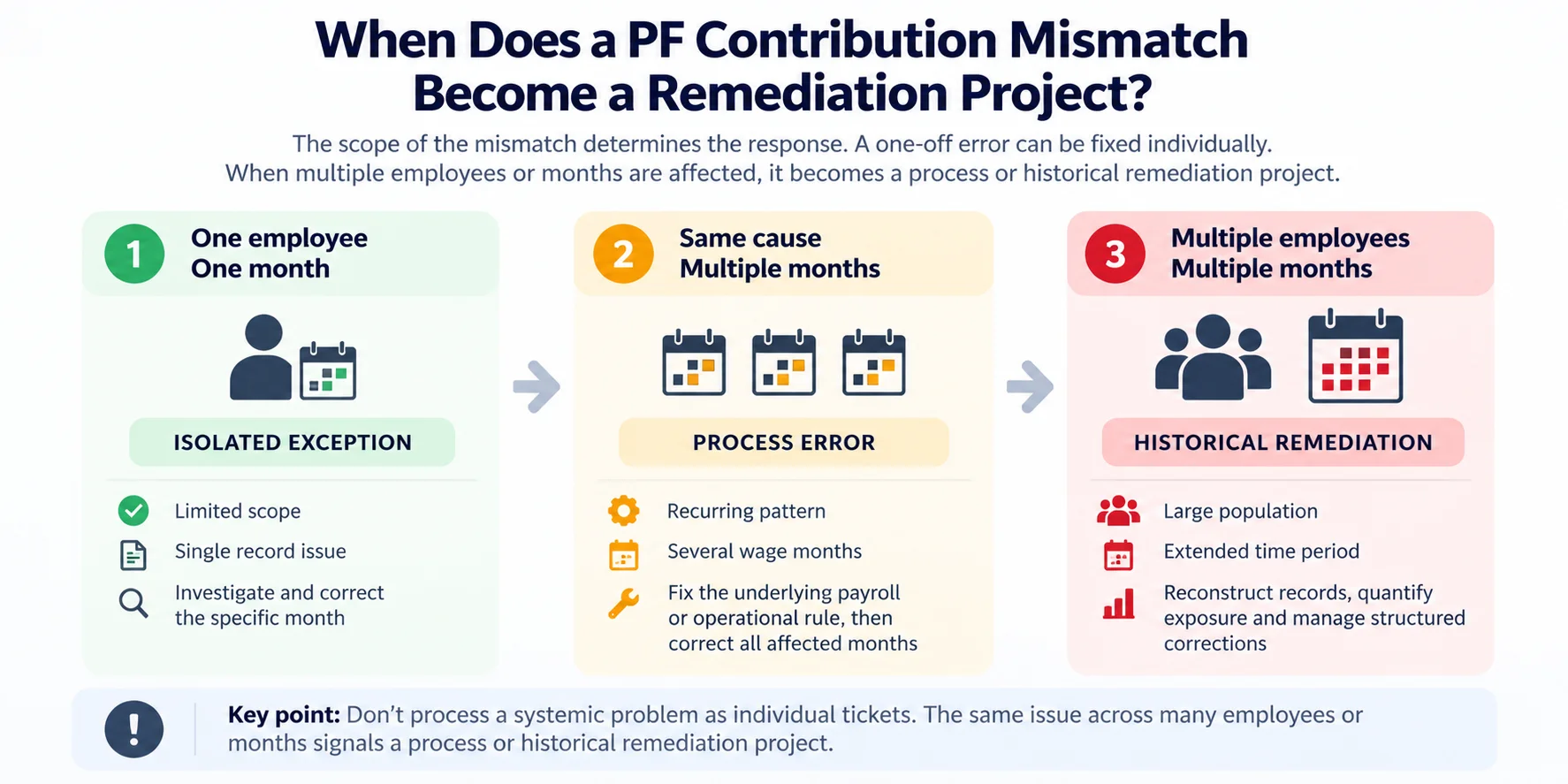
When does a mismatch become a remediation project?
| Scope | Classification | What to do |
|---|---|---|
| One employee, one month | Isolated exception | Correct it directly |
| Same cause, several months | Process error | Fix the payroll rule first, then find every affected month |
| Many employees, many months | Historical remediation | Reconstruct the affected population before filing any correction |
Warning signs:
- The same complaint returns after a "fix"
- Payroll and ECR repeatedly fail to reconcile
- A payroll or HRMS migration happened without historical validation
- A previous consultant can't explain old variances
- One joining cohort shows the same issue
Correcting employees one at a time when the cause is systemic fixes symptoms and leaves the source running. For multi-period cleanups, see Historical PF Errors.
Request a PF Contribution Review →
Frequently asked questions
Why can the challan match payroll while an employee's PF record is wrong?
Establishment totals net out employee-level and component-level errors. One employee can be over-reported while another is under-reported. The employer share can also be split wrongly between EPS and EPF while the total stays correct.
How should September 2026 PF contributions be calculated?
September 2026 is calculated in two periods in a single ECR. 1–16 September uses the ₹15,000 ceiling and 17–30 September uses the ₹25,000 ceiling, following the wage-ceiling revision effective 17 September 2026.
What if payroll applied the ₹25,000 ceiling for all of September 2026?
Contributions for 1–16 September were then calculated on a higher base than required. If payment for September hasn't been processed, correct the return before remitting, since downward revisions are restricted once payment processing starts.
Can an employer correct a PF contribution after payment?
For wage months from September 2025 onward, yes, for an upward revision through a Revised Return. Downward revisions are restricted once payment processing has started for that month.
How are PF arrears from a salary revision handled?
Establish the revision's effective date, identify every affected wage month, and calculate the expected contribution for each month under the rules that applied then. Then compare those figures with the historical ECR and payment records.
Should employers correct PF errors one employee at a time?
Not when the same issue repeats. First establish whether several employees or months share a cause, and fix that cause before filing individual corrections.
What records should an employer compare?
For each affected employee and wage month: employee master, PF wage, expected contribution, ECR, challan/TRRN and EPFO member record.
Need help with a PF contribution mismatch?
The question that decides the fix is where the records diverged: Expected, Filed, Paid or Recorded. Once that is known, the correction route and the true scope follow.
Kustodian investigates contribution mismatches at employee × month × component level, reconstructs historical records, quantifies exposure and manages the corrections through to a clean reconciliation.
PF Interest Loss Calculator
See how much interest you lose every month your claim sits unresolved.