Most employers don't replace their PF consultant because of one mistake. They do it after months — sometimes years — of the same complaint resurfacing: an employee can't withdraw PF, a correction that was "fixed" last quarter reappears this quarter, an EPFO notice sits unanswered a little longer each time.
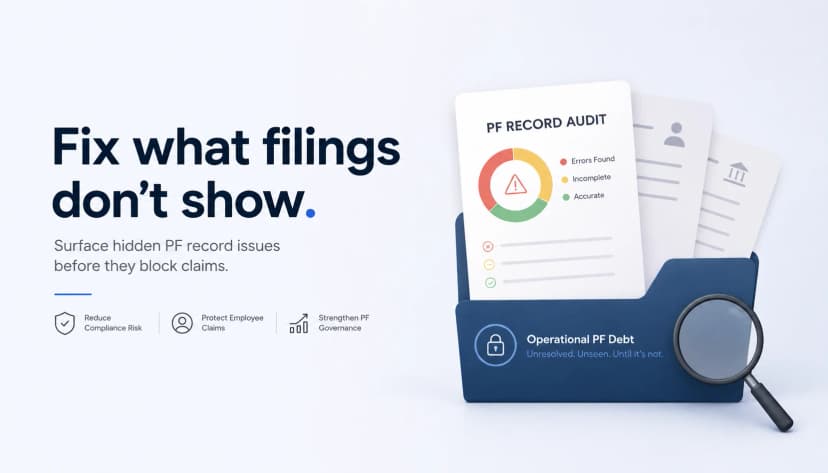
Individually, each of these looks manageable. Together, they usually mean something specific: operational PF debt — unresolved historical issues that compound quietly until an audit, an exit, or a Section 7A notice forces the reckoning.
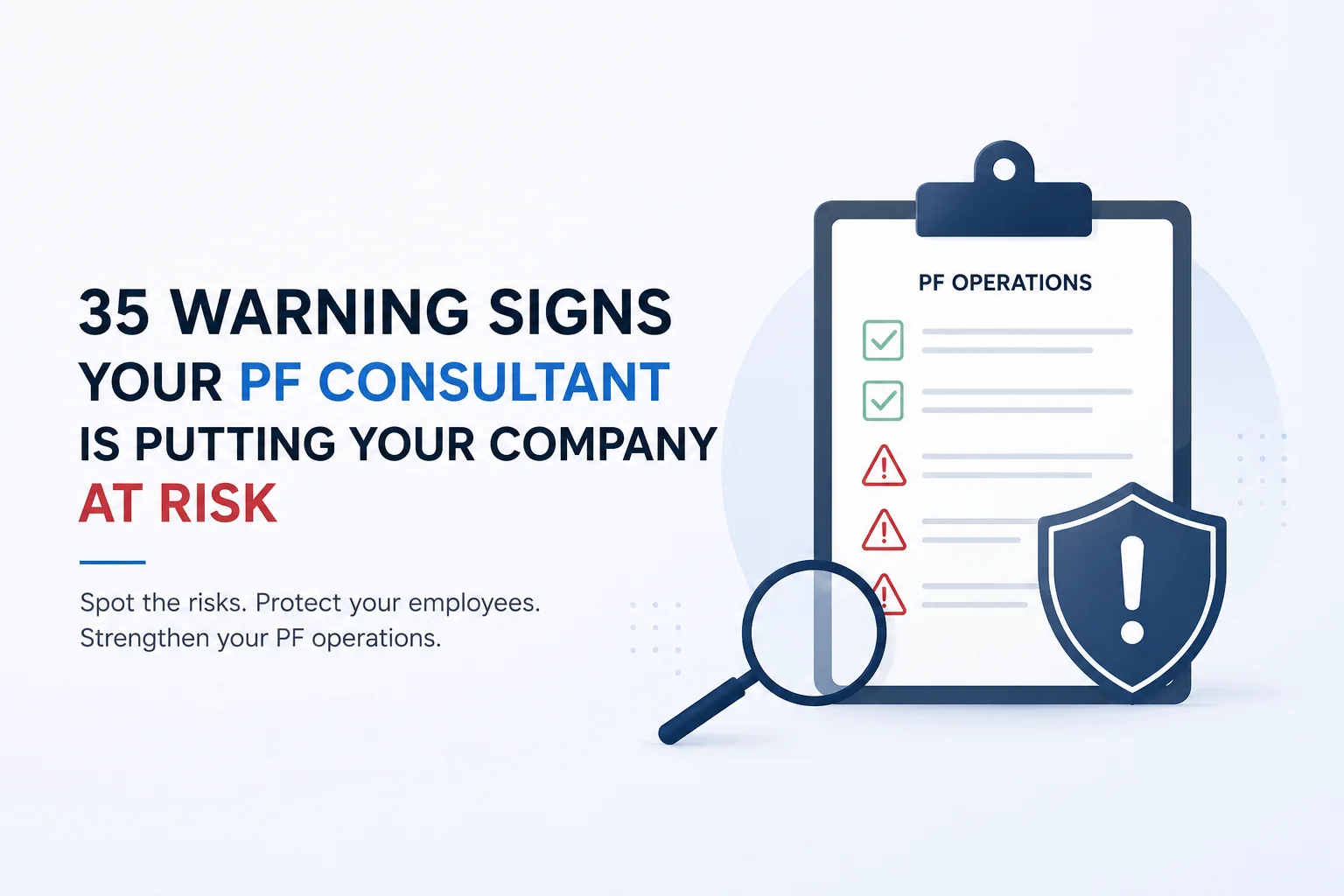
This guide gives you 35 warning signs across 6 categories, a scoring framework to quantify your exposure, and a decision path for what to do about your score — before it becomes a compliance event.
Run a Kustodian Employer PF Health Audit — a structured assessment of your PF operations, historical risk exposure, governance gaps, and consultant performance.
Quick Answer: How Do You Know If Your PF Consultant Is Doing a Good Job?
A good PF consultant does more than file monthly ECRs on time. They maintain accurate employee records, catch historical risks before they hit an employee's withdrawal, keep payroll and EPFO data reconciled, and flag compliance exposure before it becomes a notice.
If your organisation has recurring employee complaints, open historical corrections, contribution mismatches, or unanswered EPFO notices, your PF operations need review — even if filings are technically on time. Filing on schedule is table stakes, not evidence of good management.
Is This Normal, or Is It a Warning Sign?
Every employer hits occasional PF friction. The question is whether an issue is a one-off or a pattern.
| Situation | Usually Normal | Needs Investigation |
|---|---|---|
| One employee needs a correction | ✓ | |
| Temporary EPFO portal downtime | ✓ | |
| Isolated KYC mismatch | ✓ | |
| Same employee's issue recurs after "resolution" | ✓ | |
| Multiple employees report the same problem | ✓ | |
| Claims routinely need manual intervention | ✓ | |
| Payroll and EPFO records rarely reconcile | ✓ | |
| Consultant never proposes anything proactively | ✓ | |
| Every issue gets blamed on EPFO | ✓ |
Patterns deserve investigation even with no visible compliance failure yet — operational risk shows up in repetition, not in any single incident.
The Kustodian Employer PF Health Score
Score your organisation across 6 categories, 6 signs each (35 scored signs; one category's 6th item is a compound flag — see note below). Count every sign that applies to you.
| Score | Operational Health | Recommended Action |
|---|---|---|
| 0–10 | Healthy | Continue quarterly reviews |
| 11–20 | Needs Review | Investigate recurring patterns in affected categories |
| 21–30 | High Operational Risk | Conduct a Historical PF Audit |
| 31–35 | Critical | Immediate operational and consultant review |
A high score doesn't automatically mean your consultant is incompetent — it means your PF operations carry recurring risk signals that need investigation before they surface as employee claims, audit findings, or compliance notices. The root cause could be the consultant, your payroll process, your internal governance, or some combination.
The 6 Categories Where Good PF Consultants Reduce Risk
1. Consultant Behaviour & Responsiveness
1. Slow response during time-sensitive issues (claim rejections, urgent withdrawals) 2. No documented escalation process when something goes wrong 3. No monthly compliance or operational reporting — you only hear from them when there's a problem 4. No periodic PF health review, ever proposed 5. Every issue explained away as "an EPFO problem," never an internal process gap 6. Advice is always reactive — nothing preventive is ever raised unprompted
What it usually means: Weak account governance rather than technical complexity. Most consultants who exhibit this pattern have limited operational capacity — they're managing volume, not managing your risk.
Business impact: Medium on employees and payroll day-to-day; high on long-term governance, because dependency on an unresponsive single point of contact compounds every other category below.
2. Employee Experience
1. Employees repeatedly struggle to withdraw PF
2. Duplicate UANs discovered during onboarding or exit
3. Pension (EPS) calculations appear incorrect or inconsistent
4. Missing service history in an employee's record
5. Transfer requests fail repeatedly for the same employee
6. The same complaint surfaces across multiple departments or joining cohorts
What it usually means: Employees notice record-quality problems before HR does. These patterns typically trace back to historical record inconsistencies, weak onboarding controls (Form 11 errors are the single largest source of duplicate UANs), or correction requests that were filed but never actually closed out with EPFO.
Business impact: Very high on employee trust — a PF withdrawal delay is one of the most common reasons an ex-employee escalates publicly or files a grievance. High on HR workload; medium on compliance directly.
3. Payroll & Monthly Operations
1. Payroll figures routinely differ from what EPFO's records show
2. The same employees need ECR corrections month after month
3. Contribution mismatches surface only after filing, not before
4. Payroll depends on manual Excel patchwork every cycle
5. No documented payroll-to-EPFO reconciliation process exists
6. Every payroll system migration reliably breaks PF data
What it usually means: A consultant who only validates that a file was accepted by EPFO — not that the underlying numbers were correct — is optimizing for filing compliance, not data accuracy. Under the EPF & MP Act, an employer remains liable for contributions that were deducted from an employee's salary but never actually remitted, regardless of whether the consultant filed the ECR. That gap is invisible until a 7A inquiry or an employee complaint surfaces it.
Business impact: High across employee contributions, payroll accuracy, and compliance; medium on audit readiness.
4. Historical Records
1. Wrong Date of Joining (DOJ) on file
2. Missing or incorrect Date of Exit (DOE)
3. Duplicate UANs left unresolved for months
4. Historical correction requests stay "open" indefinitely with no closure date
5. Incomplete service history for one or more employees
6. Multiple employees from the same joining batch or location show the same issue
What it usually means: This is where operational PF debt accumulates most visibly. It's rarely caused by one bad month — it's usually the residue of a consultant transition without a structured handover, or the absence of any periodic historical audit. A DOE error, in particular, can block an employee's final settlement years after they've left, when nobody at the company is even tracking the case anymore.
Business impact: Very high on employee claims and pension outcomes; high on operational risk; medium on reputation.
Recommended next step: If a sign in this category applies to more than one employee, don't fix records one at a time — scope it. A PF Audit tells you whether it's an isolated case or a batch problem before you spend effort remediating the wrong thing.
5. Governance & Documentation
1. Employer doesn't hold its own EPFO portal credentials — the consultant does
2. Consultant controls the Digital Signature Certificate (DSC) with no documented ownership record
3. No written Standard Operating Procedures (SOPs) for PF processes
4. No historical filing repository the employer can access independently
5. All compliance knowledge sits with one individual, internal or external
6. No consultant transition or handover plan exists
What it usually means: This category is about who actually controls the asset — you, or your vendor. An employer who doesn't hold their own portal credentials and DSC access cannot switch consultants without risking a compliance gap during transition, and cannot independently produce historical records during an audit. This is the category most likely to turn a vendor problem into a business-continuity problem.
Business impact: Very high on business continuity and operational control; high on compliance.
6. Compliance & Risk Management
1. EPFO notices go unanswered or are consistently late
2. The same audit finding recurs year after year without being closed
3. Contractor-related PF issues (Section 8A liability) remain unresolved
4. No internal periodic compliance review happens independently of the consultant
5. Consultant provides no compliance health reporting — you'd only find out about exposure from EPFO directly
What it usually means: Compliance failures are almost never sudden. A Section 7A inquiry — EPFO's mechanism for determining contribution liability — is typically preceded by exactly this pattern: notices that sat too long, audit findings that were "addressed" without being closed, and no internal review process independent of the consultant marking their own work.
Business impact: Critical on regulatory exposure; high on financial risk and reputation.
Score Yourself
| Category | Signs That Apply | Out of |
|---|---|---|
| Consultant Behaviour & Responsiveness | ___ | 6 |
| Employee Experience | ___ | 6 |
| Payroll & Monthly Operations | ___ | 6 |
| Historical Records | ___ | 6 |
| Governance & Documentation | ___ | 6 |
| Compliance & Risk Management | ___ | 5 |
| Total | ___ | 35 |
Match your total to the Health Score table above. A score of 21+ warrants a structured audit before you decide anything about your consultant relationship.
What One Warning Sign Usually Points To
A single sign rarely has a single cause. Use this as a starting point for investigation, not a diagnosis.
| If you notice… | It often indicates… | Impact |
|---|---|---|
| Employees can't withdraw PF | Exit record, KYC, or contribution history gaps | High |
| Duplicate UANs | Weak onboarding / Form 11 process | High |
| Pension discrepancies | EPS service history or eligibility issues | High |
| Payroll ≠ EPFO records | Reconciliation or ECR process failure | High |
| EPFO notices arriving | Documentation or compliance gaps | Critical |
| Consultant holds portal credentials | Governance weakness | High |
| Same correction requested repeatedly | Historical operational debt | Medium–High |
What Happens If You Ignore These Signs
Nothing about PF risk stays isolated for long.
| Ignored sign | Typical downstream effect |
|---|---|
| Employee complaints continue unresolved | Lower trust, more HR escalations |
| Historical records stay inaccurate | Delayed withdrawals, transfers, pension claims — sometimes years later |
| Payroll reconciliation stays inconsistent | Growing manual effort, recurring corrections |
| Governance stays weak | Dependency on individuals; painful consultant transitions |
| Compliance issues accumulate | Escalating regulatory scrutiny, eventually a 7A or 14B notice |
The cost of ignoring these patterns is rarely one penalty. It's the compounding operational load that only becomes visible during an employee exit, an audit, or a business event like a funding round or acquisition due-diligence process.
Should You Replace Your PF Consultant?
Not every high score means "fire the consultant." Sometimes the root cause is internal — payroll process, historical records inherited from a prior vendor, or governance gaps that exist regardless of who's filing.
Use this before deciding:
- Is it one isolated issue? → Monitor and tighten internal controls; no vendor action needed yet.
- Is it a repeated pattern across employees or cycles? → Run a Historical PF Audit to scope it.
- Is the root cause primarily internal (payroll config, onboarding, historical data)? → Fix governance and process first.
- Is the root cause primarily the consultant (unresponsive, no proactive reporting, no documentation)? → Review consultant performance directly.
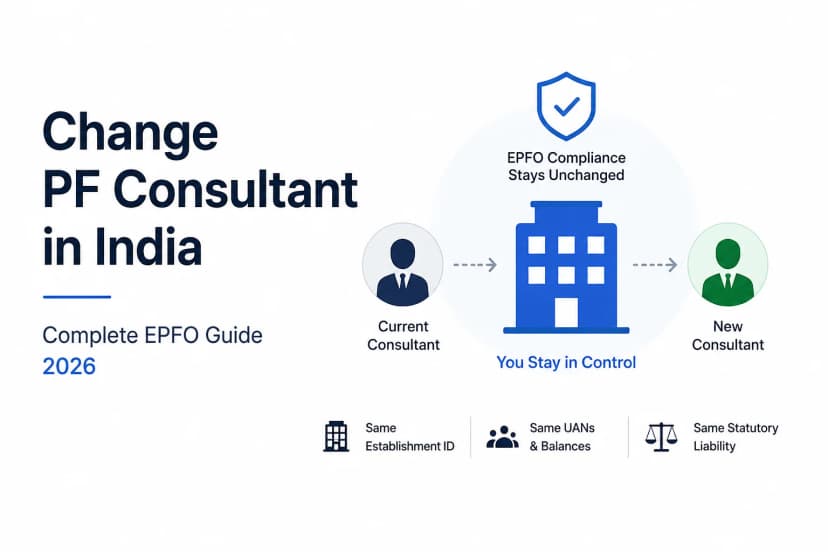
- Are governance failures recurring regardless of who you've hired? → Plan a structured consultant transition.
FAQs
How do I know if my PF consultant is doing a good job? Beyond filing monthly compliance on time, a good consultant prevents recurring operational issues, keeps records accurate, supports governance handover-readiness, and flags risk before it reaches an employee or a notice.
Are employee complaints always the consultant's fault? No. They can originate in payroll configuration, HR onboarding, or historical records inherited from a previous vendor. Investigate the root cause before assigning blame.
Can poor PF management affect employee pensions? Yes — incomplete service records or unresolved EPS eligibility issues can directly affect the pension amount an employee is entitled to receive.
Should employers review PF operations even without complaints? Yes. Many historical issues stay invisible until an employee exits, a claim is filed, or an audit begins. A periodic review catches them earlier and cheaper.
Does a recurring correction always mean a bigger problem? Usually. The same correction reappearing points to a root cause in onboarding, payroll, or historical records — not a one-off clerical error.
When should I consider changing my PF consultant? When recurring governance failures, poor documentation, unresolved historical issues, or weak communication persist despite having raised them directly.
Need a second opinion on your PF operations?
Kustodian helps employers identify compliance gaps, resolve historical EPF/EPS issues, and strengthen PF governance before they become costly problems. Book a free PF consultation with our experts today.
Understand the Pattern Before You Treat the Symptoms
Most employers don't replace their PF consultant over one mistake — they do it after recurring problems quietly erode employee trust and accumulate compliance exposure. The Employer PF Health Score exists to surface that pattern early, while it's still cheap to fix.
If your score lands in High Risk or Critical, the next step isn't necessarily a new consultant — it's understanding why the risk exists.
Run a Kustodian Employer PF Health Audit. You'll get:
- Your Employer PF Health Score, validated against your actual records
- An Operational Risk Heatmap across all 6 categories
- A Historical PF Risk Assessment
- Root cause analysis — consultant, process, or governance
- A prioritised action matrix and recovery roadmap
- A consultant governance review
Note on statutory references: Section 7A of the EPF & MP Act, 1952 governs EPFO's inquiry powers to determine contribution liability; Section 14B governs damages for delayed remittance. Section 8A addresses principal employer liability for contractor-employed workers. Verify current provisions against the latest Gazette notifications before citing specific figures or thresholds to clients — regulatory text should be sourced directly from epfindia.gov.in at publish time, not reproduced from memory.
PF Interest Loss Calculator
See how much interest you lose every month your claim sits unresolved.