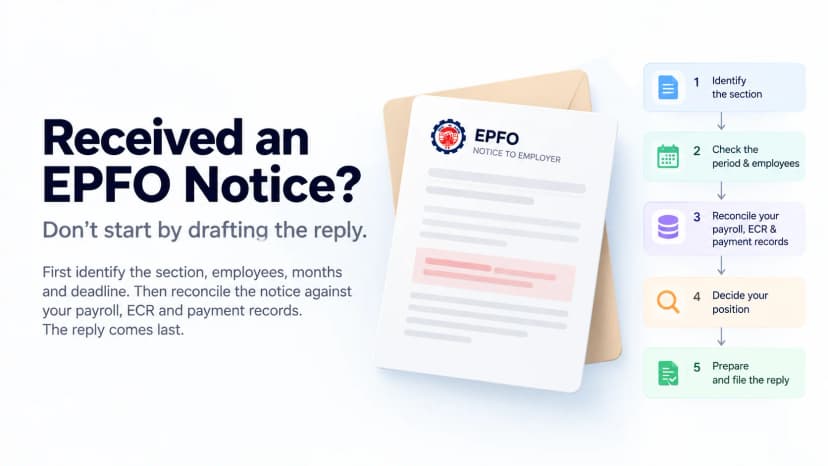
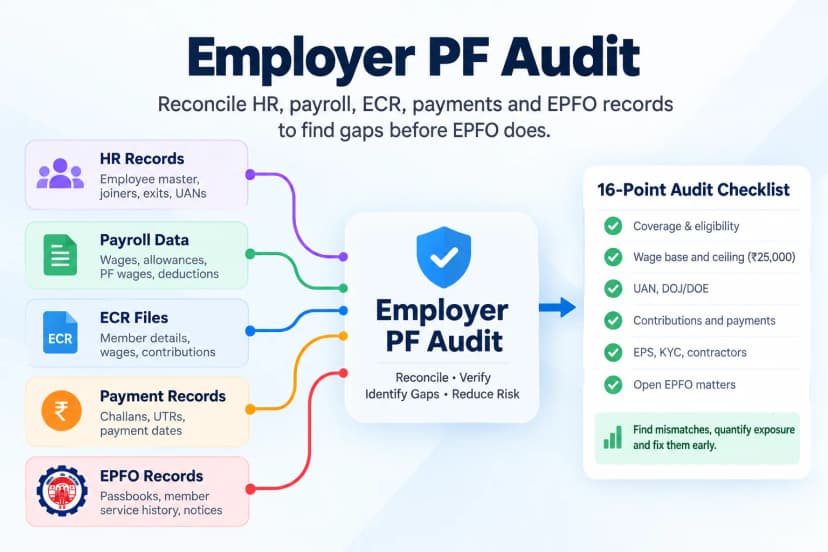
For HR, payroll, finance and compliance teams · Updated November 2026
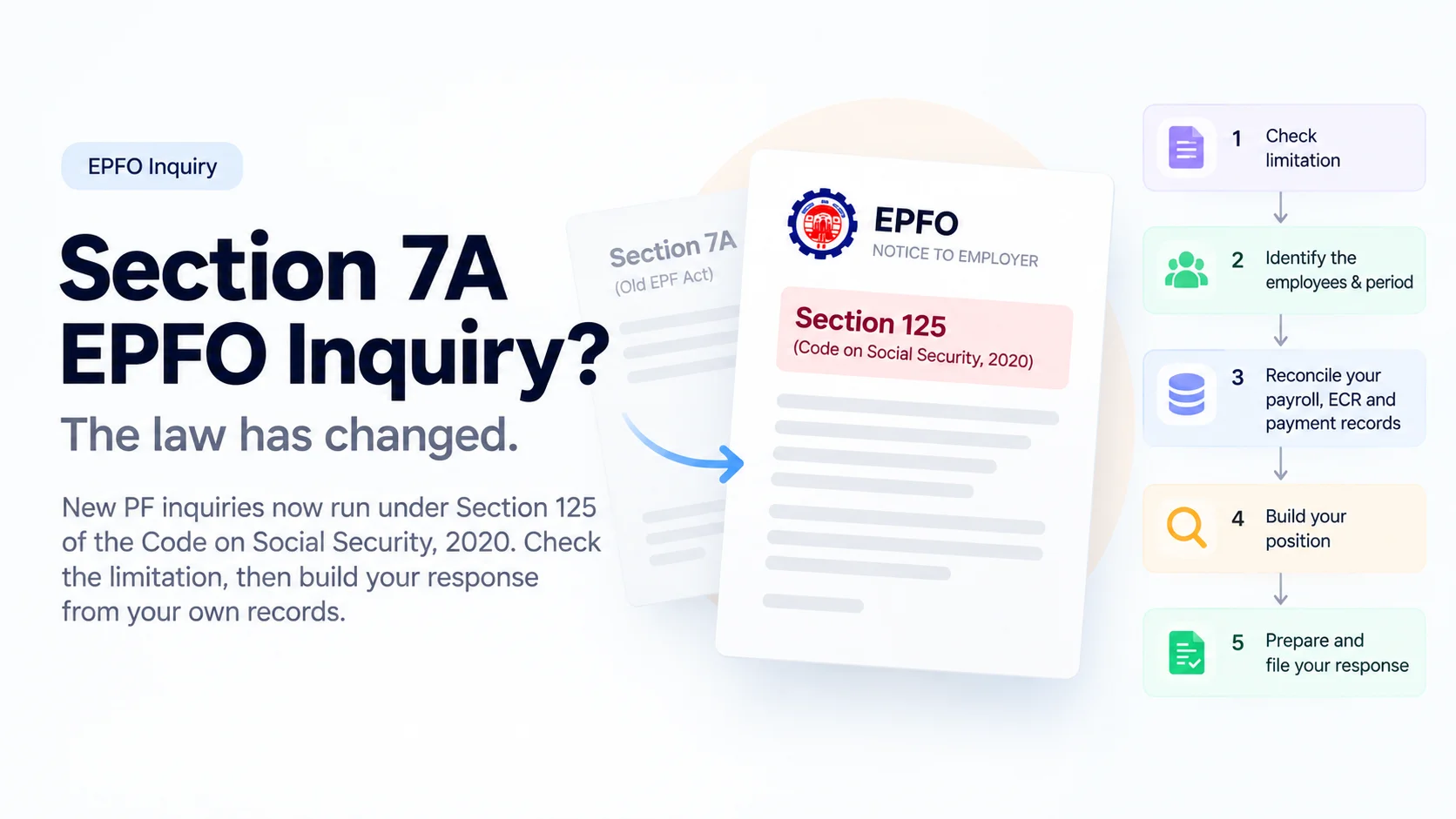
Received a Section 7A notice? Since 21 November 2025, new PF inquiries run under Section 125 of the Code on Social Security, 2020, which replaced Section 7A.
The inquiry is a judicial proceeding. It cannot start more than five years after the dues fell due. If you don't appear, EPFO can decide on the records it holds.
Check the period for limitation first, then build your response from your own records.
| Question | Short answer |
|---|---|
| Is Section 7A still in force? | No. s.125 of the Code replaced it from 21 Nov 2025. Inquiries already pending must conclude by 20 Nov 2027. |
| Is there a time limit? | An inquiry cannot start more than 5 years after the amount fell due, and should finish within 2 years (+1 with recorded reasons). |
| What if I miss the hearing? | The officer can decide on the records available. You have 3 months to apply to set an ex parte order aside. |
| How do I appeal? | To the Tribunal under s.23, with 25% of the assessed amount deposited first and no power to waive it. |
| Do damages follow? | Often, as a separate s.128 order of up to 100% of the arrears, after a hearing. |
What is a Section 7A (Section 125) inquiry?
A Section 125 inquiry is a formal proceeding in which an EPFO officer decides whether PF applies to an establishment or its workers, and how much an employer owes. It replaced the Section 7A inquiry under the EPF Act, 1952.
The officer has the powers of a civil court to summon people, require documents and take evidence on affidavit. No order can be passed without giving the employer a reasonable opportunity to be heard (s.125).
If you're not sure your notice is an inquiry at all, start with the EPFO notice to employer guide.
What changed from Section 7A to Section 125
| Topic | Old EPF Act | Code on Social Security, 2020 |
|---|---|---|
| Inquiry into applicability and dues | s.7A | s.125 |
| Time limit to start | None | 5 years from when the amount fell due |
| Time limit to finish | None | 2 years, plus 1 more with recorded reasons |
| Who conducts it | Authorised officer | Officer not below Group 'A' rank |
| If you don't appear | Decided on available records (s.7A(3A)) | Decided on available records (s.125(5)) |
| Undoing an ex parte order | Application under s.7A(4) | Application within 3 months (s.125(6)) |
| Appeal pre-deposit | 75%, waivable (s.7-O) | 25%, not waivable (s.23(3)) |
| Damages | s.14B | s.128: up to 100% of arrears, after a hearing |
| Interest | s.7Q | s.127: 12% a year simple interest (S.O. 2698(E)) |
Inquiries pending on 21 November 2025 continue, but must conclude by 20 November 2027. People still say "7A"; the notice you receive may cite either section.
What EPFO is trying to decide
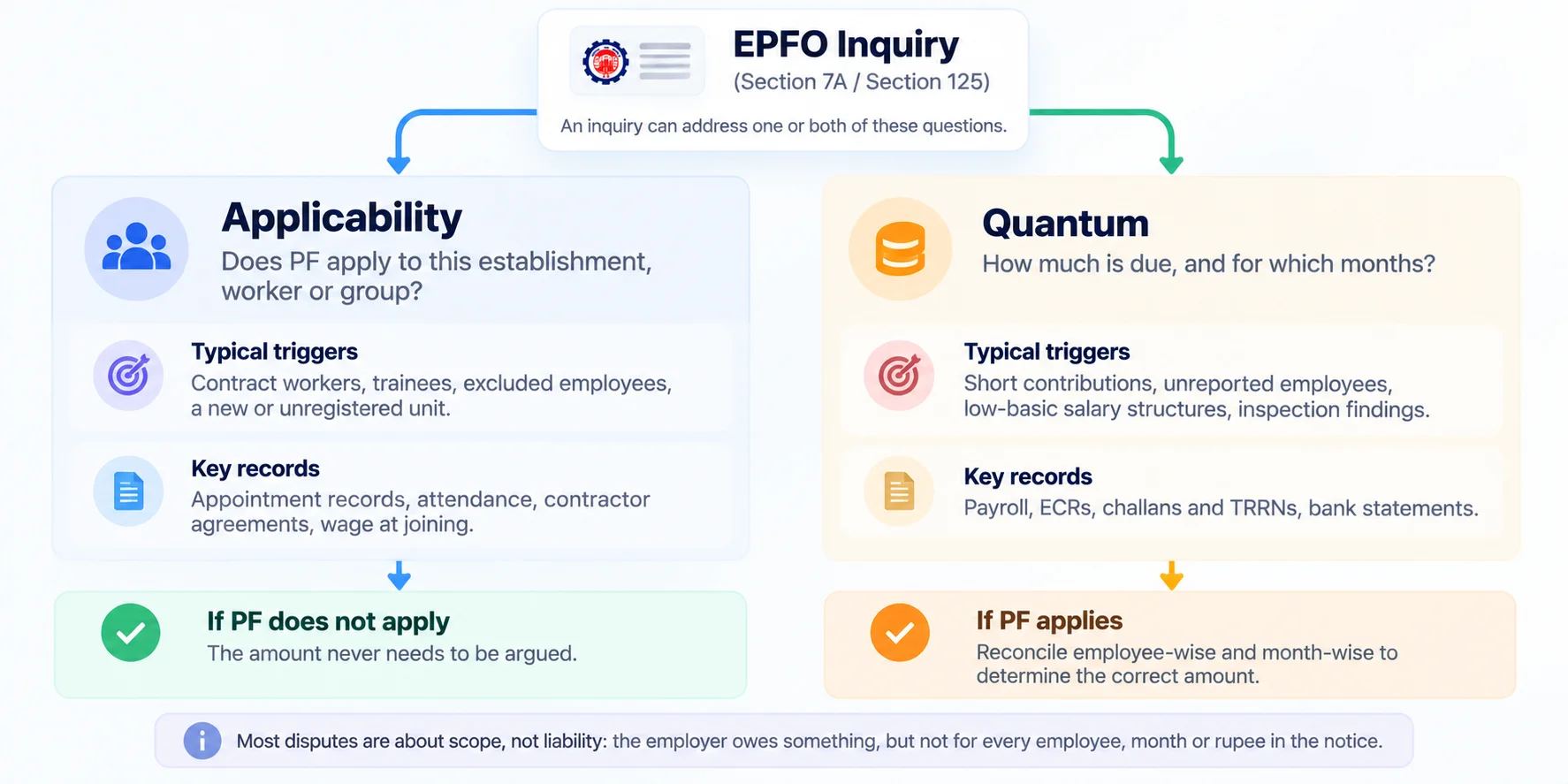
Every inquiry answers one or both of two questions. Knowing which one you face decides which records matter.
| Question | Typical triggers | Evidence that decides it |
|---|---|---|
| Applicability: does PF apply to this establishment, worker or group? | Contract workers, trainees, excluded employees, a new or unregistered unit | Appointment records, attendance, contractor agreements, wage at joining |
| Quantum: how much is due, and for which months? | Short contributions, unreported employees, low-basic salary structures, inspection findings | Payroll, ECRs, challans and TRRNs, bank statements |
Most disputes are about scope, not liability: the employer owes something, but not for every employee, month or rupee in the notice.
How the inquiry runs
The one branch that matters is whether you appear. A missed hearing turns an evidence contest into a decision on EPFO's records alone.
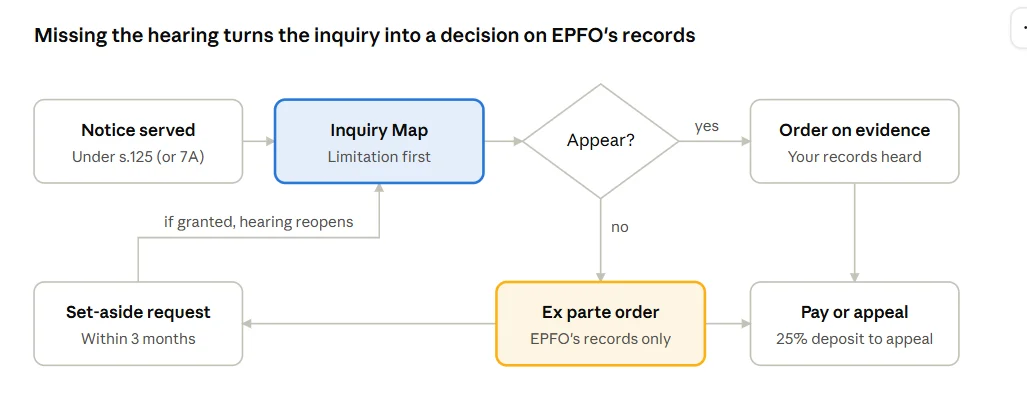
Appearing lets your evidence shape the order. Missing the hearing leaves only a 3-month set-aside window, and only on limited grounds.
The Section 125 Inquiry Map
Kustodian's Section 125 Inquiry Map: test limitation first, then authority, applicability, quantum and evidence, in that order, because each can end the case before the next is needed.
| Check | Question | Why it can decide the case |
|---|---|---|
| 1. Limitation | Did any month in the notice fall due more than 5 years before the inquiry started? | Those months cannot be assessed under s.125 |
| 2. Authority and service | Is the officer of Group 'A' rank or above? Was the notice properly served on the establishment? | Improper service is a ground for setting aside an ex parte order |
| 3. Applicability | Is the establishment, worker or category covered at all? | If not, the amount never needs arguing |
| 4. Quantum | Which employees, months and wage base produce the amount claimed? | Most disputes are about scope, not liability |
| 5. Evidence | Which records prove each point, and do they agree with each other? | The inquiry decides on the record produced |
The bar stops new inquiries reaching back more than five years. EPFO's transition FAQ says inquiries started under Section 7A before 21 November 2025 continue even where they cover older periods, so take advice before relying on limitation in a pending 7A case.
For checks 4 and 5, the reconciliation method in the EPFO notice guide applies: classify each allegation as correct, incorrect, partly correct or unresolved before writing anything.
Documents specific to an inquiry
Beyond payroll, ECR and payment records, inquiries often turn on these:
| Record | What it establishes | Matters most for |
|---|---|---|
| Appointment letters and attendance | Who worked for you, and when | Applicability |
| Contractor agreements and invoices | Who engaged the workers, and on what terms | Contract labour |
| Contractor ECRs and challans | Whether the contractor paid PF | Contract labour |
| Earlier inspection reports | What EPFO observed before | Inspection-led inquiries |
| Accounting ledgers | Payments made outside payroll | Quantum disputes |
One rule covers all of them: reconcile records before you file them, and explain any difference. An attendance register showing 60 workers beside ECRs showing 41 creates a new question unless you explain the gap.
Worked example: PF for contract workers
Suppose an inquiry claims PF for 60 contract workers over 18 months (illustrative). A reply saying "they were the contractor's employees" does not settle it. The map does:
| Check | Finding (illustrative) |
|---|---|
| Limitation | All 18 months fell due within the last 5 years; no months excluded |
| Applicability | All 60 were deployed at the establishment, so PF applies |
| Quantum | Contractor ECRs and challans cover 41 workers. Attendance shows 19 more who never appear in them. |
| Evidence | Contractor challans for 41; attendance and gate records for 19 |
| Position | Contest 41 with contractor evidence. Concede 19: the principal employer answers for the contractor's gap. |
The concession is a finding, not a defeat: it narrows the order to the amount the records support. Check the contractor agreement's indemnity clause before paying, and see the contractor check in the employer PF audit to stop the gap recurring.
After the order: your options
Read the order against the notice: the period, the employees and the basis for each amount. Then choose the route that fits.
| Order outcome | Your options | Key facts |
|---|---|---|
| Ex parte order (you didn't appear) | Apply to the officer to set it aside | Within 3 months of the order being communicated. You must show the notice wasn't duly served or you had sufficient cause. Irregular service alone is not enough if you knew the hearing date and had time to appear. |
| Assessment you accept | Pay the dues with interest | 12% a year simple interest from the due date (s.127). A separate damages order may follow. |
| Assessment you dispute | Appeal to the Tribunal (s.23) | Deposit 25% of the amount determined first. The Tribunal cannot waive it. Time limit as prescribed by the Central Government. |
| Damages order you dispute | Appeal under s.23 | No pre-deposit on the face of the section |
| Damages for a default before 14 June 2024 | Settle under VISHWAS 2026 | Open until 28 Dec 2026. Interest must be paid first; you undertake not to appeal further. |
| Order unpaid | Recovery (s.129) | The establishment's property is attached first, then the employer's own |
If the order covers many employees or years, check whether the same error is still running in payroll today. Otherwise the next inquiry starts where this one ended. The historical PF errors guide covers how to work a multi-year backlog.
How Kustodian handles Section 125 / 7A cases
Kustodian has handled 100+ employer engagements, including show cause notices, inquiries and unit audits. We run the Inquiry Map on your records, reconcile every employee-month in the notice, and prepare the written submissions and evidence pack for the hearing.
What we need: the notice, the hearing date, the establishment code, the period and the approximate number of workers involved.
What you get: a limitation and scope assessment, a reconciliation of each allegation, the submission and annexure pack, and support through the hearing.
Section 7A / Section 125 FAQs
Is Section 7A still valid after the Labour Codes?
New inquiries are held under s.125 of the Code on Social Security from 21 November 2025. Inquiries already pending under Section 7A continue, and must be concluded by 20 November 2027.
Is there a time limit for a Section 7A or 125 inquiry?
Yes, under the Code. An inquiry cannot start more than five years after the amount became due, and should finish within two years, extendable by one. Section 7A had neither limit.
What happens if I don't attend the hearing?
The officer can decide the case on the evidence and records available (s.125(5)). You can apply within three months to set aside that order, if the notice wasn't duly served or you had sufficient cause.
How much must I deposit to appeal a 7A or 125 order?
25% of the amount determined, before the Tribunal hears the appeal. Under the old Act it was 75% but could be waived; under the Code it cannot.
Can I settle the damages that follow an assessment?
For defaults before 14 June 2024, yes, under VISHWAS 2026 until 28 December 2026, after clearing the interest.
Can EPFO recover from the employer personally?
Under s.129, recovery goes first against the establishment's property. Only if that falls short can it move to the employer's own property, and arrest is one of the recovery modes.
Sources
- Code on Social Security, 2020, India Code (ss. 23, 125, 127–129)
- Interest notification S.O. 2698(E), 29 May 2026, Gazette of India
- Employees' Provident Funds Scheme, 2026, G.S.R. 525(E), 29 June 2026, Gazette of India
- Compliance Handbook for Employers under the Four Labour Codes, Ministry of Labour and Employment
- Assessment, recovery and compliance under the Code on Social Security, Taxmann, law as on 7 September 2026
This guide explains the general process and is not legal advice. Disputed proceedings should be assessed against the specific notice, the applicable law and current EPFO instructions.
PF Interest Loss Calculator
See how much interest you lose every month your claim sits unresolved.