For HR, payroll, finance and compliance teams · Updated November 2026
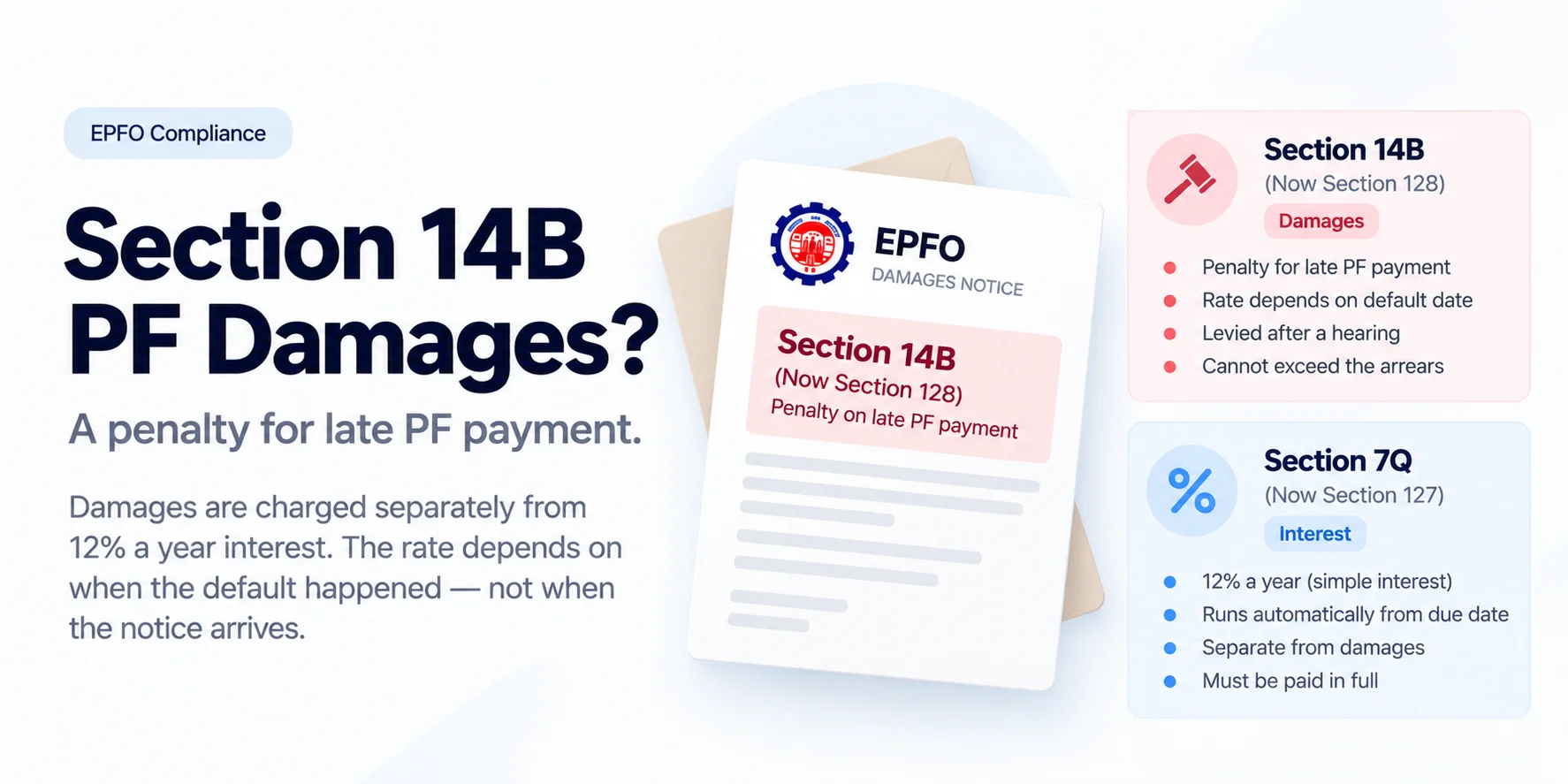
Section 14B damages are a penalty on late PF payment, charged separately from the 12% a year interest under Section 7Q.
For defaults from 14 June 2024, the EPF Scheme, 2026 sets damages at 0.25%, 0.5% or 1% of the arrears per month, depending on how long the payment was late. Older defaults use slabs of 5% to 25% a year. Since 21 November 2025 the power sits in Section 128 of the Code on Social Security, 2020, and damages can never exceed the arrears.
For defaults before 14 June 2024, VISHWAS 2026 lets you settle at reduced rates until 28 December 2026.
| Question | Short answer |
|---|---|
| What is the 14B damages rate? | 0.25% to 1% of arrears a month for defaults from 14 June 2024, graded by length of delay; 5–25% a year for earlier defaults |
| Is it the same as 7Q interest? | No. Interest (now s.127) is 12% a year and automatic. Damages (now s.128) are a separate penalty, levied after a hearing. |
| Is there a cap? | Damages cannot exceed the amount of arrears (s.128). |
| Can damages be reduced? | Yes: by correcting the calculation, by mitigating facts at the hearing, or by settling pre-June 2024 defaults under VISHWAS. |
| Is a pre-deposit needed to appeal? | Not on the face of s.23 for a damages appeal, unlike an assessment appeal (25%). |
What are Section 14B damages?
Section 14B damages are a penalty EPFO can levy when an employer defaults in paying PF, pension or insurance contributions, transferring accumulations, or paying charges. They punish the delay itself; the unpaid contribution is collected separately.
Any delay is enough. In Horticulture Experiment Station, Gonikoppal v. Regional Provident Fund Organisation (23 February 2022), the Supreme Court held that intent to delay is not required to impose damages.
What changed under the Code
| Topic | Old EPF Act | Code on Social Security, 2020 |
|---|---|---|
| Damages | s.14B | s.128 |
| Interest on late payment | s.7Q | s.127: 12% a year simple interest (S.O. 2698(E), 29 May 2026) |
| Ceiling on damages | Not more than the amount of arrears | Same |
| Hearing before levy | Required | Required |
| Waiver | Limited | Allowed where an approved IBC resolution plan recommends it |
| Appeal | EPF Appellate Tribunal | Tribunal under s.23; no pre-deposit for a damages appeal on the face of the section |
Old-Act damages proceedings continue. If you are being assessed for dues as well, see the Section 7A / 125 inquiry guide.
Damages vs interest
| Damages (s.128, old 14B) | Interest (s.127, old 7Q) | |
|---|---|---|
| Nature | Penalty | Compensation for delay |
| Rate | 0.25% to 1% a month, by length of delay (defaults from 14 June 2024) | 12% a year |
| Discretion | Levied after a hearing; amount can vary with the facts | Automatic from the due date |
| Settled under VISHWAS? | Yes, for pre-14 June 2024 defaults | No; must be paid in full first |
Section 14B damages rates
The rate depends on when the default happened, not when the notice arrives. Defaults from 14 June 2024 carry the graded monthly rates of the EPF Scheme, 2026; earlier defaults keep the old annual slabs.
| Default | Damages rate | Source |
|---|---|---|
| On or after 14 June 2024, delayed less than 2 months | 0.25% of arrears a month | Para 23, EPF Scheme 2026 |
| On or after 14 June 2024, delayed 2 to 4 months | 0.50% of arrears a month | Para 23, EPF Scheme 2026 |
| On or after 14 June 2024, delayed more than 4 months | 1% of arrears a month | Para 23, EPF Scheme 2026 |
| Up to 13 June 2024, delayed under 2 months | 5% a year | Old Para 32A |
| Up to 13 June 2024, delayed 2 to under 4 months | 10% a year | Old Para 32A |
| Up to 13 June 2024, delayed 4 to under 6 months | 15% a year | Old Para 32A |
| Up to 13 June 2024, delayed 6 months or more | 25% a year | Old Para 32A |
| Any period | Never more than the arrears | s.128 (old s.14B) |
Para 23(2) of the EPF Scheme, 2026 applies these graded rates to every default from 14 June 2024, including defaults that arose under the 1952 Scheme. They replace the flat 1% a month introduced in June 2024, so a post-June 2024 notice calculated at 1% for a short delay is worth checking. The 2024 change covered pension (EPS) and insurance (EDLI) contributions too; check the EPS and EDLI Schemes, 2026 for their current rates.
Worked example: ₹10 lakh paid 5 months late
An employer pays ₹10,00,000 in arrears exactly 5 months after the due date (illustrative). A delay of more than four months falls in the top slab of 1% a month.
| Default after 14 June 2024 | Default before 14 June 2024 | |
|---|---|---|
| Damages | 1% × 5 months = ₹50,000 | 15% a year × 5/12 = ₹62,500 |
| Interest (s.127, old 7Q), 12% a year | ₹10,00,000 × 12% × 5/12 = ₹50,000 | ₹50,000 |
| Total | ₹1,00,000 | ₹1,12,500 |
| VISHWAS option | Not eligible | Damages recalculated at 1% a month: ₹50,000 instead of ₹62,500. Interest still due in full. |
Shorter delays now cost much less. A payment less than two months late on a post-June 2024 default attracts 0.25% a month, a quarter of the old flat rate.
Read your notice's calculation sheet the same way: for each wage month, check the due date, the payment date, the delay counted, the rate applied and the arrears it was applied to. Most errors sit in the payment date or the arrears base, not the rate.
Settle or contest?
The date of the default decides your options. For pre-June 2024 defaults, the choice between settling and contesting has a deadline: VISHWAS 2026 closes on 28 December 2026.
| Your situation | Option | What to weigh |
|---|---|---|
| Default on or after 14 June 2024 | Check the calculation; contest only real errors | The rate is set by the length of delay (0.25% to 1% a month), so disputes are about the period, amount, payment dates and slab applied |
| Default before 14 June 2024: notice not yet issued, notice issued, order passed, or appeal pending | Settle under VISHWAS 2026, or contest | VISHWAS gives reduced damages but ends any appeal and requires an undertaking not to appeal further. Interest must be paid first. |
| Damages already fully paid | Nothing to settle | VISHWAS gives no refunds |
| Case involves fraud or falsified records | Contest or pay | Excluded from VISHWAS |
The Bombay, Madras and Kerala High Courts have directed employers with pending damages disputes to apply under VISHWAS before its deadline, Outlook Money reported.
What reduces Section 14B damages
Damages are levied after a hearing, and the amount can vary with the facts. The Kerala High Court held in Bake N Joy Hot Bakery that 100% damages is not mandatory. Grounds differ sharply in strength:
| Ground | Strength | What to prove |
|---|---|---|
| Calculation error: wrong period, arrears base or delay | Strong | Employee-month table against EPFO's calculation sheet |
| Payment made earlier than EPFO's record shows | Strong | TRRN, challan and bank debit date |
| Arrears include amounts not actually due | Strong | Payroll and ECR showing the correct contribution |
| Genuine cause: closure, natural disaster, financial distress | Moderate; affects amount, not liability | Documentary evidence for the period |
| "We didn't intend to delay" | Weak on its own | Intent is not required (Supreme Court, 2022) |
| Approved IBC resolution plan recommends waiver | Specific | The approved plan |
How to check a 14B damages notice
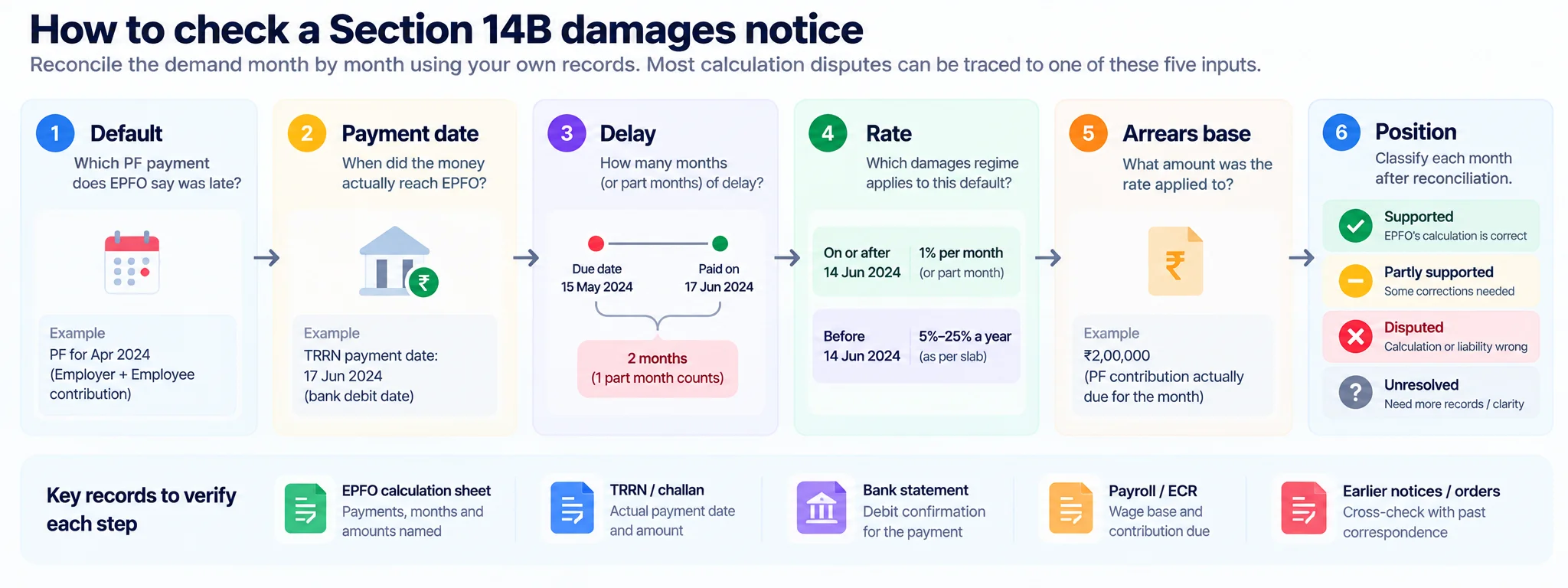
Kustodian's 14B test: for every wage month in the notice, confirm the due date, the actual payment date, the delay counted, the rate applied and the arrears base, then classify the demand as supported, partly supported, disputed or unresolved.
| Check | Question | Common error |
|---|---|---|
| Default | Which payment does EPFO say was late? | Months already paid on time included |
| Payment date | When did the money actually reach EPFO? | Challan generation date used instead of the payment date |
| Delay | How many months, counting part months? | Delay counted past the real payment date |
| Rate | Which regime applies: pre- or post-14 June 2024? | Wrong regime or slab: old annual slabs on a post-June 2024 default, or a flat 1% where a lower graded rate applies |
| Arrears base | What amount was the rate applied to? | Base includes amounts not due, or months counted twice |
| Position | Supported, partly supported, disputed or unresolved? | Replying before reconciling |
The records that settle these questions are few:
| Record | Settles |
|---|---|
| EPFO's calculation sheet | What EPFO computed, month by month |
| Challans with TRRN | What was generated and against which wage month |
| Bank debit statements | When the money actually left your account |
| Payroll and ECR | What the contribution should have been |
| Earlier damages notices and orders | Months already assessed, to avoid double counting |
For the full payroll-to-EPFO reconciliation method, see the employer PF compliance audit. For how to structure the written reply, see the EPFO notice guide.
After a damages order
| Outcome | Next step |
|---|---|
| Order matches your reconciliation | Pay. For a pre-June 2024 default, compare against the VISHWAS amount first. |
| Order has calculation errors | Appeal to the Tribunal under s.23 (no pre-deposit for damages on the face of the section) |
| Order passed without a hearing | A hearing is required before damages are levied (s.128); this is a ground for challenge |
| Order unpaid | Recovery under s.129 starts with the establishment's property |
Repeated damages orders usually mean the payment process itself is late. Fix the cycle that produces them, or the next notice will cover the months you are paying for now.
How Kustodian handles damages notices
Kustodian has handled 100+ employer engagements, including damages and interest matters. We recalculate every wage month in the notice, compare the result against VISHWAS where it applies, and prepare the submission for the hearing.
What we need: the notice or order, EPFO's calculation sheet, and challans with bank debit dates for the months named.
What you get: a month-by-month recalculation, a settle-versus-contest comparison for pre-June 2024 defaults, and the hearing submission.
For pre-June 2024 defaults, the VISHWAS window closes on 28 December 2026.
Section 14B damages FAQs
What is the Section 14B damages rate in 2026?
For defaults on or after 14 June 2024, the EPF Scheme, 2026 sets 0.25% of the arrears a month if the payment was less than two months late, 0.50% for two to four months and 1% for more than four months. For earlier defaults, 5% to 25% a year depending on the length of delay, unless settled under VISHWAS 2026.
Is 14B damages the same as 7Q interest?
No. Interest (now s.127) is 12% a year and runs automatically from the due date. Damages (now s.128) are a separate penalty, levied after a hearing.
Can Section 14B damages exceed the PF arrears?
No. Section 128 caps damages at the amount of arrears.
Can 14B damages be waived or reduced?
They can be reduced by correcting the calculation or by mitigating facts at the hearing, and settled at reduced rates under VISHWAS for pre-June 2024 defaults. Waiver is allowed where an approved IBC resolution plan recommends it.
Should I settle under VISHWAS or appeal?
Settle when your calculation broadly matches EPFO's and an appeal would only argue the amount. Consider contesting when the default itself or the payment dates are wrong. Settling ends the appeal for good.
Is a pre-deposit required to appeal a damages order?
Not on the face of s.23 of the Code. The 25% pre-deposit applies to appeals against assessments of dues.
Sources
- Code on Social Security, 2020, India Code (ss. 23, 127, 128, 129)
- Horticulture Experiment Station, Gonikoppal v. RPFO, Supreme Court, 23 February 2022
- Clarification on applicability of revised damages rates, Deloitte, September 2024 (notifications of 14 June and 28 August 2024)
- Revision in rate of damages on arrears, Khaitan & Co, June 2024
- JSA Employment Law Newsletter, May 2025 (Bake N Joy Hot Bakery, Kerala High Court)
- Interest notification S.O. 2698(E), 29 May 2026, and EPF Scheme 2026, G.S.R. 525(E), Gazette of India
- Assessment, recovery and compliance under the Code on Social Security, Taxmann, law as on 7 September 2026
This guide explains the general position and is not legal advice. Check the rate and period against your notice and current EPFO instructions.
PF Interest Loss Calculator
See how much interest you lose every month your claim sits unresolved.