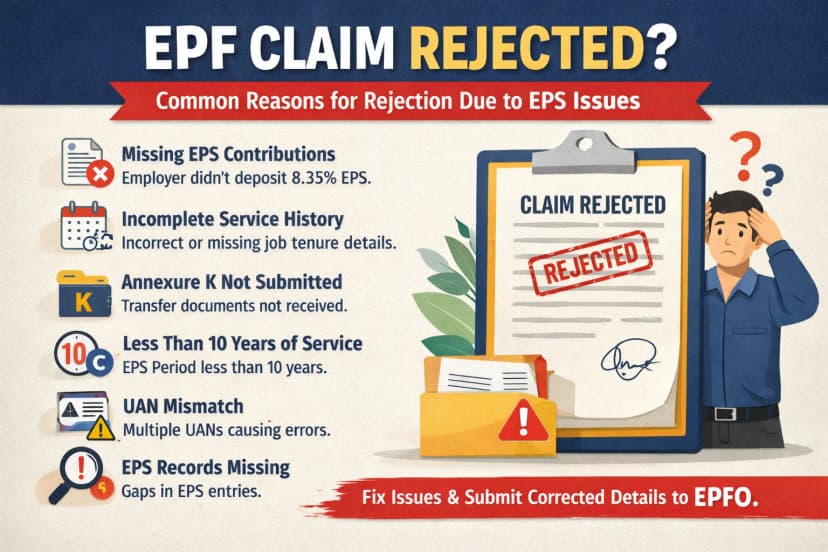
Kustodian helps individuals resolve EPF withdrawal, transfer, and settlement issues, including claim delays, rejected claims, Aadhaar mismatches, missing exit dates, and KYC-related errors.
EPF Claim Status: Quick Answer
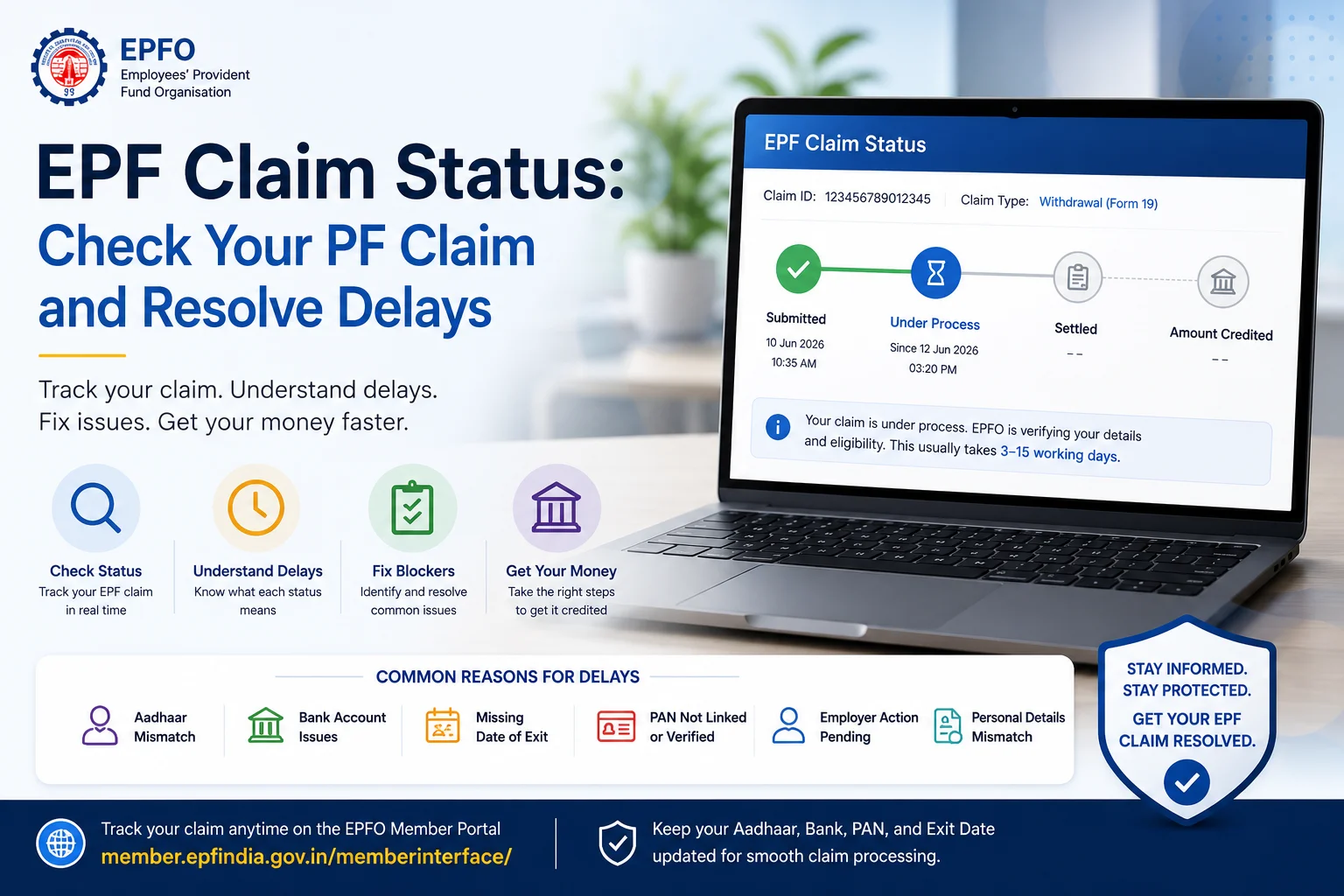
You can check your EPF claim status through the EPFO Member Portal, UMANG app, SMS service, or missed-call facility. Common claim statuses include Submitted, Under Process, Settled, Rejected, and Forwarded to Field Office.
If your claim remains under process for more than 15–20 working days, verify your Aadhaar, bank account, PAN, and Date of Exit before raising a grievance. Many delayed claims are caused by record mismatches rather than EPFO processing delays.
In this guide, you'll learn:
- How to check EPF claim status
- What each claim status means
- Typical processing timelines
- Why claims get delayed or rejected
- What to do next if your claim is stuck
If your EPF claim has been under process for weeks, rejected without a clear reason, or shows payment issues, Kustodian can help identify record mismatches, missing employer updates, and other blockers that may be delaying your claim.
1. How to Check EPF Claim Status
EPFO provides multiple ways to track the status of a PF withdrawal, transfer, or advance claim. The Member Portal offers the most detailed information, while UMANG, SMS, and missed-call services provide quick alternatives.
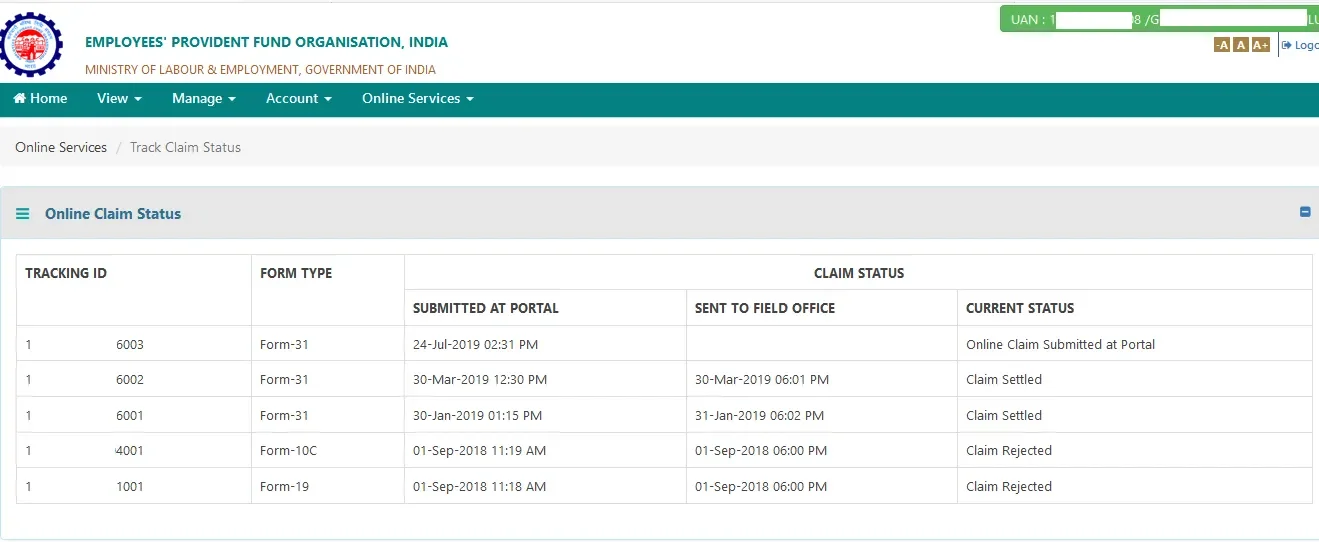
Method 1: EPFO Member Portal
This is the most reliable way to track your claim.
- Log in to the EPFO Member Portal using your UAN and password. If your UAN is not active, see our UAN Activation Guide.
- Open Online Services.
- Select Track Claim Status.
- View the latest status of your claim.
Use this method if you want detailed information about processing, settlement, rejection, or payment status.
Method 2: UMANG App
You can also track claims through the UMANG app.
- Open the UMANG app.
- Search for EPFO services.
- Sign in using your registered details.
- Select Track Claim.
- View the current claim status.
This is useful for members who primarily access EPFO services on mobile devices.
Method 3: SMS Service
If your UAN is activated, send:
EPFOHO UAN ENG
to: 7738299899
EPFO will return the PF account and contribution information linked to your UAN. For detailed claim-stage tracking (such as Under Process or Settled), use the EPFO Member Portal.
Method 4: Missed-Call Service
Give a missed call from your registered mobile number to:
011-22901406
The call disconnects automatically, and EPFO sends PF account information via SMS. For detailed claim-status updates, use the EPFO Member Portal.
Which Method Should You Use?
| Method | Best For | Login Required |
|---|---|---|
| EPFO Member Portal | Detailed claim tracking | Yes |
| UMANG App | Mobile access | Yes |
| SMS Service | Quick information | No |
| Missed Call Service | Basic account updates | No |
For claim delays, rejections, or payment issues, the EPFO Member Portal usually provides the most useful information.
2. How Long Does an EPF Claim Usually Take?
Most EPF claims move through several stages before the money reaches your bank account. Exact timelines vary by claim type, record accuracy, employer updates, and verification requirements.
As a general rule, a claim showing Under Process for a few days is normal. A claim that remains unchanged for several weeks may require investigation.
| Claim Stage | Typical Time |
|---|---|
| Submitted | 1–2 working days |
| Under Process | 3–15 working days |
| Forwarded to Field Office | Varies |
| Settled | After approval |
| Amount Credited | Usually 1–3 working days after settlement |
If your claim has remained under process for more than 15–20 working days, check your Aadhaar, bank account, PAN, and Date of Exit before assuming there is a processing delay.
3. What Does Your EPF Claim Status Mean?
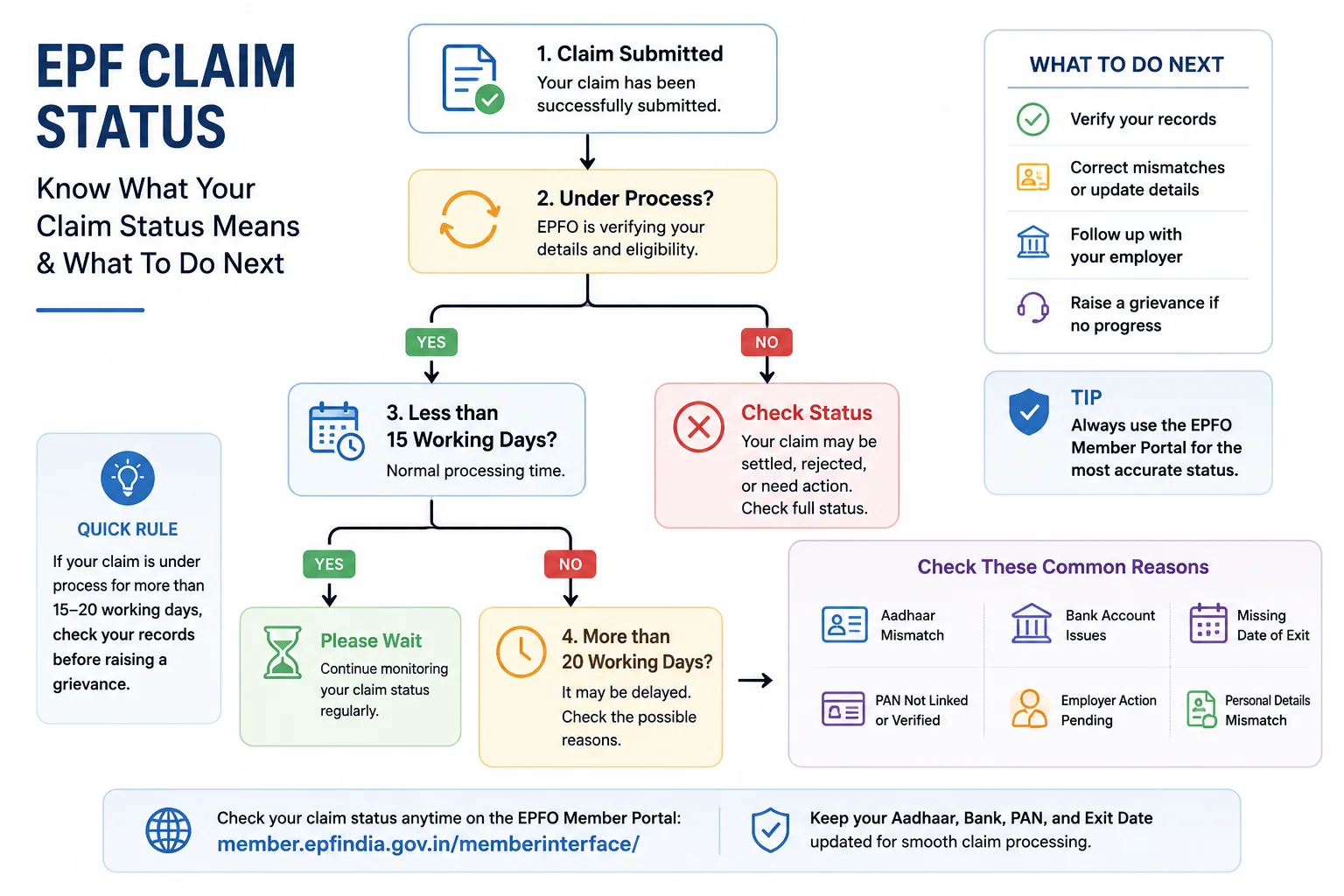
The status itself often tells you whether you should wait, fix a record issue, or take action.
| Status | Meaning | Typical Duration | What To Do |
|---|---|---|---|
| Submitted | EPFO has received the claim | 1–2 days | Wait for processing to begin |
| Under Process | The claim is being reviewed and verified | 3–15 working days | Check the records if delayed |
| Forwarded to Field Office | Manual review is required | Varies | Monitor progress and wait |
| Settled | Claim approved and payment initiated | 1–3 days | Check the linked bank account |
| Rejected | The claim cannot proceed due to an issue | Immediate | Identify and correct the issue |
| Payment Failed | The transfer to the bank account was unsuccessful | Immediate | Verify bank details |
| Pending at Employer | Employer action is required | Varies | Follow up with the employer |
Under Process
This is the most common EPF claim status and usually means verification is underway.
In most cases, no action is required unless the status remains unchanged for more than 15–20 working days. Long-running claims are often linked to Aadhaar mismatches, missing exit dates, or incomplete KYC records.
Forwarded to Field Office
This status means the claim requires manual review instead of automated processing.
It does not automatically indicate a problem, but processing may take longer because additional verification is required.
Settled
A settled status means the claim has been approved, and payment has been initiated.
If the amount does not reach your bank account within a reasonable period, verify that the linked account details are correct and active.
Payment Failed
This status means EPFO approved the claim, but could not successfully transfer the funds to your bank account.
The most common causes are incorrect account details, closed accounts, or bank verification issues. Verify your linked bank account before raising a grievance.
Rejected
A rejected claim means EPFO found an issue that prevented processing.
The most common reasons include Aadhaar mismatches, bank-account issues, missing PAN details, incorrect personal information, or eligibility-related errors.
Pending at Employer
This status means EPFO is waiting for an action from your employer, such as updating your Date of Exit, verifying employment records, or completing an approval step.
Follow up with your employer before escalating the issue to EPFO.
4. Why Is Your EPF Claim Stuck?
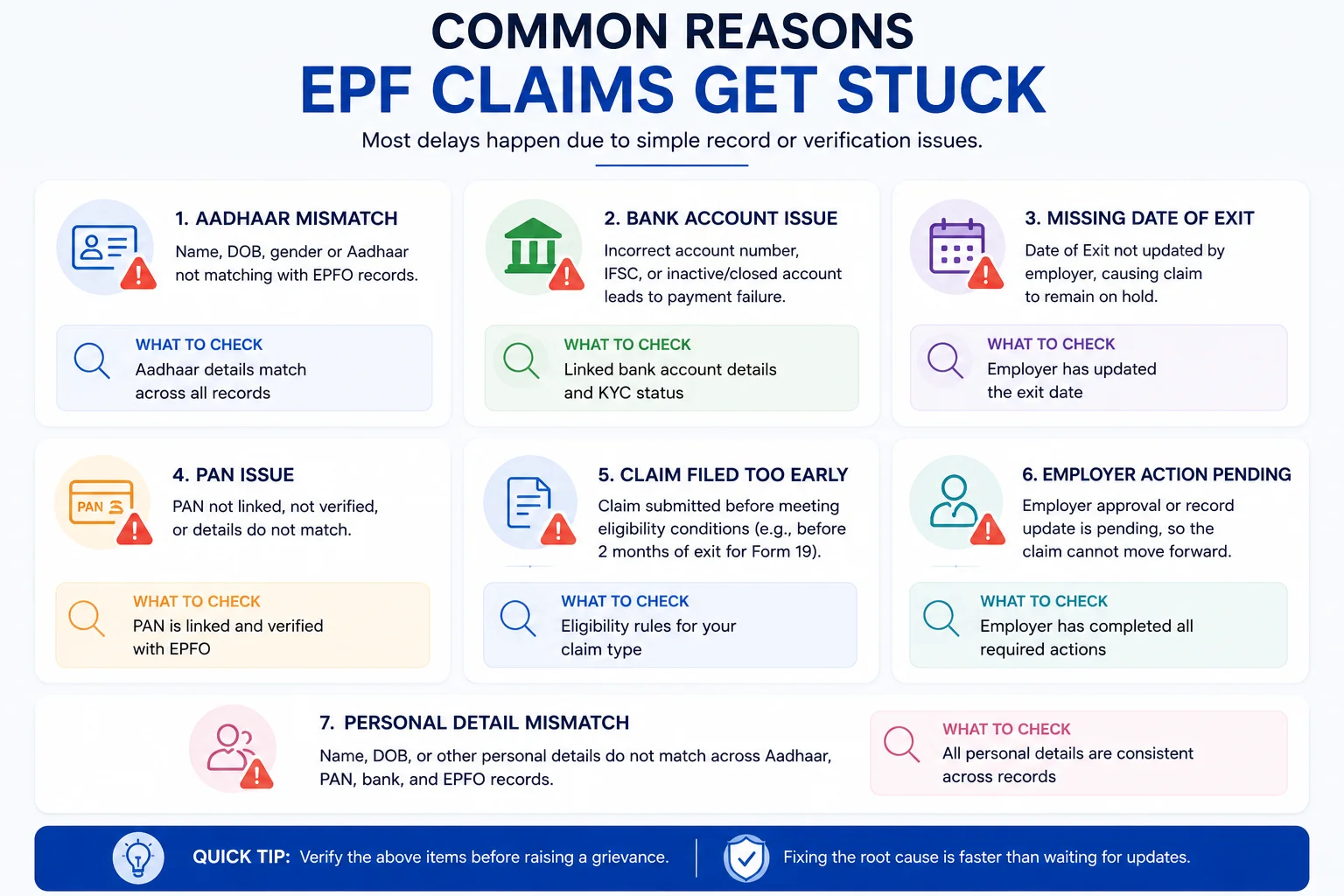
A delayed claim does not always mean EPFO is taking longer than usual. In many cases, the delay is caused by a mismatch, a missing record, or an eligibility issue attached to the claim.
The table below covers the most common causes of EPF claim delays and rejections.
| Problem | Typical Symptom | What To Check |
|---|---|---|
| Aadhaar mismatch | Under Process, Rejected | Name, DOB, gender match across records |
| Bank account issue | Payment failed, settled, but the money was not received | Linked account details and KYC |
| Missing Date of Exit | Under Process, Rejected | The employer has updated the exit date |
| PAN issue | Rejected | PAN linked and verified |
| Claim filed too early | Rejected | Eligibility requirements met |
| Employer action pending | Pending at Employer | Approval or record update pending |
| Personal detail mismatch | Rejected, delayed verification | Name and profile details match across records |
*Claim filed too early (for example, before meeting Form 19 eligibility requirements)
*Employer action pending (such as KYC updates or profile corrections). If member details need correction, see our Joint Declaration Guide.
Not Sure What's Blocking Your Claim?
Many claim delays are caused by Aadhaar mismatches, missing Date of Exit updates, KYC issues, or employer-side errors. Kustodian helps identify the root cause before you spend time raising unnecessary grievances.
The Most Common Claim Blockers
Based on 8,300+ EPF-related claim and withdrawal cases reviewed by Kustodian, the majority of delayed claims can be traced back to a small number of record issues rather than EPFO processing delays.
The most frequent problems include:
- Aadhaar and EPF records not matching
- Missing Date of Exit after leaving employment
- Incorrect or unverified bank details
- Employer updates that were never completed
- Personal details that differ across Aadhaar, PAN, bank, and EPF records
Many members continue checking the same status repeatedly without realizing the claim cannot move forward until the underlying record issue is corrected.
Quick Self-Check Before Raising a Grievance
Before escalating a delayed claim, verify that:
✓ Aadhaar is linked and verified
✓ Bank account is linked and active
✓ PAN is updated (where applicable)
✓ Date of Exit is available
✓ Personal details match across records
✓ Employer actions have been completed
If one of these items is missing or incorrect, fixing it is often more effective than filing a grievance immediately.
Everything Looks Correct, exit, but Your Claim Is Still Delayed?
If you've verified your Aadhaar, PAN, bank details, and Date of exit, but your claim still isn't moving, the issue may require deeper investigation. Kustodian helps members identify record inconsistencies and correction requirements.
5. What To Do Next Based on Your Claim Status
Use the table below to decide whether you should wait, correct a record, follow up with your employer, or escalate the issue.
| Status | Recommended Action |
|---|---|
| Submitted | Wait for processing to begin |
| Under Process (less than 15 working days) | Continue monitoring |
| Under Process (more than 20 working days) | Verify Aadhaar, bank details, PAN, and Date of Exit |
| Forwarded to Field Office | Wait for manual review |
| Settled, but the money was not received | Verify the linked bank account |
| Rejected | Review and correct the rejection reason |
| Payment Failed | Update bank-account details |
| Pending at Employer | Follow up with the employer |
| No progress after corrections | Raise a grievance |
The goal is to identify whether the issue is with the claim itself, your records, or an action that is still pending. Most claim delays become easier to resolve once the underlying cause is identified.
6. Frequently Asked Questions
How long does an EPF claim settlement take?
Most EPF claims are processed within a few working days, although timelines vary depending on claim type, record accuracy, employer updates, and verification requirements. A claim showing Under Process for 3–15 working days is generally considered normal.
Why is my EPF claim showing Under Process?
An Under Process status means EPFO is reviewing your claim and verifying eligibility, KYC details, and employment records. If the status remains unchanged for more than 15–20 working days, check your Aadhaar, bank account, PAN, and Date of Exit.
What does "Forwarded to Field Office" mean?
This status means the claim requires manual review by an EPFO field office instead of automated processing. It does not automatically indicate a problem, but it may increase processing time.
Why was my EPF claim rejected?
Common reasons include Aadhaar mismatches, missing PAN details, incorrect bank-account information, missing Date of Exit, eligibility issues, or personal details that do not match across records.
What should I do if my claim is rejected?
First, identify the rejection reason. Correct the underlying issue, verify your records, and then submit a fresh claim if required. Reapplying without fixing the issue usually results in another rejection.
My claim is settled, but I have not received the money. What should I do?
A settled status means payment has been initiated. If the amount has not reached your bank account after a reasonable period, verify that the linked account details are correct and active. Payment delays are often linked to banking or KYC issues rather than claim approval.
Can I check the EPF claim status without logging in?
Yes. EPFO provides SMS and missed-call services for members with an activated UAN and linked KYC records. However, the Member Portal provides the most detailed claim information.
Can I track PF transfer and withdrawal claims from the same portal?
Yes. The EPFO Member Portal allows members to track different types of claims, including withdrawals, transfers, and advances. If you're tracking a transfer claim, see our ,..
When should I raise an EPF grievance?
Consider raising a grievance if your claim remains delayed after verifying all records, if the status has not changed for an unusually long period, or if a settled claim has not been credited despite correct bank details. Learn how to file and track complaints through our EPFiGMS Grievance Guide.
My EPF claim is taking too long. What should I do?
If your claim has remained under process for more than 15–20 working days, verify your Aadhaar, bank account, PAN, and Date of Exit before raising a grievance. Long-running claims are often caused by record mismatches rather than processing delays.
Need Help Resolving a Delayed or Rejected EPF Claim?
Checking claim status tells you where your application is. It rarely tells you why it is stuck.
Many delayed claims are caused by Aadhaar mismatches, missing exit dates, bank-account issues, or incomplete records that prevent processing from moving forward.
If you're unsure what's blocking your claim, Kustodian can help identify record issues, correction requirements, and the next steps needed to move your claim toward resolution.
PF Interest Loss Calculator
See how much interest you lose every month your claim sits unresolved.