Your résumé update takes an hour. Your EPF update, if skipped, can cost you a pension.
Here's what most people don't realize: a PF transfer can show as "complete" on the EPFO portal while your pension service history quietly doesn't carry over. EPFO's own Form 13 bundles the two together on paper — "I request that my provident fund balance along with my pension service details may please be transferred" — but the two records are tracked separately inside EPFO's system, and each can fail independently.
This checklist tells you exactly what to verify, and when, so that never happens to you.
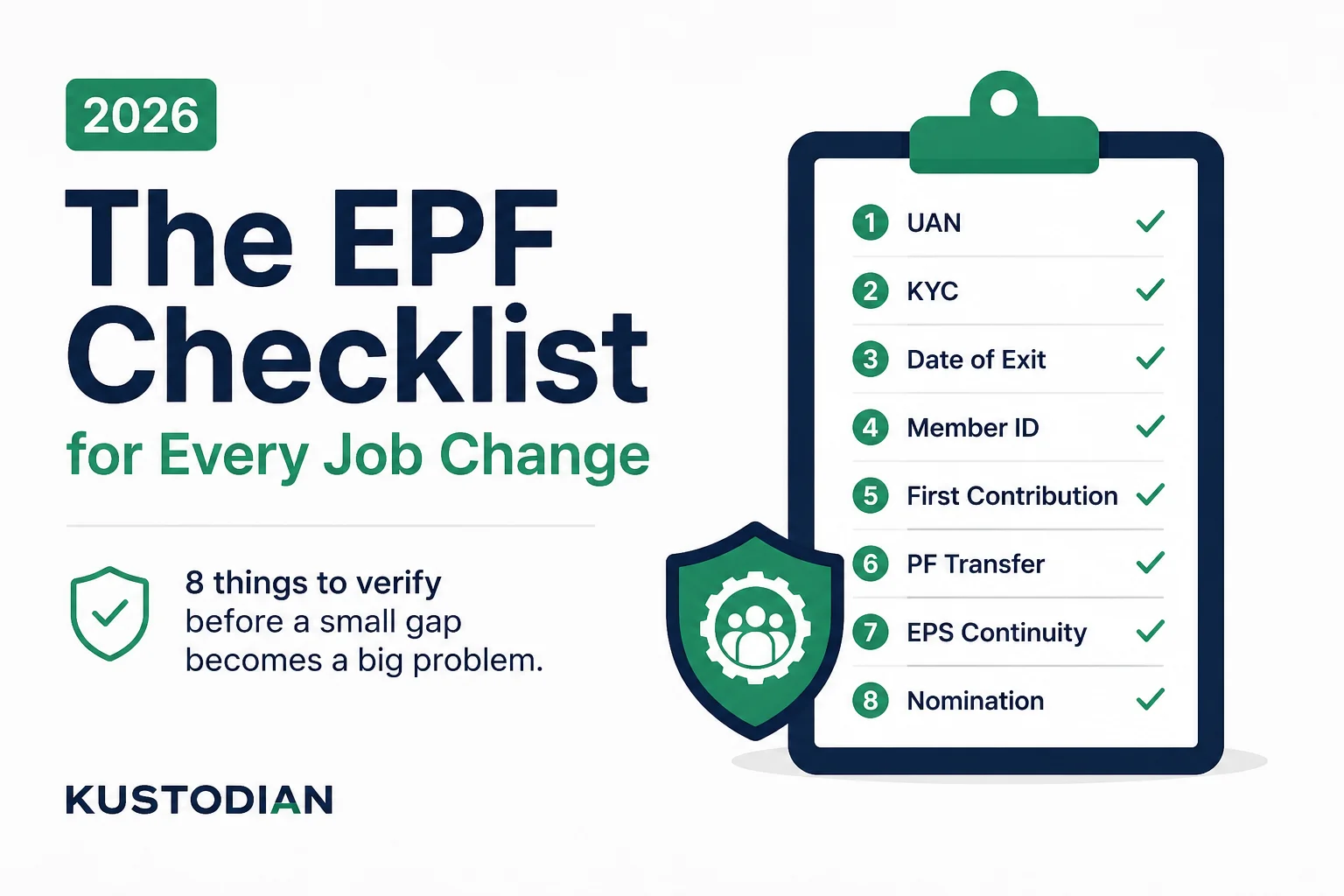
The 8 Things That Actually Break
Every job change touches four underlying records. The eight checks below are just how you verify each one didn't silently fail.
| Record group | # | Check | What breaks | When |
|---|---|---|---|---|
| Identity | 1 | UAN | New employer issues a second UAN instead of reusing yours | Day 1 at new employer |
| 2 | KYC (Aadhaar, PAN, bank) | Mismatch blocks auto-transfer silently | Before resigning | |
| Employment | 3 | Date of Exit | Old employer never marks it — blocks transfer indefinitely | End of notice period |
| 4 | Member ID | New ID not generated under your existing UAN | After first salary | |
| Money | 5 | First contribution | Employer PF deduction doesn't appear in passbook | After first salary |
| 6 | PF transfer | Balance doesn't merge into new Member ID | 30–45 days after first contribution | |
| Pension | 7 | EPS continuity | Pension service years don't show as continuous | After transfer confirms |
| 8 | Nomination | Old nomination carries forward unreviewed | Within 90 days |
Run through this once, in order, and you're done. Skip it, and any one of these can surface — usually years later — as a rejected claim.
Don't want to check these manually?
Kustodian's Job Change Health Check runs all eight in about two minutes: UAN status, Date of Exit, KYC match, transfer status, previous service, and EPS continuity — with a plain "fix this" note wherever something's off.
Why the Damage Is Delayed
A job change doesn't erase your EPF identity — it creates a second employment record under it. Your UAN stays constant for life; a new Member ID is created under it with each employer. That's the whole model. Everything else on this page is just making sure that model actually holds.
Payroll and EPFO are different systems. Your salary can be credited, your PF deducted, and your employment records still be wrong. That's why most job-change mistakes stay invisible until you transfer your PF, withdraw it, or claim your pension — often years later, when the previous employer's HR has moved on and the paper trail is cold.
Why This Checklist Exists
Helping employees resolve delayed EPF and pension claims, one pattern kept repeating: the problem was almost never that someone didn't know how to file a transfer. It was that no one had told them what to verify before filing it — while the fix was still a five-minute correction instead of a months-long grievance. This checklist is that missing step.
Found a gap in your checklist? Don't wait until it becomes a claim problem. Schedule a consultation with Kustodian to review your UAN, Member IDs, service history, transfers, and pension records with an EPF expert before your next job change or withdrawal.
Before You Resign
Once you've exited, getting documents or corrections from HR gets harder fast. Do this first:
- Download your appointment letter, salary slips, and Form 16
- Pull your latest EPF passbook (passbook.epfindia.gov.in)
- Confirm Aadhaar, PAN, and bank KYC are all seeded and linked to your UAN
- Review your EPF nomination
Common mistake: resigning before checking KYC. A silent Aadhaar-bank mismatch is invisible until it blocks your transfer months later.
During Your Notice Period
This is where your previous employer's obligations get fulfilled — or don't.
- Confirm your Date of Exit gets updated once your last day is set. This single field gates every future transfer.
- Verify your final month's PF contribution actually posts to your passbook.
- Get your relieving letter and experience certificate before you lose access to company systems.
Red flag: if your employer suggests creating a new UAN instead of using your existing one, refuse. This is the single most common cause of duplicate UANs.
Joining Your New Employer
Payroll systems don't self-correct. Verify each of these instead of assuming:
| Record | Confirm it's… |
|---|---|
| UAN | The same one from your previous job |
| Member ID | Newly generated, under that UAN |
| Aadhaar / PAN | Correctly linked, not re-entered incorrectly |
| Bank account | Matches what's on EPFO's records |
Submit Form 11 if your employer requests it — this is how they officially declare your prior PF details for linking.
After Your First Salary
A PF deduction on your payslip isn't proof your account is set up correctly. Check the passbook directly:
- Employer and employee contributions both visible under the new Member ID
- Still only one UAN — no second one created by mistake
- Passbook actually updated, not just the payslip line item
Transferring Your PF on Job Change (The Part Most People Get Wrong)
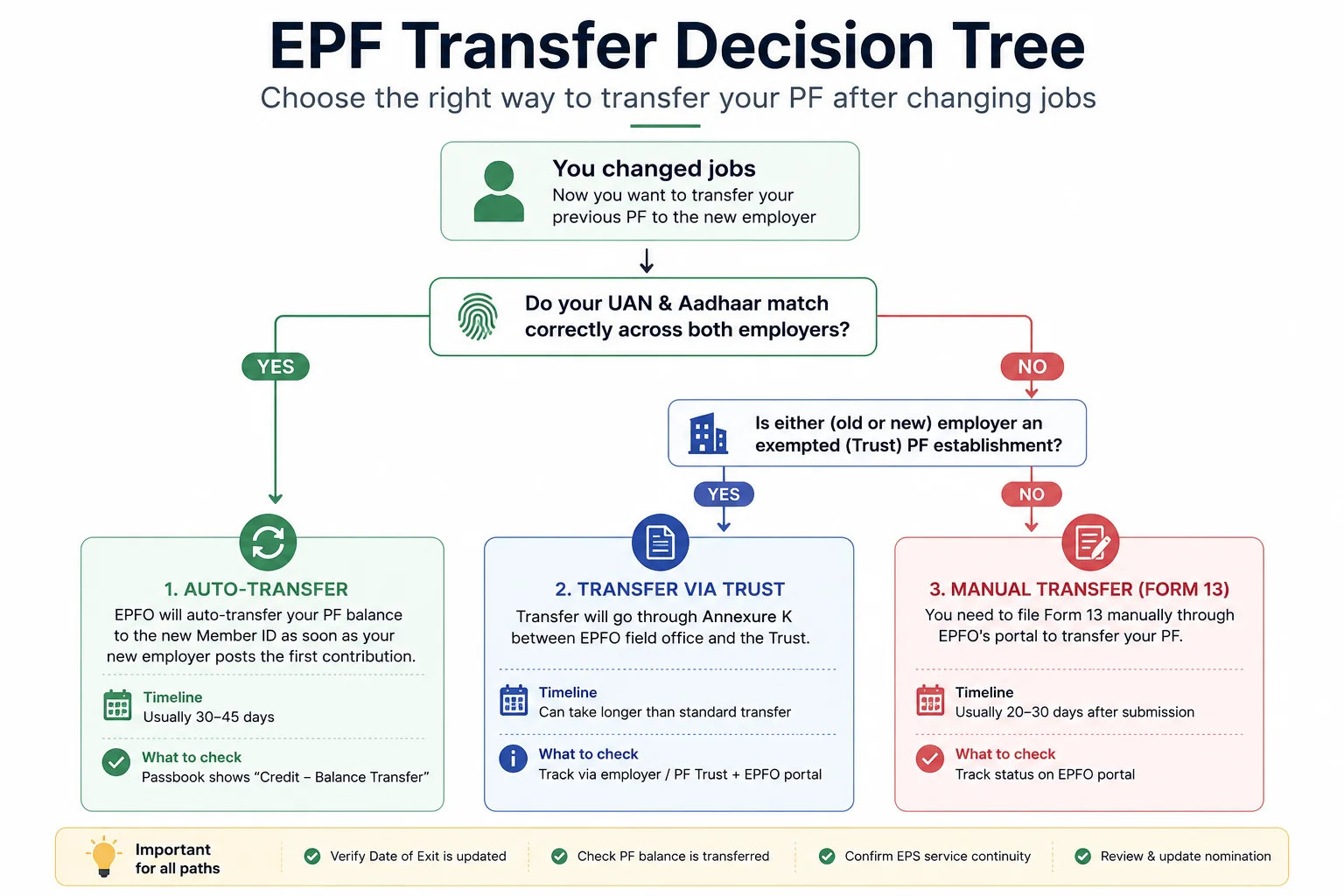
Here's the mechanism, because understanding it changes what you check.
If your UAN and Aadhaar match cleanly across both employers, EPFO's auto-transfer merges your old balance into the new Member ID as soon as your new employer posts the first contribution — no Form 13 needed. Watch for a "Credit — Balance Transfer" entry in your new passbook, typically within 30–45 days.
If it doesn't auto-transfer — mismatched KYC, or an account EPFO can't cleanly match — you file Form 13 manually through Online Services → One Member–One EPF Account (Transfer Request), then track it under Transfer Status.
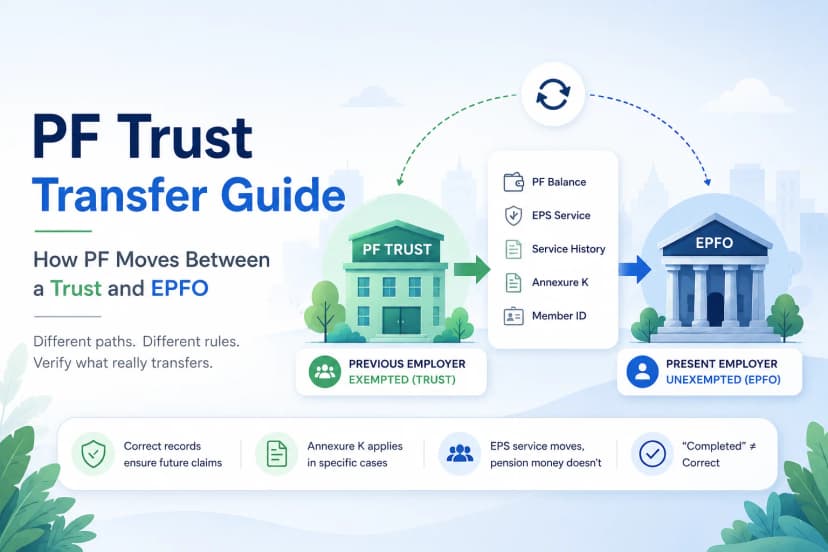
If either account sits with a private PF trust (an "exempted establishment") rather than EPFO directly, the transfer routes through an additional document — Annexure K — passed between the field office and the trust. This step is invisible to you and is the most common reason a trust-involved transfer takes longer than a standard one.
A completed transfer confirms your balance moved. It does not, by itself, confirm your pension service history moved with it — check that separately, next.
Not sure whether your transfer is actually complete? Get a Free EPF Audit from Kustodian. We'll review your UAN, Member IDs, transfer history, Annexure K status (where applicable), service continuity, and pension records to identify hidden issues before they become withdrawal or pension claim problems.
Verifying Your EPS Pension Continuity
This is the check almost everyone skips, and the one with the highest downstream cost.
Your employer's 12% contribution splits automatically: 3.67% to your EPF account, 8.33% to EPS (pension). Form 13 is designed to transfer both together — but they're tracked as separate records inside EPFO, so confirm both independently:
- Your PF balance shows as transferred (passbook credit entry)
- Your service history shows as continuous, not reset, across employers
- Your total EPS service is trending toward the 10-year mark required for lifetime pension eligibility
Under current EPFO rules, the EPS pension withdrawal waiting period is 36 months — so if you leave a job with under three years of EPS service and don't transfer, you may face a wait before you can access those benefits at all. Transferring avoids the wait entirely.
Within 90 Days: Final Check
You should be able to answer yes to all eight:
- Same UAN throughout
- New Member ID created correctly
- Date of Exit updated by previous employer
- First PF contribution visible in passbook
- PF balance transferred (or auto-transfer confirmed)
- Previous service history shown as continuous
- EPS continuity verified separately from PF transfer
- Nomination reviewed and current
Any "no" is fixable now, in days. The same gap discovered at withdrawal or retirement can take months — old employers close, HR contacts change, and the paper trail you'd need gets harder to reconstruct every year it sits unresolved.
Common Issues That Get Missed
These are the specific ways the eight checks above tend to fail in practice — usually spotted only when something else (a claim, a withdrawal, a second job change) forces a closer look.
| What you notice | What's actually wrong | Fix |
|---|---|---|
| Two UANs show up under your name | New employer created one instead of reusing yours | File a multiple UAN merge grievance at epfigms.gov.in |
| Transfer shows "pending" for months | KYC mismatch, or employer hasn't attested | Check transfer status; escalate via grievance if stalled |
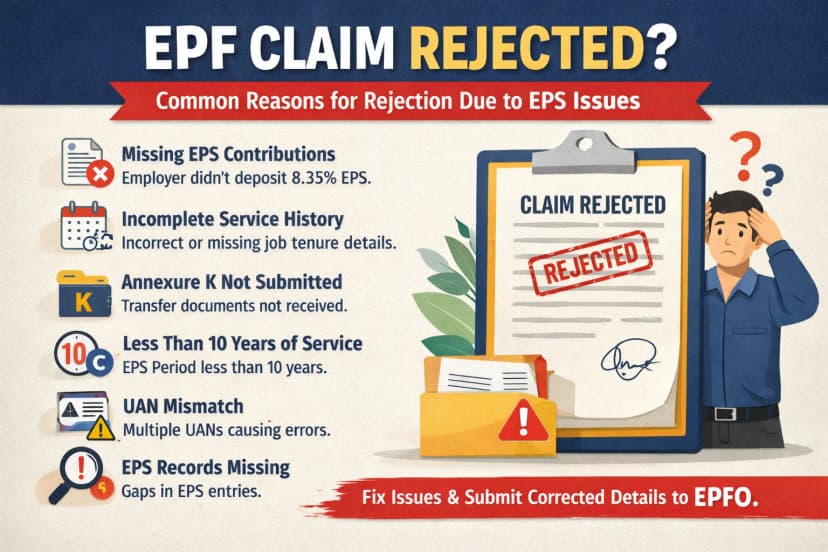
| Passbook shows PF credited but EPS section looks unchanged | Balance transferred; service history didn't map correctly | Raise it separately — a PF transfer completing doesn't confirm EPS continuity |
| Old employer never responds about Date of Exit | HR closed the loop internally without updating EPFO | Try present-employer attestation on Form 13 instead of waiting indefinitely |
| Passbook has a gap between two employers' contribution dates | Service not mapped as continuous, even though you didn't stop working | Read previous service missing — this is the case that most often surfaces only at pension claim time |
| Nomination form still shows an outdated name or address | Nomination doesn't auto-update between employers | Review and refile — this takes minutes but is skipped almost every time |
| KYC "verified" on old employer's system, rejected on new one | Aadhaar/PAN details entered slightly differently across employers | Re-verify KYC under the new Member ID before assuming auto-transfer will work |
Why these specific ones are dangerous: none of them stop your salary or your monthly PF deduction from looking normal. They only surface at the exact moments you can least afford a delay — a transfer, a withdrawal, or a pension claim.
FAQ
Can I have two UANs after changing jobs? No — EPFO requires one UAN per member for life. A second one fragments your service history and delays future transfers. File a grievance at epfigms.gov.in under "UAN Related → Multiple UAN" to merge them; if both are linked to the same Aadhaar, EPFO can consolidate automatically.
Is my PF transferred automatically when I change jobs? Only if your UAN and Aadhaar match cleanly across both employers — then it's automatic once your new employer posts its first contribution. Otherwise, you file Form 13 manually.
Does a completed PF transfer mean my pension is safe? Not automatically. Confirm your EPS service history shows as continuous separately from checking your PF balance — they're related but tracked independently.
What if my previous employer never updates my Date of Exit? Your transfer stays blocked indefinitely. Follow up with their HR directly during your notice period, while you still have leverage and contacts there.
Should I withdraw instead of transfer? If you're joining another EPF-covered employer, transferring is almost always better: it preserves continuous service (needed for the 10-year EPS pension threshold and the 5-year tax-free withdrawal mark), and avoids TDS that applies to early withdrawals.
Can I transfer my PF after a career break, with no new employer yet? You can only initiate a transfer once you have an active new Member ID to transfer into. If you're between jobs, your existing balance stays safely parked under your UAN — it isn't lost, just inactive until your next employer contribution starts.
What if my previous employer refuses to attest my Form 13? You can usually select your present employer for attestation instead — Form 13 lets you choose either. If both refuse, raise it through the EPFO grievance portal rather than waiting indefinitely.
Can I transfer my PF without Aadhaar linked to my UAN? Auto-transfer specifically requires Aadhaar-UAN linkage. Without it, you'll need the manual Form 13 route with physical employer attestation, which takes longer.
Can I transfer from a private PF trust (exempted establishment) to a regular EPFO account? Yes — this is the case where Annexure K applies. Expect a longer timeline than a standard EPFO-to-EPFO transfer, since it involves an extra document exchanged between the trust and the field office.
Can I transfer my PF two or three years after leaving a job? Yes, there's no deadline that blocks a transfer itself. But the longer you wait, the harder it gets to reach the previous employer's HR if a Date of Exit or KYC issue needs fixing first.
Still have questions about your PF transfer? Schedule a consultation with Kustodian. Our EPF experts can review your UAN, Member IDs, transfer history, Annexure K status, and pension records to help you avoid delays before they become claim issues.
PF Interest Loss Calculator
See how much interest you lose every month your claim sits unresolved.