Most duplicate Universal Account Numbers (UANs) aren't created by a flaw in EPFO's systems. They're created in the first 30 days of a new hire's employment — usually because no one checked whether the employee already had one before payroll began.
Form 11 is the first of five onboarding controls that decide whether a new hire's PF record starts clean or starts broken. Get it right, and Form 11 is a two-minute check. Get it wrong, and the employer is looking at a failed transfer, a fragmented service history, a delayed claim, or an incorrect EPS eligibility calculation — surfacing two or three years later, once it's much harder to trace back to onboarding.
This guide covers the employer-side process end to end: what Form 11 should trigger, how to decide between linking an existing UAN and generating a new one, and where onboarding actually breaks down at scale.
Quick Answer
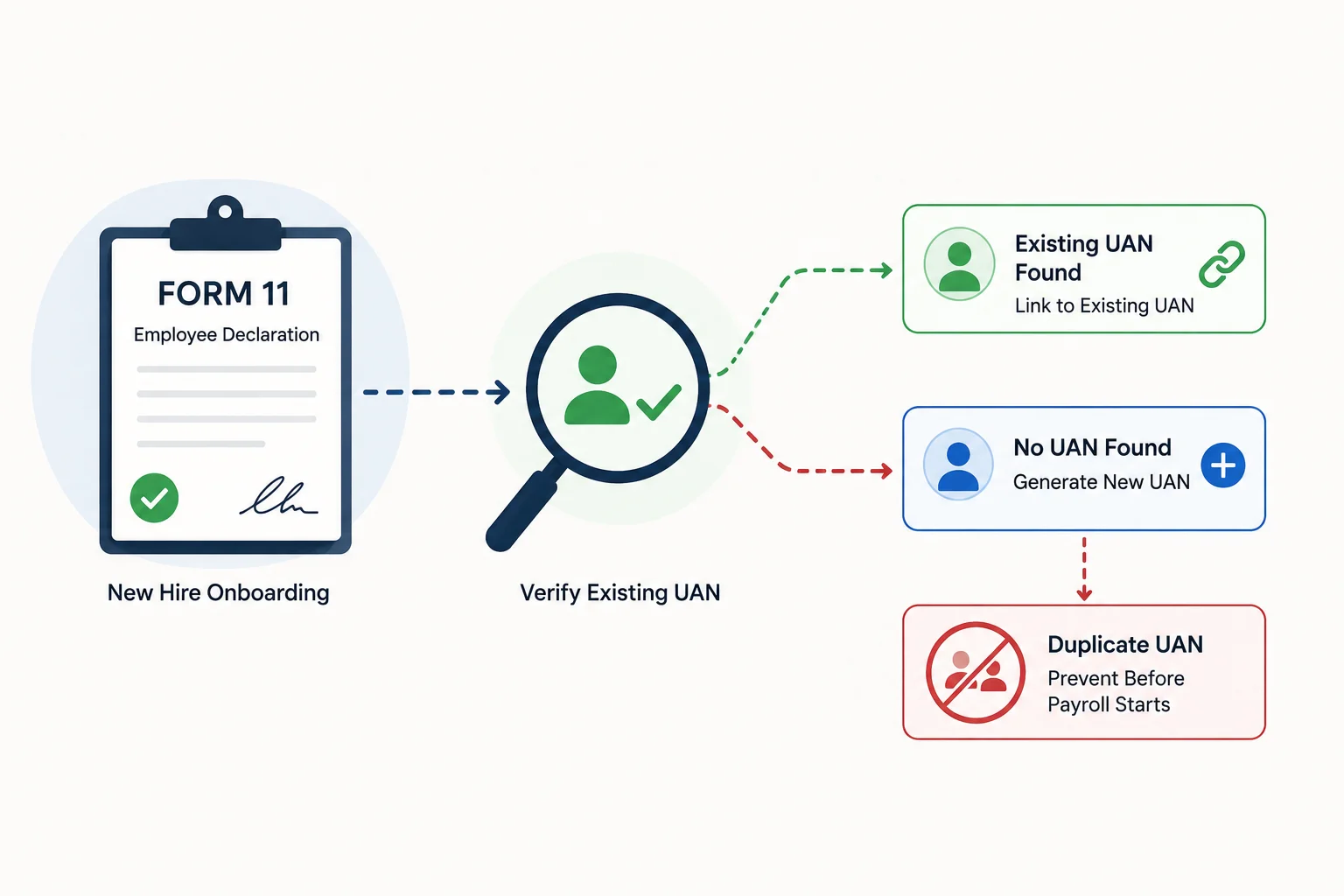
Form 11 is the declaration EPFO requires under Paragraph 34 & 57 of the EPF Scheme, 1952 and Paragraph 24 of the EPS, 1995, collected when an employee joins a covered establishment. Its statutory purpose is to record employment and EPF history. Its operational purpose, for employers, is narrower and more important day to day: it's the trigger to check whether the employee already has a UAN before payroll runs or a new UAN gets generated. Skipping that check is one of the largest causes of duplicate UANs.
Want to prevent duplicate UANs before they become costly?
Kustodian helps employers verify UANs, streamline EPF onboarding, and resolve historical EPF/EPS issues before they impact employees. Book a free EPF consultation with our experts today.
Multiple Member IDs vs. a Duplicate UAN
HR teams frequently treat "the employee has a PF record from a previous job" and "the employee has a duplicate UAN" as the same problem. They're not — and conflating them is exactly how duplicates get created.
| Multiple Member IDs (normal) | Duplicate UAN (a problem) | |
|---|---|---|
| What it is | One UAN, several Member IDs — one per employer | Two separate UANs issued to the same person |
| How it happens | Employee changes jobs; each new employer creates a Member ID linked to the existing UAN | A new employer generates a fresh UAN instead of linking the existing one |
| Action needed? | No — this is how EPF is designed to work | Yes — violates EPFO's one-UAN-per-member rule and fragments service history, EPS eligibility, and EDLI cover |
| Employer's job | Link the new Member ID to the existing UAN | Prevent it at onboarding, or initiate a transfer/merge request if it's already happened |
If onboarding doesn't distinguish these two, "playing it safe" by generating a new UAN for anyone who seems unsure becomes the default failure mode.
The Kustodian Employer PF Onboarding Control Framework
Collect → Verify → Decide → Configure → Validate
| Stage | Employer action |
|---|---|
| Collect | Form 11 completed at or before joining |
| Verify | Existing UAN, Aadhaar e-KYC, and PAN checked against declared details |
| Decide | Link the existing UAN, or generate a new one — never both |
| Configure | Payroll mapped to the correct Establishment ID and Member ID |
| Validate | First ECR reviewed against Form 11 before filing |
Every section below maps to one of these five stages. Form 11 covers "Collect" — the rest of onboarding is what determines whether that declaration actually prevents a duplicate UAN.
Employee Already Has a UAN — Now What?
This is the decision HR teams get wrong most often, and it's a common query in its own right.
| Situation | Employer should |
|---|---|
| Active UAN | Link |
| Doesn't remember | Verify |
| First job | Generate |
| Information conflicts | Pause onboarding |
"Doesn't remember" and "doesn't have one" are not the same situation, and they shouldn't get the same response. Verify against available records via the EPFO Unified Portal or your Employer Portal access before defaulting to "generate." Generating is the fallback for confirmed first-time members only — not the default for anyone who's unsure.
What Employers Should Verify Before Generating or Linking a UAN
Treat this as one sequence, not a checklist to sample from. Steps 2–3 are where almost every duplicate UAN originates.
| Step | Action | Why it matters |
|---|---|---|
| 1 | Collect Form 11 at or before joining — not after payroll starts | Late collection means verification happens after the mistake is already in the system |
| 2 | Ask directly whether the employee has an existing UAN or prior EPF membership | This single question prevents most duplicate UANs |
| 3 | If a UAN exists, verify and link it — do not generate a new one | Generating without checking is the #1 cause of duplicates |
| 4 | If no UAN can be confirmed, initiate allotment through the EPFO-prescribed process for your establishment via the Employer Portal | EPFO periodically updates how allotment is completed — confirm the current method rather than assuming last year's process still applies |
| 5 | Verify Aadhaar e-KYC and PAN against declared details | Prevents KYC rejections and claim delays later |
| 6 | Confirm Date of Joining before the first ECR | DOJ errors are difficult to correct retroactively and affect service history |
| 7 | Map payroll only after steps 1–6 are complete | Prevents incorrect first-month contributions |
| 8 | Review the first ECR against Form 11 before filing | Last checkpoint before the record becomes official with EPFO |
Why Duplicate UANs Increase During Bulk Hiring and Payroll Migration
A single new hire is easy to verify carefully. Volume is where the process fails.
| Scenario | Why the risk is higher |
|---|---|
| Bulk / campus hiring | High volume increases data-entry and skipped-step risk |
| Lateral hiring | These employees almost always already have a UAN — the highest-risk category |
| Payroll or HRMS migration | Existing records may not reconcile cleanly with EPFO data |
| Mergers & acquisitions | Multiple employment histories require cross-verification |
| Contractor-to-payroll conversion | Prior PF history is often undocumented or informal |
Example: A 180-person campus hiring batch will typically include a handful of employees who interned or briefly worked elsewhere and already hold a UAN they've forgotten about. If onboarding skips the existing-UAN check and defaults to generating new UANs for the whole batch, those employees now carry two UANs — invisible until they try to transfer PF years later. Catching it at onboarding costs one extra verification step. Catching it after the fact costs a transfer request, EPFO processing time, and a round of HR follow-up per employee.
Hiring 100+ employees or migrating payroll? Kustodian's Employer Onboarding Audit reviews your Form 11 workflow, UAN verification controls, and first-ECR process before errors become historical correction cases.
The Four Employer Onboarding Failures Behind Most Duplicate UANs
| Failure type | What goes wrong | Downstream impact |
|---|---|---|
| Verification | Existing UAN or prior employment isn't checked | Duplicate UAN, failed transfers |
| Documentation | Form 11 collected late, incomplete, or not archived | Correction requests months or years later |
| Workflow | Payroll starts before verification finishes | Contribution and KYC mismatches |
| Governance | No onboarding SOP, no periodic audit | The same mistakes repeat every time HR turns over |
None of these surface immediately. They surface when the employee changes jobs, applies for a transfer, or files a claim — long after the person who made the onboarding decision has moved on.
Mature Onboarding vs. High-Risk Onboarding
| Mature onboarding | High-risk onboarding |
|---|---|
| Form 11 reviewed before payroll | Collected after payroll starts |
| Existing UAN verified | Assumed absent |
| Identity validated via Aadhaar e-KYC | Relied on employee memory |
| First ECR reviewed against Form 11 | Filed without review |
| Written onboarding SOP | Left to individual HR judgment |
If more than one row on the right describes your process, the gap is worth closing before your next hiring wave, not after the next failed transfer.
FAQ
Does every employee need to submit Form 11? Yes — any employee joining an establishment covered under the EPF Scheme, 1952 is expected to complete it.
Should employers always generate a new UAN for new hires? No. Generate one only after confirming the employee doesn't already have one. Defaulting to "new" is the most common cause of duplicates.
Is Form 11 by itself enough to prevent duplicate UANs? No. It has to be paired with an actual UAN and identity check before payroll runs — the form alone only records a declaration.
What if an employee can't remember their UAN? Verify against available records before creating a new one. "I don't remember" is not the same as "one doesn't exist."
What does a compliant new-employee PF process actually look like end to end? Collect Form 11, verify existing UAN and identity, decide to link or generate, configure payroll against the correct Establishment ID and Member ID, and validate the first ECR — the five stages in the framework above.
Can onboarding mistakes be corrected after the fact? Usually yes, but it requires a transfer or merge request and takes longer than preventing it in the first place. See our [guide to merging duplicate UANs] for that process.
Not Sure Your Onboarding Would Catch This?
Most employers don't find out their onboarding process has a gap until an employee's transfer fails. Kustodian's Employer Onboarding Review is a free 20-minute walkthrough of your Form 11, UAN verification, and first-ECR process — we tell you where the gap is before it becomes a correction case.
PF Interest Loss Calculator
See how much interest you lose every month your claim sits unresolved.